Trowel Talk: Chicago's Famed Palmer House
.jpg)
“Plastering never will become a lost art unless it be through the indifference and abuse of those engaged in the various branches of the industry…”
– Byron Dalton, Practical Plastering and Related Subjects, 1937
I recently had the opportunity to revisit Chicago, the home of one of my personal heroes, Byron Dalton. To most in the industry today, the name Dalton has little or no significance. But to some of us older die-hard plastering fanatics, Dalton could be considered the American patriarch of the plastering trade.
He was the founding president of the Chicago Plastering Institute and author of the 1937 technical manual, “Practical Plastering and Related Subjects,” an incredible collection of plastering techniques, guides for laying out simple and complex geometric shapes, and recipes for plastering mixes using everything available in his day from animal hair to lime you slacked yourself right on the jobsite.
The Contest
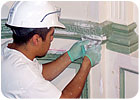
I was all of 19 years old when my union business agent, David Kidd approached me on the job one day to ask me about entering a plastering contest for apprentices. I immediately accepted the challenge without giving a second thought to what I was getting myself into. A few days later when I received the contest plans and rules, reality hit me like a ton of bricks. I had to construct a template and run a crown mold in place-“and just how the #@*& was I going to do that?” I asked myself. The next day I shared my concern with another of my heroes, an exceptional journeyman plasterer by the name of Wendell King. Thus began my indoctrination into the world of ornamental plastering.The next morning, Wendell reached into his lunch bucket and handed me a little green book and said, “Everything you need to know is right here.” It was a second edition copy of Dalton’s book. So each evening after dinner I would find a quiet spot to sit and read a chapter or two of this almost mystical transcript. Then, all day long as we spread veneer finish side-by-side on long hospital hallways, Wendell would verbally walk me through the processes of creating a plaster crown mold, beginning with nothing more than a simple drawing on a white piece of paper.
As I was taught these basic principles of ornamental plastering, I gained a great appreciation of just how sophisticated our trade can be. Who knew back then, as I was just learning to take mud off a hawk without spilling it all over myself, and any unfortunate bystanders, that I was taking my first steps in the shoes of the great masters of the craft? For the first time in my life I found myself actually interested in geometry. I could imagine in my mind’s eye one day laying out great elliptical molds or elaborate coffered ceilings in some grand ballroom that would play host for both presidents and kings.
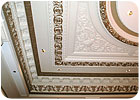
In these days of glass fiber reinforced gypsum (GFRG) and pre-cut foam shapes, we tend to forget that these modern conveniences are imitations to the centuries-old work of the great masters of plastering. And while I may have not developed my skills in the trade as far as my young ambitions may have imagined, I still have that starry look in my eye anytime I get the chance to see true craftsmanship. So while in Chicago, I delighted in the opportunity to hook up with Kevin Schell, the current president of the Chicago Plastering Institute, and I was treated to a tour of one of the finest examples of ornamental plastering in America, the Palmer House.
Palmer House History
The original Palmer House opened its doors on Sept. 26, 1871. But as fate would have it, it was destroyed in the Great Chicago Fire on Oct. 9, just 13 days after its grand opening. Potter Palmer, owner and namesake of the hotel, immediately started rebuilding, with the intent to create what he claimed to be “the world’s only fireproof hotel” made from steel, brick, and plaster. The hotel enjoyed its second grand opening in 1875. The hotel has played host to such famous Americans as Ulysses S. Grant, Grover Cleveland, William McKinley, Mark Twain, Oscar Wilde, and just before my recent visit, William Jefferson Clinton.Over a two-year period between 1923 and 1925, the hotel once again experienced a major renovation that added multiple floors and luxury amenities of the highest caliber. The Palmer House is credited as having the first electrical lighting system in any American hotel, and after its 1920s addition was added, it was billed as the “world’s largest hotel.”
The ownership of the hotel has passed from hand to hand over the years; Conrad Hilton once purchased it and even though another company now owns the hotel today, the Palmer House-Hilton name continues to be retained. Nearly 140 years after its original grand opening, the Palmer House is still the second-largest hotel in Chicago, and contractors are wrapping up a major year-long renovation to restore the Grand Old Lady to the status of which she so rightly has become accustomed.
Pepper Construction was awarded the contract as general contractor for the restoration. The work included renovations to over 900 guest rooms and modernization to various meetings rooms and the grand ballroom with its incredible plasterwork. Two separate plastering contractors were awarded separate contracts for the repair and restoration work, Skyline Plastering and Luczak Brothers Inc. Luczak Brothers has been in the plastering business in Chicago since 1896, specializing in plastering both plain and ornamental, and has been involved in many previous renovations of the hotel.
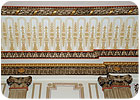
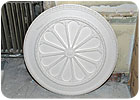
I caught up with my old friend and Luczak foreman, Rick Dahm, early in the morning just after he had sent his crew of plasterers and tenders scattering off throughout the hotel to work on their various projects. As we walked through the hotel, Rick showed me original pieces of decorative plaster that were removed and used as models to create rubber molds to ensure authenticity of any replacement to damaged plaster enrichments or mold work. He explained that everything repaired is being replaced using USG #1 molding plaster and that no synthetic materials have been used. Even a delicate ventilation grate was created from casting from molding plaster and hemp.
Restoration's Intricate Process
On one floor, we find plasterers sticking crown molding into place that has been previously run on a bench. This process involves cutting the pre-run molding very much the way you would wood molding. The molding is set into place using screws and plaster. The joining pieces and all mitered intersections are then pointed up in place using the same material. Once the work has been completed, no seams or joints can be seen or felt and the work is as smooth as glass. Often on large and elaborate ceiling molds, a combination of techniques is used. Sometimes mold work is run in place and then detailed enrichments such as eggs and darts are added later on top of the run work.In addition to the elaborate cornice work and some modest groin ceilings, there are miles of plaster walls in need of refinishing after the removal of decades old wallpaper. Rick told me they like to use Larsen’s Plasterweld over the cleaned existing plaster and refinish it using lime and gauging plaster. Gauging plaster allows them to control the setting time and they can produce a mirror smooth finish under almost any circumstance or amount of wall or ceiling surface.
As we walked through hallways and past alcoves filled with beautiful niches, molding, and enrichments of every imaginable kind, we bumped into Keith Haralson, the foreman for Skyline Plastering. He was rushing from one project to another, but took time to show us the renovation work his company is doing; repair work primarily in the guest rooms and luxury VIP suites. Skyline’s crews are also repairing walls with lime and gauging over Larsen’s Plasterweld, but they also utilize a veneer basecoat wherever the walls have enough damage to warrant the extra layer of plaster. In addition to his job overseeing up to a dozen plasterers on this historic project, Keith is also one of two part-time instructors for the Chicago area apprenticeship program.
In a building as old as the Palmer House, in addition to renovation work, there is the daily chore of maintaining the rich ornamental plaster. For one thing, the plumbing is older than most anyone reading this magazine, and from time to time, it leaks. And like water and oil, water and finished interior plaster don’t mix.
House Plasterers
Once upon a time, elaborate hotels in places like New York, Boston, and Los Angeles had enough plaster work in need of attention that they could afford to retain their own plasterers on staff, just to keep it all looking fresh and clean. The Palmer House is one of only a small handful of establishments that still subscribe to this tradition. Before we left, I couldn’t resist spending a little bit of time visiting Scott Jackson and Noel Bird with the House Plasterers at the world famous Palmer House. Scott is the second Jackson to be on staff at the Palmer House; his grandfather worked as the House Plasterer for nearly 35 years before retiring at 65.When the fancy ornamental work becomes damaged, especially in problem areas like under the swimming pool, often times the plasterers will make and keep molds and templates on hand for quick repair or replacement of the original. Other times they create new molds from scratch if a problem pops up in an area that has been trouble-free for long periods.
I would like to thank Kevin Schell of the Chicago Plastering Institute and John Manley of Operative Plasterers’ and Cement Masons’ International Association, Local Union No. 5 for providing me this rare opportunity to photograph this work while in progress and meet the craftsmen who are responsible for its restoration. W&C
Looking for a reprint of this article?
From high-res PDFs to custom plaques, order your copy today!



