Walls & Ceilings logo
search
cart
facebook twitter linkedin youtube youtube Spotify Podcasts Apple Podcasts Spotify Podcasts Apple Podcasts
  • Sign In
  • Create Account
  • Sign Out
  • My Account
Walls & Ceilings logo
  • NEWS
  • TOPICS
    • Drywall
    • Stucco/EIFS
    • Ceilings
    • Steel Framing
    • Fireproofing
    • Interior Plaster
    • Building Envelope
    • Insulation
    • Technology
    • Interior
    • Exterior
    • Women In Construction
  • COLUMNS
    • Up Front
    • All Things Gypsum
    • Art & Craft of Plastering
    • Stucco Stop
    • Steel Deal
    • Industry Voices
  • PRODUCTS
    • Buzz Guide
  • EVENTS
    • Industry Events
    • Webinars
    • BUILD Expo
  • MEDIA
    • Videos
    • Podcasts
    • Photo Galleries
    • BUILD26 Videos
    • Take our Quiz!
    • Infographics
  • EXCLUSIVE
    • Newsletters
    • Top 50 Contractors
    • Contractor of the Year
    • State of the Industry
    • W&C Store
    • Market Research
    • CEUs
    • Sponsor Insights
    • Custom Content & Marketing Services
  • DIRECTORY
  • EMAGAZINE
    • eMagazine
    • Advertise
    • Archive Issues
  • SIGN UP!
Columns

Trowel Talk: Let's Talk About Trowels

By William E. Rogers ACP
June 24, 2008


“When you buy a tool, buy the best, and then you only buy it once.” – Dale Albers, Journeyman Plasterer, Friend and Mentor

I was 14 years old and the tool I held uncomfortably in my hand had long ago been relegated to the bottom of a pick-up truck tool box; the dark and dusty graveyard where old trowels with rusted blades and popped rivets go to die. You see plasterers very rarely throw away their old trowels; they just put them out to pasture. A quality built trowel will serve its purpose for many years, even decades if cared for properly.

But sometimes a trowel accidentally gets knocked off the scaffolding or someone neglectfully lays a mud board or a piece of scaffolding down on a trowel inadvertently left in the back of a truck. Even these “walking wounded” will generally make their way to some useful purpose, (i.e. scraping floors, cut into midget trowels) and some will even fall into the hands of young bucks who think they want to make their living in this physically demanding trade.
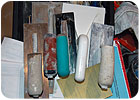
Golden stainless steel

There are two categories of trowels: those that are made for professionals and those that are made to sell to do-it-yourselfers who will use the tool once or twice in a lifetime.

Trowel Anatomy 101

There are four basic components to a well-made trowel:
  • Blade
  • Shank
  • Handle
  • Rivet
There are three basic types of blades used for making trowels: High carbon steel (sometimes referred to as “blue steel”), stainless steel, and golden stainless steel. Each type of steel has unique properties that impact how the tool can be best used.

Stainless steel

Carbon steel produces a strong, lightweight, and flexible blade, however they are prone to rust and pitting if not carefully dried and stored after the work is done. Stainless steel is an alloy of carbon steel, chromium, nickel, manganese, and other trace materials that make it impervious to rust. (Some say that stainless steel and cockroaches will be the only things to survive a nuclear holocaust.)

The drawback to stainless steel is that it is a little heavier and less flexible. Golden stainless steel is easily recognized by the coppery-golden color, a byproduct from heat-treating ordinary stainless steel. The tempering or “annealing” process is used to harden the steel, improve its abrasive resistance and fortify its strength after its been subjected to the drilling and stamping of the manufacturing process. The advantages of a golden stainless are the same as a normal stainless steel blade but due to the strengthening benefits of heat-treating, a thinner blade can be used which reduces weight and increases flexibility.
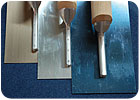
High carbon steel trowel blades
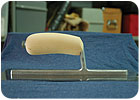
The shank is what links the blade to the handle. It is comprised of a long narrow “spine” that lies flat down the middle and on the backside of the blade; the “neck” that traverses the space between the blade and the handle; and the “stem” that protrudes through the handle and to which the handle is attached. The shank of a professional trowel is made from cast aluminum or an aluminum alloy. This creates a part that is both lightweight and strong. The length of the “spine,” as it lies along the trowel blade, will greatly determine the flexibility or rigidity of the trowel. Pool trowels, which are designed to be very flexible so they can work around radiuses, have a very short spine; trowels used for high-end interior finish work tend to have a longer spine to maintain as flat a wall as possible.

“Camel-Back” or aka “California-Style” wood handle.

The handle of a trowel is made from hard wood, usually basswood, or a more modern contrivance called a “soft-grip” made of synthetic rubber. The wood handles remain the more popular among plasterers. Wood handles come straight or shaped with a curve, which is commonly referred to as a “camel-back” or “California-style” handle. These curved shape handles are far more popular and allow a more comfortable and natural grip. I polled several veteran plastering instructors from across the country and found two primary reasons for their choice of wood over soft-grip:

A)        They like the smooth feel of wood over some of the soft-grip handles that have a seam or joint in them. This preference is probably driven more in plastering over the other trades because of the unique manipulation of the trowel turning in the plasterers hand as he changes direction and from application on the wall to loading his hawk.

B)        One hundred percent of those I surveyed said that they always customize their handle as soon as they get it, using a rasp, file and sand paper. I guess if it worked for grandpa, as smart and hard as he worked, it will work for me.
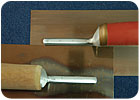
Top: Rivets pass through the spine of the shank, larger rivet at “toe.” Bottom: Rivets do not pass all the way through but are wider as is shank spine.
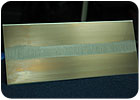
The blade of the trowel is attached to the spine of the shank with rivets. The rivet can protrude partially into the shank or all the way through it, the benefit and practice of these choices differs slightly even among the leading manufacturers. One leading manufacturer uses slightly smaller rivets than some others to reduce weight but adds a larger headed rivet at the “toe” end because this is where most rivets will fail (the “toe” is the front or leading edge of the trowel, while the “heel” is the back or trailing edge). The same manufacturer also chooses to drive the rivet pin all the way through the shank because their experience has shown this to be a stronger fastening of the parts. The face of the blade is ground to finish off the rivet heads to be flat with the blade surface; if care is not taken and the grinding is too deep, this will weaken the rivet head causing it to pull through the blade metal prematurely. The rivets of a well-made trowel will hold the blade tightly to the shank over many years of daily use.

Rivet heads and face of trowel blade ground flush.

Care and Maintenance

Breaking in a new trowel is a periodic requirement for all good plasterers. Most will begin by using the trowel to spread the scratch and brown-coats of plaster, which really don’t require a trowel blade that has been worn to the “sweet-spot.” This allows them to fine tune the shaping of the handle and break in the blade, and to see how the components, especially the rivets, hold up. Once the trowel feels comfortable to the hand and the blade begins taking on a good “set,” a natural and very slight concaved curve, it is only then considered a very valuable tool.

Most plasterers will have several trowels of the same size all in various stages of the break-in process; some they use for scratch and browning, and others they use for interior or exterior finish work. Some of these that have been taken care of and used daily will wear down by 10 to 20 percent of their original width over a lifetime of use.

Unless a trowel is damaged by abuse or neglect, it is the rivets that will give out long before the blade, shank or handle will wear out. You can extend the life of a trowel by only using it as it was intended and refrain from using it as a scraper and pulling the blade backwards, as this causes undue stress on the rivet connections.

Interior finish plastering requires a perfectly smooth edge; some say a “razors-edge.” If you think a box cutter is sharp, try (carefully) feeling the edge of a plasterer’s finish trowel sometime. As the trowel is used to spread and polish the wall surface, the metal eventually will begin to wear. The square cut edge will give way to a beveled knife-edge, and eventually the metal will become thin and easily nicked. Once the edge has been worn to the sweet-spot, you want to try and keep it there and not allow it to become too thin. The prudent use of a fine metal file, held perpendicular with the blade edge, and run down the edge like a carpenter planing the edge of a door, and a couple of careful swipes with some fine emery cloth, will ensure the edge of the blade remains straight and nick-free.
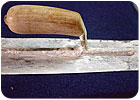
An unclean trowel equals unnecessary extra weight, sore elbows and wrists.

Keeping the trowel clean is just a matter of common sense. A dirty trowel, even one with just a tiny bit of build up on the shank, is heavier than a clean trowel. And when you consider the many hours a plasterer spends with trowel in hand, even a quarter ounce of extra weight contributes to the wear and tear on wrists and elbows over time. The best method to ensure a tool is kept clean is to make it part of your workday routine. Always take a few minutes to scrape and clean off all of the material from the tool at the end of the day. Lay it flat on the ground and with a little water and sand, run a margin trowel laid flat, back and forth on the back side of the blade (this and the shank are where most build up accumulates) until all of the color is gone and there is nothing but shiny bright metal. Your joints and muscles will thank you.

If you educate yourself about the options, you can keep a quality product clean and well maintained. The trowel you buy today will not only serve you well each and every day, but it may very well find its way into the hand of some young buck yet to be born. W&C


I wish to thank the following for their contributions to this topic.

  • Steve Cook, Kraft Tools www.krafttool.com
  • Tim Brennecke, Marshalltown Co. www.marshalltown.com
  • OPCMIA Plastering Instructors: Sam Prince (Wash.), Kevin Gordo (Pa.), Wimlish Owens (Ga.), Marty O’Brien (Mass.), Tim Nelson (Calif.), Fred Gallimore (Okla.), Rick DalPazzo (Mo.), Raul Montoya (Ariz.), Maybell Hartness (Idaho), Jimmy Obergon (Nev.), Kyle Sparkman (Ohio), Dan Jackson (Va.), David Woods (Calif.), Laura Johnson (Ore.), Jerry Shelton (Calif.), Nicho Garcia (Texas), Gene Neville (Ohio), and Sammy Stuart (Ark.).

Share This Story

Looking for a reprint of this article?
From high-res PDFs to custom plaques, order your copy today!

William Rogers is the executive director of the Plasterers and Cement Masons Job Corps Training Program, a national training opportunity for America's disadvantaged youth sponsored by AWCI, OPCMIA and the U.S. Department of Labor.

Recommended Content

JOIN TODAY
To unlock your recommendations.

Already have an account? Sign In

  • Abercrombie & Fitch

    EIFS in 2026: How Specialty Finishes Are Redefining Exterior Wall Systems

    As building codes, owner expectations, and design demands...
    Stucco/EIFS
    By: Regi Mendoza
  • proper air and vapor control

    From Energy Efficiency to Moisture Management: Why Air and Vapor Control Matter

    How proper air and vapor control within building...
    Building Envelope
    By: Benjamin Meyer AIA, LEED AP
  • Linear Metal Ceiling Beam Baffles

    Top 25 Ceiling Contractors of 2026

    Suspended ceilings demand precision, code compliance and...
    Ceilings
    By: John Wyatt and Tanja Kern
You must login or register in order to post a comment.

Report Abusive Comment

Manage My Account
  • eMagazine Subscription
  • Newsletters
  • Online Registration
  • Manage My Preferences
  • Subscription Customer Service

More Videos

Sponsored Content

Sponsored Content is a special paid section where industry companies provide high quality, objective, non-commercial content around topics of interest to the Walls & Ceilings audience. All Sponsored Content is supplied by the advertising company and any opinions expressed in this article are those of the author and not necessarily reflect the views of Walls & Ceilings or its parent company, BNP Media. Interested in participating in our Sponsored Content section? Contact your local rep!

close
  • medical professionals moving a patient on a stretcher through the halls of a medical building
    Sponsored byNational Gypsum Company

    What Does High Performance Mean When It Comes To Gypsum Boards?

Popular Stories

Linear Metal Ceiling Beam Baffles

Top 25 Ceiling Contractors of 2026

Wichita Biomedical Campus

Wichita Drywall Worker Dies After Scaffolding Fall

QXO Just Changed the Game-Here's What Contractors Are Asking

QXO Just Changed the Game-Here's What Contractors Are Asking

Less compound

Joint Compound Market to Reach $9.7B by 2033

Events

June 24, 2026

The Bright Side & Benefits of Designing with Integrated Lighting

Credits 1 AIA LU/HSW; 0.1 ICC CEU

This course will explore the pivotal role architects and lighting design play in creating safer, more sustainable spaces. Learn how to avoid common lighting mistakes and make informed decisions that create the best visual environment for occupants. 

January 1, 2030

Webinar Sponsorship Information

For webinar sponsorship information, visit www.bnpevents.com/webinars or email webinars@bnpmedia.com.

See our full library of webinars

View All Submit An Event

Products

2026 National Painting Cost Estimator

2026 National Painting Cost Estimator

See More Products

Related Articles

  • Trowel Talk: Let's Play It Safe

    See More
  • Publisher's Post with Jill Bloom

    Let’s Talk About Your Business, Projects and People!

    See More
  • AEC BuildTech

    Let’s Talk about AEC BuildTech

    See More
×

Connect with the industry’s leading resource for unparalleled insights and education.

Join thousands of industry professionals today. Shouldn’t you know what they know?

JOIN NOW
  • RESOURCES
    • Advertise
    • Contact Us
    • Directories
    • Store
    • Want More
  • SIGN UP TODAY
    • Create Account
    • eMagazine
    • Newsletters
    • Customer Service
    • Manage Preferences
  • SERVICES
    • Marketing Services
    • Reprints
    • Market Research
    • List Rental
    • Survey/Respondent Access
  • STAY CONNECTED
    • LinkedIn
    • Facebook
    • Instagram
    • YouTube
    • X
  • PRIVACY
    • PRIVACY POLICY
    • TERMS & CONDITIONS
    • DO NOT SELL MY PERSONAL INFORMATION
    • PRIVACY REQUEST
    • ACCESSIBILITY

Copyright ©2026. All Rights Reserved BNP Media, Inc. and BNP Media II, LLC.

Design, CMS, Hosting & Web Development :: ePublishing