St. Mark's the Spot
A grand Minnesota church is resurrected from ashes.
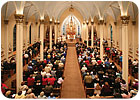
In 1856, the town of Shakopee, Minn., was on the frontier’s edge. Once an Indian village on the Minnesota River, it now beckoned settlers from eastern states and Europe to come further west, to break the prairie land and farm its rich soil. St. Mark’s Catholic Church of Shakopee was borne from the vestiges of these hard-working and visionary people. In 1999, after the decision was made to refurbish the church for its 150th anniversary in 2006, a concerted effort began to fix crumbling lime mortar around the exterior stone walls, replace the roof and even add air conditioning to the storied old church. By 2005, attentions were placed on the interior, with the most notable treatment being the dramatic change in color from the minimalist period that the church went through in the ’70s.
 “The
church was painted in shades of gray, nine shades to be exact,” says Fr. Bill
Stolzman, pastor of St. Mark’s. During the minimalist period, beautiful altars
were replaced with bare bones sheets of granite or marble. Decorations,
including the “Stations of the Cross” were altered so as not to detract from
the focus of the priest at the communion table. Fortunate for St. Mark’s, the
altar was not replaced. Unfortunate was the fact that the church’s original
grandeur blended into shades of gray.
“The
church was painted in shades of gray, nine shades to be exact,” says Fr. Bill
Stolzman, pastor of St. Mark’s. During the minimalist period, beautiful altars
were replaced with bare bones sheets of granite or marble. Decorations,
including the “Stations of the Cross” were altered so as not to detract from
the focus of the priest at the communion table. Fortunate for St. Mark’s, the
altar was not replaced. Unfortunate was the fact that the church’s original
grandeur blended into shades of gray.
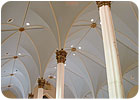
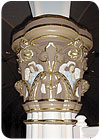
The interior restoration brought color once again to what had become a bleak and dreary interior. Stenciling was added to the now pastel-colored walls around the historic stained glass windows. The groined and vaulted plaster ceilings were repaired and painted a light shade of blue. Statuary once again came back to life and up-lighting created a warm reflectance off of gold leafing on the altar and columns that were capped with capitals containing angel sentinels.
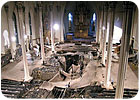
As a source of fuel for the fire, the floor and many of the pews were perhaps the most obvious loss. The main altar made it through the fire relatively unscathed; however, a delicately carved butternut side altar was toppled and severely damaged. An organ installed in the mid ’70s had to be replaced, as did the new air conditioning.
“The new AC system had never been turned on before the fire,” says Kent Jones P.E. of Encompass Engineering. “One thing the church had going for it was the abundant plaster lining the interior walls. (And) if not for the fact that the masonry walls weren’t combustible the fire would have destroyed the (entire) building in our estimation.”
Encompass was perhaps better equipped to handle the forensic investigation of the building than most engineering firms, because the company had worked with the church on the exterior renovation in 1999.
“We knew what this building meant to the parishioners and what they were willing to invest to restore the church rather than replace it,” says Howard Noziska, P.E. and Principal of Encompass. “The problem we faced, with the floor now gone, was that there was no way to inspect the ceiling without a stable base to erect scaffolding.”
“Thinking ahead as we did this,” says Jones, “we planned for the construction of hollow trenches within the concrete to accommodate future mechanical and electrical components.”
Using a rolling scaffold over the newly installed concrete floor, the walls and the ceiling could now be more closely scrutinized. Although the fuel for the fire was attributed mainly to the original wooden floor, an argument can probably be made for the heat restraining capacity of the gypsum plaster in keeping the fire from consuming the walls and ceilings also.
 This
is perhaps a history lesson that should not be lost on today’s younger
designers: Before we had sprinklers that often cause as much damage as the fire
they suppress, our forebearers often considered plaster for its fire resistive
properties. In its hard state it is called “hemihydrate,” which essentially
means that it has returned to the rock-like state of crystallization it had
before it was mined from the earth. What makes it great as a fire protective
coating is that as it consumes heat (calcines), it dissociates from the water
molecules that were needed in its installation. The temperature at which this
transpires is in excess of 250 degrees F. This perhaps explains why some of the
plaster through examination and subsequent lab testing was determined to have
sustained serious damage. However, what was remarkable and perhaps a testament
to plaster’s fire-resistive qualities is that the system of wood structural
support behind the plaster also made it through the fire relatively unscathed.
This
is perhaps a history lesson that should not be lost on today’s younger
designers: Before we had sprinklers that often cause as much damage as the fire
they suppress, our forebearers often considered plaster for its fire resistive
properties. In its hard state it is called “hemihydrate,” which essentially
means that it has returned to the rock-like state of crystallization it had
before it was mined from the earth. What makes it great as a fire protective
coating is that as it consumes heat (calcines), it dissociates from the water
molecules that were needed in its installation. The temperature at which this
transpires is in excess of 250 degrees F. This perhaps explains why some of the
plaster through examination and subsequent lab testing was determined to have
sustained serious damage. However, what was remarkable and perhaps a testament
to plaster’s fire-resistive qualities is that the system of wood structural
support behind the plaster also made it through the fire relatively unscathed.
“Originally, we thought that much of the plaster could be spared,” says Jones. “We thought that perhaps some of the loose plaster could be salvaged with a combination of washers and screws. Patching and flat work would then be skim coated with a layer of Dryvit Primus and reinforcing mesh.”
In the end it was determined that this process would be too extensive. This was also exacerbated by smoke damage that continued to linger long after the smoldering fire had been extinguished.
“I’m glad they decided to tear off the old plaster,” says Rich Furry, field superintendent for Custom Drywall, who was in charge of renovating the plasterwork. “There were spider cracks and failures all over the place and the smell would have never subsided without doing something about it.”
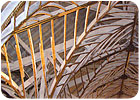
Behind the plaster ceiling a system of wood framework was revealed that was tied into timber trusses that were spaced 15 feet apart. The roof itself was supported by cross members equally spaced between the trusses. The columns that rose through the sanctuary were tied into the bottom chord of the trusses. Some thought had been given to removing these columns in the renovation, to provide an unobstructed sight line to the altar. It was also determined that they were not designed to support the weight of the roof in the original construction. However what had become evident in the investigation is that the roof had sagged over the years and that some of the roof’s load had indeed been transferred to the columns. All of this notwithstanding, their removal would have taken a lot away from the aesthetics of the original architecture and may have associated even more costs to renovating the roof.
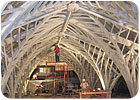
 Staging beneath the ceiling proved in itself a challenging proposition. Scaffolding was set to provide for a platform floor directly below the ceiling some 40 feet above the sanctuary. This was termed a “dance floor” by the Custom crew because the plywood floor was constructed without gaps and the resulting curves of the columns and ceiling resulted in a kind of ballroom appearance. Still more scaffolding was used on top of the dance floor to get to the upper reaches of the complex ceiling.
Although the wood structure behind the plaster survived the fire, the smoky smell had permeated it. This was resolved by coating the wood with an inhibiting coating that sealed in the smell before the plaster renovations began.
This time around, Custom’s crew, which included experienced lather Eric Demars, used lasers to sight in the compound curves of the ceiling. Furry, also a lather, described this process of sighting and setting the beads as “buggy whip bends,” which probably is as visual an account as anything we could describe here. This type of ceiling is what is referred to as a “groined vault” or sometimes called a “double barrel vault” or “cross vault.” These were common in the Gothic cathedrals of Europe because of their loftiness and visual pretense of the cross as a religious symbol.
To take up the support for the plaster that was lost in taking the wood lath off the ceiling, ribbed lath was used. What makes this product unique is its high standing ribs that cleat into the plaster in a distinct herring bone type pattern. This configuration is also beneficial for its heavy gauge wire stiffeners that run parallel through the sheets. At the walls a paper-backed lath was used to keep the fresh plaster from backfilling into the cavities created by the wood stud furring placed over the masonry walls.
“Black Diamond proved to be a little more forgiving in providing better workability and a little slower set time,” says Furry.
The ornamental work proved to be a process in combining new technology with old. The original molding that divided the vaulted ceiling into distinct panels was as crooked as a bucket of snakes. What seems apparent in the original construction is that given the compound curve configuration and thickness inconsistency of the plaster, a datum line could not be established to which a plaster mold could be run accurately. Nor could the molding be bench fabricated and then stuck in place without segmenting it into very small pieces.
Custom had a better idea. Based upon their considerable experience in using foam shapes for many EIFS projects over the years, the company called its Dryvit distributor to prefabricate 8-foot arching pieces that could be prewrapped with synthetic basecoat and reinforcing mesh on the ground and then positioned and fastened into place on the ceiling. Once up, a flap of reinforcing mesh from the new molding was feathered into place over the plaster flatwork with molding plaster for a seamless look. But that wasn’t the extent of the issues that confronted Custom Drywall. Several ornamental plaster moldings and cornice work had to be fixed and duplicated, including areas of trim under the balcony choir loft. Some of the capitals on top of the columns had to be recreated from molds created from originals out of silicone rubber. Bases for the columns, which could not be saved, also had to have new molds made and plaster recast.
Another issue that remained to be addressed was duplicating the plaster columns that proved to be unsalvageable. Again modern technology had an answer for a 150-year-old problem. Instead of fixing the columns, new ones were fabricated from fiberglass. But like what was done by hand long ago, plaster was employed to cover the forms and mend the seams between the sections that made up the new columns. Last but not least Custom even played a part in repairing some of the statuary, including the Crucifix that hung above the sanctuary.
Asked about Custom Drywall’s manners and work ethic in supporting the renovation, Father Bill was enthusiastic in noting how respectful all of the workers were in showing their reverence to their surroundings.
I cannot end this article without one other little point about the plaster: As an icebreaker in meeting Father Stolzman, I asked him if he knew that St. Bartholomew is known as the Patron Saint of plasterers. Father Bill replied rather stoically, “No, I was not aware of that.” Curious thing I mentioned, “St. Bartholomew was martyred on August 24, 1572.” That happened to be the same calendar day that St. Mark’s tragically burned.
Father Stolzman, understanding the implication, looked at me in stony silence. Frankly I felt like I was back in second grade. I hadn’t meant to be flippant or funny. But you have to admit it is a rather remarkable coincidence. Maybe old Saint Bart thought the original plasterwork needed more rehabilitation than just paint. It just took him awhile to get around to doing something about it. W&C
In 1856, the town of Shakopee, Minn., was on the frontier’s edge. Once an Indian village on the Minnesota River, it now beckoned settlers from eastern states and Europe to come further west, to break the prairie land and farm its rich soil. St. Mark’s Catholic Church of Shakopee was borne from the vestiges of these hard-working and visionary people. In 1999, after the decision was made to refurbish the church for its 150th anniversary in 2006, a concerted effort began to fix crumbling lime mortar around the exterior stone walls, replace the roof and even add air conditioning to the storied old church. By 2005, attentions were placed on the interior, with the most notable treatment being the dramatic change in color from the minimalist period that the church went through in the ’70s.
The interior restoration brought color once again to what had become a bleak and dreary interior. Stenciling was added to the now pastel-colored walls around the historic stained glass windows. The groined and vaulted plaster ceilings were repaired and painted a light shade of blue. Statuary once again came back to life and up-lighting created a warm reflectance off of gold leafing on the altar and columns that were capped with capitals containing angel sentinels.
The
wood framework skeleton that supported the complex ceiling.
Up in Smoke
Just two weeks before the church was set to reopen its newly awakened splendor to her parishioners, tragedy struck. During the early waking hours of August 24, 2005 a fire broke out in the sanctuary. The cause was later determined to be the result of spontaneous combustion. That morning a passerby spotted smoke and the nearby sensors in the parish center set off an alarm. Even though the Shakopee Fire Department arrived almost immediately, the fire could not be put out. In the end it took 13 fire departments and 11 hours to put out the smoldering fire. In an effort to provide relief from smoke damage, two of the historic stained glass windows on either side of the altar were sacrificed. Holes were also made in the roof and the fire was finally extinguished by twice flooding the crawl space and floor with water.As a source of fuel for the fire, the floor and many of the pews were perhaps the most obvious loss. The main altar made it through the fire relatively unscathed; however, a delicately carved butternut side altar was toppled and severely damaged. An organ installed in the mid ’70s had to be replaced, as did the new air conditioning.
“The new AC system had never been turned on before the fire,” says Kent Jones P.E. of Encompass Engineering. “One thing the church had going for it was the abundant plaster lining the interior walls. (And) if not for the fact that the masonry walls weren’t combustible the fire would have destroyed the (entire) building in our estimation.”
Encompass was perhaps better equipped to handle the forensic investigation of the building than most engineering firms, because the company had worked with the church on the exterior renovation in 1999.
“We knew what this building meant to the parishioners and what they were willing to invest to restore the church rather than replace it,” says Howard Noziska, P.E. and Principal of Encompass. “The problem we faced, with the floor now gone, was that there was no way to inspect the ceiling without a stable base to erect scaffolding.”
Lathers
work on top of scaffolding that rests on top of “dance floor” staging built 40
feet above the sanctuary.
Calculated Gamble
This is when Encompass decided to recommend a step that is highly unusual in the field of building forensic inspection: The renovation would have to begin before the investigation had become complete. More specifically, the floor would have to be addressed before the top of the church could be more thoroughly evaluated. To complicate matters, it would not make sense to construct the floor without addressing foundation and utility related issues that could not be excluded. What could not be answered is whether this would be money well spent, or simply thrown away; because completely rebuilding the roof and ceiling structure may in the end make the cost of the entire renovation prohibitive. The least disruptive solution was to eliminate the floor structure entirely and fill the crawl space with Flowcrete, a low strength concrete product that would lock in the footings that rested under the columns. This also would save significant costs in manpower and any necessity for heavy equipment.“Thinking ahead as we did this,” says Jones, “we planned for the construction of hollow trenches within the concrete to accommodate future mechanical and electrical components.”
Using a rolling scaffold over the newly installed concrete floor, the walls and the ceiling could now be more closely scrutinized. Although the fuel for the fire was attributed mainly to the original wooden floor, an argument can probably be made for the heat restraining capacity of the gypsum plaster in keeping the fire from consuming the walls and ceilings also.
New
moldings accentuate the new and beautifully painted ceiling.
“Originally, we thought that much of the plaster could be spared,” says Jones. “We thought that perhaps some of the loose plaster could be salvaged with a combination of washers and screws. Patching and flat work would then be skim coated with a layer of Dryvit Primus and reinforcing mesh.”
In the end it was determined that this process would be too extensive. This was also exacerbated by smoke damage that continued to linger long after the smoldering fire had been extinguished.
“I’m glad they decided to tear off the old plaster,” says Rich Furry, field superintendent for Custom Drywall, who was in charge of renovating the plasterwork. “There were spider cracks and failures all over the place and the smell would have never subsided without doing something about it.”
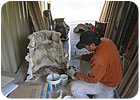
Making
silicone molds of the original capitals with angel sentinels.
Silk Purse Out of Sow's Ear
The rehabilitation began by carefully taking down the plaster from the walls and the ceiling. What was left of the ceiling was the skeleton of the many wood laths that had been individually nailed up by pioneers 150 years earlier. Laths were also exposed on the outside walls, which had been furred out in 1917 to provide insulation and then re-plastered. This exposed some secrets that had been hidden for 90 years: The damaged remains of a painted fresco depicting the crucifixion was revealed. This was later sealed and re-covered for someone else to discover in another 150 years.Behind the plaster ceiling a system of wood framework was revealed that was tied into timber trusses that were spaced 15 feet apart. The roof itself was supported by cross members equally spaced between the trusses. The columns that rose through the sanctuary were tied into the bottom chord of the trusses. Some thought had been given to removing these columns in the renovation, to provide an unobstructed sight line to the altar. It was also determined that they were not designed to support the weight of the roof in the original construction. However what had become evident in the investigation is that the roof had sagged over the years and that some of the roof’s load had indeed been transferred to the columns. All of this notwithstanding, their removal would have taken a lot away from the aesthetics of the original architecture and may have associated even more costs to renovating the roof.
Paint
and gold leafing bring plaster capital and angel sentinels back to life.
Although the wood structure behind the plaster survived the fire, the smoky smell had permeated it. This was resolved by coating the wood with an inhibiting coating that sealed in the smell before the plaster renovations began.
This time around, Custom’s crew, which included experienced lather Eric Demars, used lasers to sight in the compound curves of the ceiling. Furry, also a lather, described this process of sighting and setting the beads as “buggy whip bends,” which probably is as visual an account as anything we could describe here. This type of ceiling is what is referred to as a “groined vault” or sometimes called a “double barrel vault” or “cross vault.” These were common in the Gothic cathedrals of Europe because of their loftiness and visual pretense of the cross as a religious symbol.
To take up the support for the plaster that was lost in taking the wood lath off the ceiling, ribbed lath was used. What makes this product unique is its high standing ribs that cleat into the plaster in a distinct herring bone type pattern. This configuration is also beneficial for its heavy gauge wire stiffeners that run parallel through the sheets. At the walls a paper-backed lath was used to keep the fresh plaster from backfilling into the cavities created by the wood stud furring placed over the masonry walls.
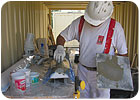
Dryvit basecoat and reinforcing mesh is applied to moldings that would be affi xed to the ceiling.
Once Guesswork Now Flatwork
Where the old plaster had varied in thickness from 3/8-inch up to 2 inches, it was corrected by modern plastering methods to a consistent thickness of 1 inch. This was important in distributing the weight of the new ceiling more evenly. Plastering craftsmen that employed their considerable technical skills included the likes of Greg Gouette and Greg Kannel of Custom’s staff. Joe Salemi of USG was also instrumental in providing technical guidance along the way in the installation of Red Top gypsum plaster and Black Diamond finishing plaster.“Black Diamond proved to be a little more forgiving in providing better workability and a little slower set time,” says Furry.
The ornamental work proved to be a process in combining new technology with old. The original molding that divided the vaulted ceiling into distinct panels was as crooked as a bucket of snakes. What seems apparent in the original construction is that given the compound curve configuration and thickness inconsistency of the plaster, a datum line could not be established to which a plaster mold could be run accurately. Nor could the molding be bench fabricated and then stuck in place without segmenting it into very small pieces.
Custom had a better idea. Based upon their considerable experience in using foam shapes for many EIFS projects over the years, the company called its Dryvit distributor to prefabricate 8-foot arching pieces that could be prewrapped with synthetic basecoat and reinforcing mesh on the ground and then positioned and fastened into place on the ceiling. Once up, a flap of reinforcing mesh from the new molding was feathered into place over the plaster flatwork with molding plaster for a seamless look. But that wasn’t the extent of the issues that confronted Custom Drywall. Several ornamental plaster moldings and cornice work had to be fixed and duplicated, including areas of trim under the balcony choir loft. Some of the capitals on top of the columns had to be recreated from molds created from originals out of silicone rubber. Bases for the columns, which could not be saved, also had to have new molds made and plaster recast.
Another issue that remained to be addressed was duplicating the plaster columns that proved to be unsalvageable. Again modern technology had an answer for a 150-year-old problem. Instead of fixing the columns, new ones were fabricated from fiberglass. But like what was done by hand long ago, plaster was employed to cover the forms and mend the seams between the sections that made up the new columns. Last but not least Custom even played a part in repairing some of the statuary, including the Crucifix that hung above the sanctuary.
Asked about Custom Drywall’s manners and work ethic in supporting the renovation, Father Bill was enthusiastic in noting how respectful all of the workers were in showing their reverence to their surroundings.
I cannot end this article without one other little point about the plaster: As an icebreaker in meeting Father Stolzman, I asked him if he knew that St. Bartholomew is known as the Patron Saint of plasterers. Father Bill replied rather stoically, “No, I was not aware of that.” Curious thing I mentioned, “St. Bartholomew was martyred on August 24, 1572.” That happened to be the same calendar day that St. Mark’s tragically burned.
Father Stolzman, understanding the implication, looked at me in stony silence. Frankly I felt like I was back in second grade. I hadn’t meant to be flippant or funny. But you have to admit it is a rather remarkable coincidence. Maybe old Saint Bart thought the original plasterwork needed more rehabilitation than just paint. It just took him awhile to get around to doing something about it. W&C
Looking for a reprint of this article?
From high-res PDFs to custom plaques, order your copy today!




