Junction Function
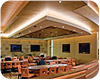
Crews
from ICS/T.J. Wies Joint Venture built soffits and light coves in addition to
installing a 75,000-square-foot, parquet-style metal ceiling at Lumière Place. Photo
credits: Photo by Mark Bealer
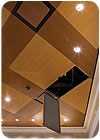
Metal
panels swing open for easy plenum accessibility at Lumière Place.
“Building owners want something different than the place next door,” says Sara Jazayeri, DPLG, CID, an interior designer at Studio 5 Partnership Architects/Planners. “They are willing to have a ceiling plane that stands out.”
“Stand-out” ceilings offer visual appeal, and building owners, architects and designers can create them without compromising the ceiling’s functionality, with good interior acoustics and the ability to hide subsystems such as lighting, HVAC, and sprinklers.
What’s more, such ceilings give ceiling contractors a chance to showcase their work. As senior project manager for ICS/T.J. Wies Joint Venture, Tim Tighe supervised the installation of a 55,000-square-foot, parquet-style ceiling at St. Louis’ Lumière Place Casino & Hotels. Crews installed approximately $1 million worth of ceiling material each month during the project, and that’s a point Tighe plans to tout for some time.
“It was a very enjoyable project to be on because it was so high-profile,” Tighe says. “The experience overall was fabulous.”
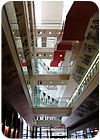
Perforated
metal panels backed by sound mats provide excellent acoustics in the five-story
atrium at the University of Cincinnati’s Lindner Center.
Ceilings designed for visual appeal require additional effort, but deliver aesthetic benefits that represent a compelling blend of function and form. Architects, designers and contractors are now finding new ways to draw attention to a property and influence the mood of its occupants, while providing sound control and access to the plenum.
Consider how high-design ceilings function in retail spaces, corporate environments and public places.
RETAIL SPACES
In retail, ceilings can help play up the merchandise and give shoppers a fresh experience. “The trend is about bringing excitement to the ceiling,” says architect Josephine E. Coleman, AIA, associate, Studio 5 Partnership. “It’s about bringing a sense of the upscale to the public.”
Ceilings can fulfill this need by offering shoppers appealing overhead forms. They also give retail clients the ability to integrate the ceilings with the lighting systems, to reflect colors and patterns on the walls, and to create overhead “clouds” that help define store departments. Overall, then, high-design ceilings can create a more intimate space for shoppers, one that spotlights the merchandise.
“Shoppers love it,” says Coleman. “It makes them excited to shop.”
CORPORATE SPACES
Corporate lobbies can offer opportunities to set the tone for a building and its tenants. When architects and designers take an imaginative approach, they can highlight these spaces with signature looks-strong statements that make use of colored panels, panels with unusual perforation patterns, or geometric systems.
Some lobby ceiling designs have become sculptural. They may take advantage of the newer, three-dimensional ceilings systems available in the market, or they may employ creative ways to use existing systems.
High-design ceilings are even being added to the office workspaces themselves. The offices of Forum Studio, the architectural arm of Clayco, feature Hunter Douglas’ TechStyle ceiling panels. According to Mike Benz, principal project designer, the team sought to use the panels “like origami,” applying the panels horizontally, vertically and on angles. Benz’ firm backlit the panel assemblies with high-efficiency lighting, taking advantage of the system’s translucent material. The resulting ceiling planes filter ambient light and highlight the 25-foot tall lobby space.
PUBLIC SPACES
In public buildings and educational venues, architects and designers have been integrating design across the walls and ceilings. In the past, decorative motifs typically have been placed on the vertical surfaces. An interesting development lately is for these elements to appear on the ceiling plane. In other words, design is migrating upward and onto the ceilings, turning them into canvases of color, patterns, imagery and iconography.
CASE STUDY: UNIVERSITY OF CINCINNATI
At the University of Cincinnati, inside the Richard E. Lindner Center, there are sepia-toned graphic murals on metal ceilings by Hunter Douglas. The flatness and flush joints of the system keep the photographs looking continuous and clean.
From the start, architect Bernard Tschumi envisioned a full-height atrium running through Lindner Center. The graphic murals simply define one passageway between buildings in an athletic quad. “It seemed like a natural path through the building,” says Kim Starr, project manager with Bernard Tschumi Architects. “Students already tend to use UC buildings as cut-throughs.”
Tschumi brought in a top designer-Eva Maddox, principal of the Branded Environments group at Perkins + Will. Maddox’s focus in the atrium was to integrate the current campus community with its legacy-the athletes and programs that have made a name for UC.
According to Brian Weatherford, creative director of Perkins + Will’s Branded Environments group, the graphics were applied directly to the ceiling panels by means of a digital printing press using a flatbed printer: “Originally we thought we might apply film so that the images would be changeable, but because the ceilings are perforated with an acoustical backing, we said, ‘What if we print right on the metal instead?’”
It was a great choice. The Lindner Center atrium is a reverberant space with plenty of hard surfaces, including glass. But, the ceiling system controls stray sounds effectively. The only “echoes” heard in the atrium are the matching graphics on glass partitions in the lower-level offices.
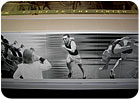
A
flatbed printer was used to emblazon UC images onto perforated metal ceiling
panels.
Lumière Place casino offers another example: the $507 million, Las Vegas-style complex is a magnet in St. Louis, featuring a huge, LED-studded, sculptural light bar that wraps up and over the 24-story facility and, at night, projects 16 million colors in an array of flickering patterns. From the outside, it rivals St. Louis’ famed Gateway Arch in visibility.
Once they enter, patrons encounter an interior that exudes comfort and warmth. The owner, Pinnacle Entertainment, wanted the casino floor to feel intimate. The building was designed by Marnell Architecture, a division of Marnell Corrao Associates, Las Vegas. Marnell president Brett Ewing, AIA, says the design called for two contrasting wood tones-Hayward Cherry and Russian Maple-to create a ceiling parquet of 4-foot by 4-foot, 2-foot by 4-foot and 2-foot by 2-foot panels.
The parquet-style ceiling, featuring Hunter Douglas Torsion-Spring panels, was installed 45 degrees off-angle to the walls. The design placed the ceiling trims approximately 1 inch off the walls and was achieved by using Hunter Douglas’ straight and curved EdgeLine trims.
“It’s a gaming casino, and there are a lot of lights,” says Tighe. “But I think they hit it right on the head. The wood effect creates a warm feeling.”
Tighe agrees that the key for a ceilings contractor is to get involved early, long before the bid date, to flush out issues, minimize complications and increase the bottom line. And Lumiere is a good example – a high-pressure, time-sensitive, design-build project. “It was a very fast-paced project,” Tighe says. “The schedule was pretty tight.” In addition, quality was paramount on the job. “These were expensive materials,” Tighe says. “We had to be careful not to damage them.”
Fortunately, the contractor’s early involvement allowed for time to consult with the ceilings manufacturer and streamline installation. Light fixture openings in the panels were factory cut, for example, ensuring fixtures fit precisely and contributed to the clean overall finish.
CREAM OF THE CROP
Architects love the drama of a high-design ceiling. Building owners take pride in a unique look, and occupants enjoy a space that conveys sophistication. Contractors have reasons to embrace high-design ceilings. Doing so allows them to stay a step ahead of the competition and capture signature ceilings opportunities.
“The direction in design is to try and separate and be the cream of the crop in terms of an experience,” says Coleman. That direction works for architects, owners and patrons. It works for ceilings specialists and contractors, too. W&C
Sidebar: Design Directions in Ceilings
Sara Jazayeri, DPLG, CID, is an interior designer at Studio 5 Partnership Architects/Planners. Working for a cutting-edge firm with her fingers on the pulse of design, Jazayeri sees these design trends taking place in the ceiling plane:- Looks: High tech and contemporary, typically metal ceiling panels.
- Finishes: Natural finishes (i.e., wood) and finishes that suggest sustainable design.
- Colors: Subdued shades and hues. “You can show a client 2,000 different colors,” says Jazayeri, “but in the end they go for something neutral.”
- Configurations: New ceiling heights, multiple ceiling planes. “People don’t want a straight line of 2 by 4s,” says Jazayeri. “They want something to break the horizontal, flat, boring space overhead.”
Looking for a reprint of this article?
From high-res PDFs to custom plaques, order your copy today!




