Adventures in Drywall: Firestopping Isn't for Dummies
Fire
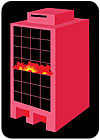
Compartments are a series of “fireproof” Zones created during the construction
process having six or more sides:
- 4 walls
- 1 floor
- 1 ceiling
- Each box will contain a fully engulfed fire for a known period of time.
I once witnessed a contractor mixing red chalk into a bucket of mud, and when I inquired what he was doing, he responded, “I’m making firestop.” While this event occurred many years ago, the egregiousness of this act and his statement has made it impossible for me to forget. While I’m sure this story gave you chills, and none of you would ever consider doing such a thing, the fact remains there is a bit of mystery as to what firestopping actually is. I have travelled with my company’s in-house firestopping specialist many times, and he has told me similar stories of things he has witnessed throughout the years. We both thought it would be a good topic to cover, and perhaps shine a light on some of the important points that someone would need to know before even attempting to install firestop.
Fire protection requires utilizing two types of protection. First is an active system like sprinklers (fire suppression). While sprinklers knock down the flames they still allow deadly smoke and gasses to spread which are the leading cause of death in fires. The passive system (firestopping) keeps these gasses and smoke from spreading, giving the occupants of a burning building enough time to escape. Firestop systems protect against the passage of flames, gasses, and smoke through penetrations and joints in fire-rated floors, walls and ceilings. By sealing these penetrations and joints, the building component is restored to its original fire rating.
Who is responsible for firestopping? It starts with architects and engineers who are responsible for making sure that firestopping designs are written into their blueprints. It is incumbent on the installing contractor to make sure that all of the proper steps are taken in accordance with the manufacturer’s instructions. Next the building inspectors need to make sure these designs are followed and that all of the materials meet their building codes. They must also make sure the contractors install these materials correctly.
In order to understand what is required to properly install firestopping, there are a number of terms you must understand. Here’s a quick list:
- Firestop System: A specific construction consisting of a fire-rated wall or floor assembly, a penetrating item or items passing through an opening in the assembly, and the materials designed to help prevent the spread of fire through openings.
- Fire Resistance Rating: The period of time a building or building component maintains the ability to confine a fire or continues to perform a structural function or both. This is usually determined or measured by ASTM E-119 test standard.
- Through-penetration: An opening made completely through a fire-rated wall or floor to accommodate a penetrating item(s).
- Penetrate (Penetrating Item): Any item passing completely through a wall or floor, such as pipes, conduits, cables, etc.
- Intumescent: A term describing materials that expand significantly when exposed to heat. Intumescent materials are often used as firestops, particularly around combustible penetrants.
- Endothermic: Pertaining to or produced from the absorption of heat. A change that takes place with absorption of heat and requires high temperature for initiation and maintenance.
- Fill, Void or Cavity Material: A firestop material used in a firestop system (mineral wool, backer rod) to set the depth and provide support for the fill, void cavity material (sealant, putty, mastic, etc.).
- ASTM E-136: Outlines a test method for determining the combustibility of products. ASTM E 136 tested and qualified products are typically used in areas where the requirement calls for “non-combustible construction.” ASTM E 136 rated products are often used to create non-combustible partitions and/or fill joints at the wall/ceiling juncture of non-rated assemblies. Products tested to this standard are not to be confused with ASTM E 814 tested firestop systems.
- ASTM E-814: Standard method of fire tests of through-penetration firestops.
- UL 1479: Fire tests of through-penetration firestops (equivalent to ASTM E-184).
- UL 2079: Tests for fire resistance of building joint systems.
- Closed Piping System: Piping system which is completely closed, usually carrying fluids under pressure.
- Vented (Open) Piping System: Piping system which is atmospherically vented by design to prevent backflow or vacuum. DWV piping (drain, waste or vent).
F, T & L Ratings
- “F” - A rating usually expressed in hours indicating a specific time that a fire resistive barrier can withstand fire before being consumed or permits the passage of flame through an opening in the assembly.
- “T” - A rating usually expressed in hours indicating the length of time that the temperature on the non-fire side of a fire rated assembly exceeds 325°F above it’s ambient temperature as determined by ASTM E 814 (UL 1479).
- “L” - An optional test performed to determine the amount of air leakage through a firestop system (in cubic feet per minute per square foot of opening). Tested in conjunction with UL 1479, ASTM E- 814 or UL 2079.
- Most sealants labeled firestop are actually “smoke” sealants, for use only as part of a multi-component firestop system.
- Firestop sealants are not generic. Each manufacturer has a proprietary formula that has been third party tested. You cannot substitute one sealant for another!
- If ASTM E814 is not listed as a test standard, the product is only approved for non-rated, residential construction.
- Is the construction type (substrate materials) listed?
- Does the design allow for penetrating horizontal and vertical fire separations?
- Is the penetrating item size and material type listed?
- Does the design allow for combustible (plastic) or non-combustible (metallic) pipe systems?
- Is the design for open (DWV) or closed (process and supply) systems or both?
- Is the design calling for the penetrating item to be centered or can it be offset?
- What is the maximum allowable annular space?
- Does the detail show penetrating header and sill plates in wood framed construction?
Now comes the fun part, being able to decipher the UL numbering system for through penetrations. It’s really not that hard, even I can do it. First off you need to know what the sequence is (Alpha-Alpha-Numeric).
The first letter represents what is being penetrated.
F= Floors
W= Walls
C= Floors or Walls (combined)
The second letter provides more information about the floor or wall.
A= Concrete floors 5 inches thick or less
B= Concrete floors greater than 5 inches thick
C= Framed floors: floors/ ceiling assemblies
D= Steel deck construction
E – I= not used at the present time
J= Concrete or masonry walls 8 inches thick or less
K= Concrete walls greater than 8 inches thick
L= Framed walls: Gypsum Wallboard assemblies
M= Bulk heads
N-Z= Not used at the present time
The four digit number describes the penetrating item or items.
- 0,000-0,999= Blank openings
- 1,000-1,999= Metal pipe, conduit or tubing
- 2,000-2,999= Non- Metallic pipe or tubing
- 3,000-3,999= Cables
- 4,000-4,999= Cable trays
- 5,000-5,999=Insulated pipe 8 inches or less
- 6,000-6,999= Miscellaneous electrical
- 7,000-7,999= Miscellaneous mechanical
- 8,000-8,999= Mixed penetrating items
- 9,000-9,999= Reserved for future use
Next is the UL numbering system for joint systems. (Alpha/Alpha-Alpha-Numeric)
- The first two letters identifies the type of joint.
- FF= Floor to Floor
- WW= Wall to Wall
- FW= Floor to Wall
- HW= Head to Wall
- CG= Wall to Wall Joints intended as corner guards
- The third letter signifies the movement capabilities of the joint system.
- S= No Movement (Static)
- D= Allows Movement (Dynamic)
- The four digit numbers describes nominal joint width.
- 0,000-0,999= Less than or equal to 2 inches
- 1,000-1,999= Greater than 2 inches and less than or equal to 6 inches
- 2,000-2,999= Greater than 6 inches and less than or equal to 12 inches
- 3,000-3,999= Greater than 12 inches
The same rules apply here. Simply look for the type of joint that needs to be sealed. A listing reading HW-D-0353 would be for a head of wall, dynamic (allows for movement), for a one- and two-hour rated gypsum wall running up to a metal deck with no more than 3/4-inch gap.
Many times damming of fire insulation material is required to provide a backing for the firestop. The following helpful hints will ensure proper placement.
- Backer rod used as a damming or support material should be installed into the opening in a thickness and compressed sufficiently as to not dislodge and fall out under normal building movement. Wrap the backer rod completely around the penetration(s) and recess it to accommodate the required amount of firestop caulk.
- Mineral wool when required, as an insulation material, should be installed into the opening compressed to a thickness as to not dislodge nor fall out under normal building movement. The mineral wool, usually 4 pcf, should be installed to the compression required by the firestop listing. The orientation of the mineral wool is also very important and may be the difference of the system being in compliance or not. For construction joints or through penetration in floor (horizontal) rated assemblies, the mineral wool or similar fibrous material should be installed with the lamination in vertical orientation assemblies. The opposite is the rule of joints and through penetrations in wall (vertical) assemblies. Here the laminations should be placed in a horizontal orientation. Installing the mineral wool in these different lamination directions allows the material to be compressed to the density required for the fire rating and building movement.
- Do not install mineral wool that is or has become wet (i.e., exposure to water, rain, or snow).
The preceding was simply a Reader’s Digest version of what firestopping is. It is by no means everything you need to know. I tried to break down some of the more daunting aspects such as listings in layman’s terms. I imagine some of you currently perform firestopping as part of your package and you already knew most of what was discussed here. For those of you who may be considering adding firestopping to your scope of work, you need to recognize the potential liability you may face if something is not done correctly or the wrong product is used.
You cannot buy firestop in a tube-firestopping is part of a tested system that includes fire-rated drywall, steel studs, “rotten cotton” (mineral wool backer), backer rod, pipe collars, putty pads, fire-rated access doors, etc. It is not just “putting pookie in a hole.” If you don’t know or understand something, ask someone. There are support people out there that can answer your questions.
There have been some deadly fires in recent years where many lives were lost. Through this has come an impetus to correctly install firestopping and make sure that, God forbid if there is another big fire, no lives are lost. And I certainly hope no one out there ever again considers mixing red chalk in mud.
Remember: your job is important-it may even save a life. W&C
Looking for a reprint of this article?
From high-res PDFs to custom plaques, order your copy today!