The Top Ten
Ten new reasons why EIFS should be the number one choice of cladding for today’s contractors.

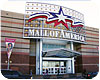
Exterior Insulation Finish Systems have been a successful mainstay in the Twin Cities market for more than 30 years. From the Mall of America to the envelope surrounding that quirky crumpled aluminum centerpiece of the Walker Art Center, the system has always been about the design flexibility of lightweight foam shapes, crack resistant coatings, ease of installation and energy savings. Considering this popularity, it’s time to dig deeper and offer 10 compelling new reasons why EIFS should be the cladding of choice.
 REASON 1:
EIFS FITS WELL INTO THE 2030 CHALLENGE
In 2003, Santa Fe Architect Ed Mazria authored a ground shaking assessment of the construction industry, when he reasoned that 48 percent of our energy is consumed by our buildings. Taking this a step further, Mazria correlated this reasoning to global warming and determined that construction was also responsible for 46 percent of our nation’s carbon emissions output.
In 2006, Mazria challenged the construction industry and in particular architects to design new buildings to use 50 percent less energy than the regional average for that building type. Subsequently, that energy efficiency standard would be increased exponentially over the years so that by 2030 all buildings are essentially carbon-neutral.
How do we get to the 50 percent target? Mazria has suggested a number of strategies: The first relies on no cost or low cost savings, such as how the building is oriented, passive heating and cooling, natural ventilation, glazing, choice of equipment and site shading. The second includes photovoltaic arrays to encompass heating and hot water needs, ground source heat pumps, triple glazing and super-insulation. The third strategy is to buy clean power, generated by wind or solar generated supply sources.¹
Focusing in on the second strategy, EIFS can make a strong case for its superlative insulation value. Graph 1 (on page 34) illustrates a couple of examples of some thermally challenged wall assemblies. What is demonstrated is that the actual thermal resistance (whole wall) is altered because of the thermal bridges created by the framing and the interfaces between windows, floors, ceilings etc. Adding EIFS to these walls, some distinct properties evolve: Much like a thermal blanket it covers and eliminates the thermal bridging, while the R-value remains a constant 3.85/inch of thickness. Another added benefit is that it has been estimated that the effective application of EPS insulation could cut carbon dioxide emissions in buildings by up to 50 percent.²
REASON 2:
EFFECTIVE AIR BARRIER INSTALLATION CAN POTENTIALLY NET 40 PERCENT BETTER ENERGY EFFICIENCY
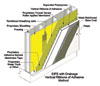
What’s really cool about the second generation of EIFS (with drainage) is that the liquid applied water-resistive barrier that is included as part of a moisture management strategy is also a very effective air barrier.³
At no time is there any worry for reverse overlaps, tears or fastener punctures commonly associated with sheet applied housewraps or building papers. This is because the WRB is completely monolithic and the EIFS is installed with adhesive. This is important because it has been demonstrated by the National Institute of Standards that an effective air barrier on a typical 24,000 square foot office building in Minneapolis can reduce gas consumption for heating by 43 percent and reduce electric use by as much as 33 percent.
 REASON 3:
EIFS PROVIDES LEADERSHIP
In August 2007, the United States Green Building Council updated the Leadership in Energy and Environmental Design criteria scoring system. The new criterion calls for all LEED projects to achieve a minimum of two “Optimize Energy Performance” points. The effect of the change is to reduce energy in new LEED buildings by a minimum of 14 percent above ASHRAE Standard 90.1 and 7 percent for existing building renovations. For LEED 2009, the criterion for new buildings is apparently being dialed down to 10 percent.
What is interesting however is that the criteria also gives up to eight points for buildings that can show even better energy performance than the minimum. Conceivably a new building showing a 35 percent better energy performance can get all eight points. That’s a third of the requirement for LEED basic certification and one quarter the requirement for LEED Silver Certification.⁴
What makes this significant is what we have already stated in Reason 2: That 35 percent better energy performance may be achievable, simply with an EIFS liquid applied air and water-resistive barrier. And, any shortcomings to that goal may be made up with the insulation value that can be put over the WRB.
REASON 4:
EIFS IS NOT WASTEFUL OF NATURAL RESOURCES
The common pitfall that many seem to fall into is the fact that because the insulation board used in EIFS is derived from fossil fuels it should be exempt from being specified. The truth of the matter is that EPS production accounts for only 0.002 percent of the world’s production of oil.⁵ And, it has been determined that one pound of EPS used as insulation will actually save 48 gallons of oil in a 50 year period of time.⁶ This is significant in terms of preserving those resources. Another little known fact about EPS is that it uses 30 percent less energy to make than paper products.⁷ Think about that the next time you throw away your junk mail or run out to get the Sunday paper.
 REASON 5:
EIFS HAS NOT SIGNIFICANTLY IMPACTED OUR WASTE STREAM
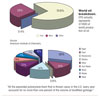
Contrary to popular belief “All the expanded polystyrene foam that is thrown away in the United States every year accounts for no more than one percent of the volume of land filled garbage.” The actual amount is 0.6 percent. Paper actually fills 30 percent of the volume of our landfills and food 15 percent.⁸ This fact that EPS is only 0.6 percent perhaps needs to be tempered a bit: Many of those older buildings that have come on-line since EIFS was brought to the United States in 1969, have not reached their useful end as of yet and as such have not made it to the waste stream. That’s pretty astonishing considering most of EIFS’ detractors would have you believe that EIFS is not a durable or long lasting product.
The fact of the matter is that as that issue may present itself, technology has come up with a solution for the volume of space that EPS can take up in our landfills. A European company, Purex International, has developed a process called Styromelt which involves putting the discarded EPS between two temperature controlled platens (think of two irons on either side). The EPS is heated to a melting point forming a dense resin that when cooled, effectively reduces the EPS volume by 95 percent. This process is now being used in Europe. It is unaffected by food or other contaminants. The thermally condensed blocks can be used for a myriad of products including green diesel and propane.⁹
REASON 6:
MOISTURE INTRUSION IS A THING OF THE PAST WHEN EIFS WITH DRAINAGE IS INSTALLED PROPERLY
That same statement also applies to conventional applications of EIFS. However, there is no doubt that the EIFS industry has felt the squeeze from some unfortunate situations in the residential sector. The industry however has learned well from its mistakes and has created a next generation product that adds a level of redundancy that cannot be achieved by any other cladding product.
The liquid applied water-resistive barrier completely seals the sheathing to which the drainage configuration EIFS is applied. If moisture does breach the finish, basecoat and expanded polystyrene insulation board, it is quickly and easily evacuated by the vertically oriented channels created by the adhesive attachment of the insulation board with a notched trowel.¹⁰ And did we mention that at no time is the WRB punctured with staples, cap nails or any other fasteners?
 REASON 7:
EIFS IS IN THE BUILDING CODE
That statement may be a little premature, however during the ICC’s Code Development Hearings in February 2008, EIFS passed preliminary approvals from both the IRC Building and Energy Code Committee and the IBC Fire Safety Code Committee for inclusion into the 2009 IRC and IBC. The IRC Committee voted 10-0 to recommend inclusion in the IRC, and the IBC vote was 11-1.¹¹ And, at the final code hearings in Minneapolis in September 2008, EIFS was formally approved without any objection. This means that EIFS will finally take its proper place within the pages of the building code.
REASON 8:
EIFS IS SAFE AND DURABLE
Some red flags went up in January 2008 when cable news ran coverage of the Monte Carlo fire in Las Vegas. Soon after that, an editorial ran in an architectural publication attacking EIFS as “superhot stuff.” The fact of the matter is that the cladding that caught fire on the outside of the Monte Carlo was not an industry recognized EIFS product. Rather, it was polyurethane coated expanded polystyrene that had only been installed on the top four floors of the building. Polyurethane when heated gives off a highly combustible gas, which is susceptible to flashover when exposed to an open flame. This perhaps explains the cause of the fire being attributed to a welder’s torch on the roof of the building. The fire did not spread to the adjoining EIFS, which is proof that EIFS undergoes rigorous testing required by building code authorities to qualify its use.
In terms of the product’s durability, its history in the Twin Cities goes back more than 30 years. With several years of high winds, hail and hot and cold seasons behind us, those first EIFS covered buildings are still performing without significant issues.
Lastly, we are beginning to see the insurance industry finally relaxing their grips on premiums and deductibles for EIFS. Policies are now being based upon criteria such as the quality of the contractor, longevity in the business, financial security, knowledge, reputation, loss history, safety record certification, attitude and internal ability. It is now not unusual for a policy today to cost two-thirds of what it may have cost five years ago. The market is soft with room to explore and it is critical that carriers see quality and a profitable history.¹²
 REASON 9:
AESTHETICS AND FINISHES
EIFS was brought to the United States around the same time that we saw the oil embargo in 1970. Its popularity grew as a result of its contribution to a building’s energy efficiency, a purpose that has just as much if not more meaning today. It wasn’t long after its debut however that the design community realized EIFS’ considerable versatility in creating aesthetic elements that really make buildings look good.
What is new for EIFS today are improvements and astonishing new choices in finishes that now make them better than ever; finishes that can shed dirt, some with higher elastic properties and some that are even hydrophobic. Do you want to assimilate the look of limestone? How about granite? Metallic panels anyone? How about the warmth of old world stucco, or even simulated brick? The choices seem to be boundless.
REASON 10:
EIFS IS THE BEST
This is a pretty simple statement, but it is true: “New research comparing both overall insulating ability and moisture resistance show EIFS with 4-inch foam insulation ‘outperformed’ walls of brick, stucco, concrete block and cementitious fiber board in moisture handling with superior thermal performance.” These are key points from Achilles Karagiozis Ph.D., the principal researcher on a project called the Natural Exposure Test Facility. Funded by the U.S. Dept of Energy, through the Office of Energy Efficiency and Renewable Energy’s Building Technologies Program and EIMA, Oakridge National Laboratories conducted field testing on a variety of wall systems to determine their thermal, air leakage and moisture control performance in real world conditions. Their key conclusions:
References:
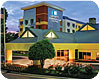
The Summerfield Suites Hotel in Charlotte, NC.
The project features Dryvit’s Reflect finish.
Exterior Insulation Finish Systems have been a successful mainstay in the Twin Cities market for more than 30 years. From the Mall of America to the envelope surrounding that quirky crumpled aluminum centerpiece of the Walker Art Center, the system has always been about the design flexibility of lightweight foam shapes, crack resistant coatings, ease of installation and energy savings. Considering this popularity, it’s time to dig deeper and offer 10 compelling new reasons why EIFS should be the cladding of choice.
EIFS FITS WELL INTO THE 2030 CHALLENGE
In 2003, Santa Fe Architect Ed Mazria authored a ground shaking assessment of the construction industry, when he reasoned that 48 percent of our energy is consumed by our buildings. Taking this a step further, Mazria correlated this reasoning to global warming and determined that construction was also responsible for 46 percent of our nation’s carbon emissions output.
In 2006, Mazria challenged the construction industry and in particular architects to design new buildings to use 50 percent less energy than the regional average for that building type. Subsequently, that energy efficiency standard would be increased exponentially over the years so that by 2030 all buildings are essentially carbon-neutral.
How do we get to the 50 percent target? Mazria has suggested a number of strategies: The first relies on no cost or low cost savings, such as how the building is oriented, passive heating and cooling, natural ventilation, glazing, choice of equipment and site shading. The second includes photovoltaic arrays to encompass heating and hot water needs, ground source heat pumps, triple glazing and super-insulation. The third strategy is to buy clean power, generated by wind or solar generated supply sources.¹
Focusing in on the second strategy, EIFS can make a strong case for its superlative insulation value. Graph 1 (on page 34) illustrates a couple of examples of some thermally challenged wall assemblies. What is demonstrated is that the actual thermal resistance (whole wall) is altered because of the thermal bridges created by the framing and the interfaces between windows, floors, ceilings etc. Adding EIFS to these walls, some distinct properties evolve: Much like a thermal blanket it covers and eliminates the thermal bridging, while the R-value remains a constant 3.85/inch of thickness. Another added benefit is that it has been estimated that the effective application of EPS insulation could cut carbon dioxide emissions in buildings by up to 50 percent.²
REASON 2:
EFFECTIVE AIR BARRIER INSTALLATION CAN POTENTIALLY NET 40 PERCENT BETTER ENERGY EFFICIENCY
What’s really cool about the second generation of EIFS (with drainage) is that the liquid applied water-resistive barrier that is included as part of a moisture management strategy is also a very effective air barrier.³
At no time is there any worry for reverse overlaps, tears or fastener punctures commonly associated with sheet applied housewraps or building papers. This is because the WRB is completely monolithic and the EIFS is installed with adhesive. This is important because it has been demonstrated by the National Institute of Standards that an effective air barrier on a typical 24,000 square foot office building in Minneapolis can reduce gas consumption for heating by 43 percent and reduce electric use by as much as 33 percent.
EIFS PROVIDES LEADERSHIP
In August 2007, the United States Green Building Council updated the Leadership in Energy and Environmental Design criteria scoring system. The new criterion calls for all LEED projects to achieve a minimum of two “Optimize Energy Performance” points. The effect of the change is to reduce energy in new LEED buildings by a minimum of 14 percent above ASHRAE Standard 90.1 and 7 percent for existing building renovations. For LEED 2009, the criterion for new buildings is apparently being dialed down to 10 percent.
What is interesting however is that the criteria also gives up to eight points for buildings that can show even better energy performance than the minimum. Conceivably a new building showing a 35 percent better energy performance can get all eight points. That’s a third of the requirement for LEED basic certification and one quarter the requirement for LEED Silver Certification.⁴
What makes this significant is what we have already stated in Reason 2: That 35 percent better energy performance may be achievable, simply with an EIFS liquid applied air and water-resistive barrier. And, any shortcomings to that goal may be made up with the insulation value that can be put over the WRB.
REASON 4:
EIFS IS NOT WASTEFUL OF NATURAL RESOURCES
The common pitfall that many seem to fall into is the fact that because the insulation board used in EIFS is derived from fossil fuels it should be exempt from being specified. The truth of the matter is that EPS production accounts for only 0.002 percent of the world’s production of oil.⁵ And, it has been determined that one pound of EPS used as insulation will actually save 48 gallons of oil in a 50 year period of time.⁶ This is significant in terms of preserving those resources. Another little known fact about EPS is that it uses 30 percent less energy to make than paper products.⁷ Think about that the next time you throw away your junk mail or run out to get the Sunday paper.
Whole Wall R-Value based upon research of Jeffrey Christion
and Jan Kosny ORNL 1999. Whole Wall with 4” of EPS based upon typical R-Value
of 3.85/inch of EPS thickness + the Whole-Wall R-Value.
EIFS HAS NOT SIGNIFICANTLY IMPACTED OUR WASTE STREAM
Contrary to popular belief “All the expanded polystyrene foam that is thrown away in the United States every year accounts for no more than one percent of the volume of land filled garbage.” The actual amount is 0.6 percent. Paper actually fills 30 percent of the volume of our landfills and food 15 percent.⁸ This fact that EPS is only 0.6 percent perhaps needs to be tempered a bit: Many of those older buildings that have come on-line since EIFS was brought to the United States in 1969, have not reached their useful end as of yet and as such have not made it to the waste stream. That’s pretty astonishing considering most of EIFS’ detractors would have you believe that EIFS is not a durable or long lasting product.
The fact of the matter is that as that issue may present itself, technology has come up with a solution for the volume of space that EPS can take up in our landfills. A European company, Purex International, has developed a process called Styromelt which involves putting the discarded EPS between two temperature controlled platens (think of two irons on either side). The EPS is heated to a melting point forming a dense resin that when cooled, effectively reduces the EPS volume by 95 percent. This process is now being used in Europe. It is unaffected by food or other contaminants. The thermally condensed blocks can be used for a myriad of products including green diesel and propane.⁹
REASON 6:
MOISTURE INTRUSION IS A THING OF THE PAST WHEN EIFS WITH DRAINAGE IS INSTALLED PROPERLY
That same statement also applies to conventional applications of EIFS. However, there is no doubt that the EIFS industry has felt the squeeze from some unfortunate situations in the residential sector. The industry however has learned well from its mistakes and has created a next generation product that adds a level of redundancy that cannot be achieved by any other cladding product.
The liquid applied water-resistive barrier completely seals the sheathing to which the drainage configuration EIFS is applied. If moisture does breach the finish, basecoat and expanded polystyrene insulation board, it is quickly and easily evacuated by the vertically oriented channels created by the adhesive attachment of the insulation board with a notched trowel.¹⁰ And did we mention that at no time is the WRB punctured with staples, cap nails or any other fasteners?
All the expanded polystyrene foam that is thrown away in the
U.S.
every year accounts for no more than one percent of the volume of landfilled
garbage.
EIFS IS IN THE BUILDING CODE
That statement may be a little premature, however during the ICC’s Code Development Hearings in February 2008, EIFS passed preliminary approvals from both the IRC Building and Energy Code Committee and the IBC Fire Safety Code Committee for inclusion into the 2009 IRC and IBC. The IRC Committee voted 10-0 to recommend inclusion in the IRC, and the IBC vote was 11-1.¹¹ And, at the final code hearings in Minneapolis in September 2008, EIFS was formally approved without any objection. This means that EIFS will finally take its proper place within the pages of the building code.
REASON 8:
EIFS IS SAFE AND DURABLE
Some red flags went up in January 2008 when cable news ran coverage of the Monte Carlo fire in Las Vegas. Soon after that, an editorial ran in an architectural publication attacking EIFS as “superhot stuff.” The fact of the matter is that the cladding that caught fire on the outside of the Monte Carlo was not an industry recognized EIFS product. Rather, it was polyurethane coated expanded polystyrene that had only been installed on the top four floors of the building. Polyurethane when heated gives off a highly combustible gas, which is susceptible to flashover when exposed to an open flame. This perhaps explains the cause of the fire being attributed to a welder’s torch on the roof of the building. The fire did not spread to the adjoining EIFS, which is proof that EIFS undergoes rigorous testing required by building code authorities to qualify its use.
In terms of the product’s durability, its history in the Twin Cities goes back more than 30 years. With several years of high winds, hail and hot and cold seasons behind us, those first EIFS covered buildings are still performing without significant issues.
Lastly, we are beginning to see the insurance industry finally relaxing their grips on premiums and deductibles for EIFS. Policies are now being based upon criteria such as the quality of the contractor, longevity in the business, financial security, knowledge, reputation, loss history, safety record certification, attitude and internal ability. It is now not unusual for a policy today to cost two-thirds of what it may have cost five years ago. The market is soft with room to explore and it is critical that carriers see quality and a profitable history.¹²
AESTHETICS AND FINISHES
EIFS was brought to the United States around the same time that we saw the oil embargo in 1970. Its popularity grew as a result of its contribution to a building’s energy efficiency, a purpose that has just as much if not more meaning today. It wasn’t long after its debut however that the design community realized EIFS’ considerable versatility in creating aesthetic elements that really make buildings look good.
What is new for EIFS today are improvements and astonishing new choices in finishes that now make them better than ever; finishes that can shed dirt, some with higher elastic properties and some that are even hydrophobic. Do you want to assimilate the look of limestone? How about granite? Metallic panels anyone? How about the warmth of old world stucco, or even simulated brick? The choices seem to be boundless.
REASON 10:
EIFS IS THE BEST
This is a pretty simple statement, but it is true: “New research comparing both overall insulating ability and moisture resistance show EIFS with 4-inch foam insulation ‘outperformed’ walls of brick, stucco, concrete block and cementitious fiber board in moisture handling with superior thermal performance.” These are key points from Achilles Karagiozis Ph.D., the principal researcher on a project called the Natural Exposure Test Facility. Funded by the U.S. Dept of Energy, through the Office of Energy Efficiency and Renewable Energy’s Building Technologies Program and EIMA, Oakridge National Laboratories conducted field testing on a variety of wall systems to determine their thermal, air leakage and moisture control performance in real world conditions. Their key conclusions:
- Brick and cementitious fiber board systems tend to accumulate and retain more moisture.
- Insulation is more beneficial when placed towards the exterior.
- EIFS with water-resistive barrier coatings performed significantly better than claddings using building paper or spun-bonded polyolefin membranes.
- EIFS drainage assemblies, using vertical ribbons of adhesive, provide a drainage path and air space that contributes positively towards hygrothermal performance of the wall.13
References:
- An Interview with Ed Mazria, Energy Design Update, August 2007.
- EPS and the Environment, Plastics Institute of New Zealand.
- NIST Report: Continuous Air Barrier Systems Reduce Energy Costs, Air Barrier Assoc. of America.
- LEED for Core and Shell v2.0 Registered project Checklist.
- American Chemistry Council.
- Extrapolated from EUMEPS, the European Manufacturers of EPS.
- American Chemistry Council.
- “Rubbish! The Archaeology of Garbage,” William Rathje and Cullen Murphy.
- Purex International Styromelt.
- John Straube, Ph.D.Eng., Department of Civil Engineering and School of Architecture, University of Waterloo.
- EIFS Industry Members Association, “EIFS One Step Closer to Code Approval.”
- Bryan Dunn, Brown and Brown Insurance, notes from EIMA Annual Meeting 2007.
- Building Envelope Research/ Testing: Hygrothermal Performance of Exterior Wall Systems: Key Points of the ORNL NET Facilities Research Project.
Looking for a reprint of this article?
From high-res PDFs to custom plaques, order your copy today!





