The Long Recovery Road
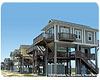
Ten homes that remained standing in Texas with little damage after Hurricane Ike, amid the rubble left behind on the Bolivar Peninsula, serve as valuable reminders of how making the right choices for construction techniques and interior finishes in coastal zones can pay off.
About 200 homes once graced the narrow coastlines of the Bolivar Peninsula, but fewer than a dozen were left after the powerful hurricane blew through in September 2008. Of those, only nine houses were move-in ready after the power, stairs and decks were restored. The tenth home sustained roof damage at the gable end that required additional repairs. These homes were built to the Institute for Business & Home Safety’s Fortified … for safer living standard. This code-plus new construction program is designed to improve a home’s ability to withstand natural disasters common in the area where it’s being built. In this case, that meant designing for the high-intensity hurricane conditions that are known to batter barrier islands.
POST STORM STUDIES
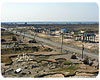
The Bolivar Peninsula was ground zero for Ike and the storm marked the first true test of the Fortified program’s engineering design concepts. It also meant a real-world examination for the builder’s choice of exterior and interior finishes. What IBHS has learned from the outcome of this storm, particularly as it relates to the areas of roof coverings and secondary water barriers, structural capacity, water intrusion and water management, will be incorporated into the Fortified program and public education efforts to help other builders and consumers increase the chance their properties can survive a similar catastrophe.IBHS post-storm analyses revealed that peak wind gusts along the eastern portion of the Bolivar Peninsula were 110 to 120 mph. Gauges installed by U.S. Geological Service researchers to measure surge and wave heights during the storm showed a still water height of about 15 feet with wave peaks between 18 and 19 feet in an area west of the Fortified homes. Other measurements of high water marks suggest that wave heights in some locations on the Bolivar Peninsula could have reached 20 to 21 feet.
Once the skies cleared and the peninsula was reopened to visitors, IBHS engineers and the builder of Audubon Village traveled to the area to see how the Fortified homes fared. Ten of the 13 homes were still standing. There was evidence of some roof damage and the lower decks had broken away during the storm surge as designed, but overall the houses were structurally sound. The three Fortified homes that were destroyed were literally knocked off their foundations by other traditionally built houses that were devastated by the storm surge.
Once inside the houses, the engineers turned their attention to water management issues.
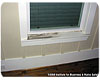
“There were clear silt lines on the floor that showed how much water got in,” says IBHS Chief Engineer Tim Reinhold. “We were surprised to see how well the interior finishes performed considering the amount of water intrusion.”
RAINFALL AND WIND SPEED
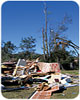
The maximum rainfall rate in this area during Ike, which was estimated by IBHS research partners at the University of Florida using Doppler radar, was about one inch per hour. This is considerably less than the roughly 8 inches per hour rainfall rate typically used to test window, door and roof covered products.“We had wind speeds that were 10 percent lower than the design speeds for the area, we had rainfall rates that were one-eighth of what’s typically used in test standards for windows and doors for water intrusion, and yet we still had a significant amount of water intrusion around windows and doors,” Reinhold says. “This clearly reinforces the idea that people building in coastal areas need to address water management issues and use good flood-resistant practices as they design and build their homes and businesses, even when they are well elevated.”
Each of the Fortified homes was built using impact-resistant windows, shutters and outward-opening doors, all of which are designed to reduce the exposure to hurricane conditions. The use of wood rather than paper-backed products inside the homes and the choice of wood floors instead of wall-to-wall carpeting, all resulted in minimal interior damage, despite the fact that these homes were closed up, without electricity, and unoccupied for several weeks following the storm.
“Had these homes not used materials that were basically flood-resistant, there would have been much more damage,” Reinhold says. “People building homes in these coastal areas, where they will not be able to dry them out quickly, need to be sure they are following good flood-resistant design and choosing materials in keeping with that goal.”
PROPER ELEVATION
Aside from water management issues, Hurricane Ike’s wrath reinforced the importance of proper elevation in coastal zones and highlighted the need for better testing and evaluation methods for roof coverings.There is no substitution for proper elevation and steps should be taken to encourage homeowners in the most vulnerable areas to build well above the Base Flood Elevation, Reinhold says.
The performance of Fortified homes, with decks built 18 feet above sea level and the houses 28 feet above sea level, in an area where the base flood elevation is 17 feet, illustrates the effectiveness of increased elevation. While the decks did not survive, most of the homes did. In contrast, conventional houses built between 1960 and 2005 on the seaward side of State Highway 87 were built to BFEs ranging from 13 to 19 feet above sea level. None of these homes survived.
“The annual probability for storm surge to exceed BFE is one percent, but there is virtually no safety factor when homes are built to BFE considering it only takes about two feet of higher water to destroy any given wood frame house,” Reinhold says. “So when the surge and waves exceed the BFE by a small amount, everything built at or below the BFE is wiped out.”

IBHS engineers surveyed damage not only on the Bolivar Peninsula but in Houston and the surrounding areas. Roof damage was the most common impairment from Ike outside of the storm surge-affected areas, and the performance of the roofing materials is a cause for concern, Reinhold says.
“Better testing and evaluation methods are critical, as are reliable methods for providing backup protection in case the roof cover is compromised,” he said. “Shingles less than two years old that were rated for 150 mph systematically failed when winds were only about 115 mph.”
IBHS will have an opportunity to explore many of these issues when construction of the new Insurance Center for Building Safety Research is completed in fall 2010. The center will be built on a 90-acre parcel of land in Chester County, S.C.
The state-of-the-art, multi-peril applied research and training facility will allow engineers to subject full-scale homes and businesses to hurricane and tornado conditions, as well as hail and wind-driven rain, and wind-blown fire to simulate embers during a wildfire.
Already, IBHS engineers are using data collected during Hurricane Ike to recreate the wind field of this powerful storm. The recreations are taking place in a one-tenth scale model of the center, which is operating in Gainesville. W&C
Looking for a reprint of this article?
From high-res PDFs to custom plaques, order your copy today!




