All Things Gypsum: Joints in Gypsum Panel Systems
When constructing a fire-rated partition, the prescribed gypsum panels must be applied to comply with the information provided in the corresponding fire test. To do otherwise is to risk compromising the integrity of the fire-rated system.
The application process includes properly laying out the panels so that panel edges and end joints are placed to conform to the fire test. Every fire test report or listing contains specific language describing how the panels were installed during the test program. The language also describes exactly how the joints between panels were spaced during the test.
Why then, despite the presence of specific language, do so many rated system post-construction dilemmas derive from an incorrect layout that places joints in conflict with the requirements of the test report?
Likely, the primary root causes of the problem are two separate, but related, concepts: Lack of applicator knowledge of the basic application requirements for any system-rated or non-rated-and misinterpretation of the fire-test language describing joint placement.
General Joint Spacing Concepts
Correct joint placement is a basic requirement of any assembly constructed with gypsum panels. When constructing a partition, there are two primary joint spacing requirements that must be acknowledged: 1) Don’t install a joint on both sides of the same stud, and 2) Don’t create a continuous line of end joints on a stud.Joints are among the weakest structural points in a wall. They create obvious breaks in the planar surface of the finished assembly and provide a natural relief point for stress. Installing a joint on both sides of the same stud is asking for trouble because any force that impacts one side of a stud is going to be transferred transversely through the assembly. If the force is significant it can cause the joint centered on the stud on the opposite side of the stud to crack.
End joints on studs are also required to be staggered between alternate panel courses when panels are installed with their bound edge perpendicular to the studs. You need to create a “running bond” pattern to prevent continuous joints from running up the face of a single stud. Joints are weak points; lining them up on one face of a stud is asking for trouble.
Both concepts apply, with some modifications, to both single layer and multi-layer systems. For additional information, reference Section 4.6 of GA-216-2010, Application and Finishing of Gypsum Panel Products.
Joints in a Fire-Rated Partition System
For a fire test assembly, gypsum panels are installed in a defined pattern to mitigate the intrinsic characteristics of the joints between individual panels and, where necessary, to limit the installation of directly aligned through-system joints. The heat of a fire impinging upon the interior of a system at an opened joint will initially impact the area immediately across from the opening. If the area of impact incorporates a joint, the heat will be directly attacking a weak point in the assembly. Unless permitted by the fire test, the joints on opposite faces of a partition should not be installed in close proximity.Closely examining the joint language for system WP 1072 as listed in GA-600, Fire Resistance Design Manual, helps illustrate some basic panel lay-out requirements. The joint application language is quite straightforward and states: “joints staggered 24 inches on each side and on opposite sides.” In this instance joints are to be separated a minimum of 24 inches from each other: 1) on the same side of the partition, and 2) on opposite faces of the partition. While the language is applicable to WP 1072 it is also referenced in numerous other systems.
It’s important to understand-and this is occasionally misunderstood-that the application language applies to joints that run in the same direction on the same or opposite faces of the partition. It does not say that horizontal and vertical joints cannot intersect. What the listing says is that the panels must be applied so that all of the horizontal joints (those parallel to the floor or ceiling) are at least 24 inches apart and all of the vertical (perpendicular to the floor or ceiling) joints are at least 24 inches apart when the joints are on the same face of the partition. It also states that joints that run in the same direction on opposite faces of the partition are to be offset by at least 24 inches.
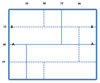
A diagram is instructive:
(Note: WP 1072 permits either a parallel or perpendicular panel application orientation. For discussion purposes, we’ll assume a perpendicular-bound edges at right angles to the studs-application.)
The solid lines show the panel edges on the visible face of a standard eight foot high partition with studs spaced at 24 inches on center. The dashed lines show the panel edges as they are installed on the opposite face of the same partition. Note that while the solid and dashed lines intersect when viewed through the partition they do not occur on the same stud and there is a minimum of 24 inches of separation between joints that run in the same direction. Line A-A is on the visible face of the partition. Line B-B is on the opposite side. The two lines are set 24 inches apart as prescribed by the fire test.
It’s also worth noting that it may be necessary to split full panels to accommodate the joint spacing requirements. In the diagram above, the top and bottom panels on the obscured face of the partition are only 2 feet wide. To accommodate the joint spacing requirements an extra horizontal joint has to be installed in the face of one side of the partition. While this does create additional finishing work, it is unavoidable from a fire-protection standpoint.
Other language in GA-600 initially appears somewhat less restrictive but, when taken in full context, is not so liberal. An example is the language describing joints for system WP 1070: “Joints staggered 24 inches on opposite sides.” In this instance, the listing addresses only the joints on opposite sides of the partition and does not provide specific guidance for the horizontal and vertical joints on the same side of the partition. What keeps the system from becoming joints amuck is: 1) With any installation you must first abide by the general spacing language that prohibits opposite side joints on the same stud, and 2) The specific fire test permits only a parallel application of panels. As a consequence, because all the installed panels “stand up” and must be applied with bound edges on successive studs, the vertical joints are adequately separated. In addition, the horizontal joints are addressed by the separation language in the fire test. It all points out that to create a properly constructed system, you often have to combine general joint language concepts with fire test requirements.
As noted above, some proprietary systems listed in GA-600 do permit joints that occur on opposite sides of a partition to line up: “(h)orizontal joints on opposite sides need not be staggered or backed.” In this instance the horizontal joints, but not the vertical joints, on opposite faces of the partition are able to be installed in close proximity.
The basic application requirements and the specific fire test define how the panels in a rated assembly are to be laid out and installed. While a correct interpretation of the relevant fire test is of paramount importance when constructing a fire-resistive assembly, the application requirements that are applicable to any installation of gypsum panels cannot be ignored during the application process. It is worth taking the time to review the fire test or listing before you begin panel lay out so that your installed system doesn’t compromise the intent of the fire test.
Looking for a reprint of this article?
From high-res PDFs to custom plaques, order your copy today!




