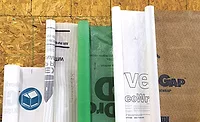
Understanding Housewraps
Understanding housewraps: A decision guide for selecting the right one.
When discussing moisture management solutions in the building industry, it’s important to recognize and accept one simple and indisputable reality: water gets into buildings. No matter how tightly a building is constructed, no matter how well it’s insulated, no matter what type of exterior cladding is chosen or how expertly it’s installed—moisture will always find a way into the building enclosure. Moisture infiltration can undermine structural integrity, cause exterior surfaces to deteriorate, and shorten life of paints and stains. It can also foster mold and rot, that not only causes structural damage but also poses serious health hazards. Ridding the wall assembly of liquid water and water vapor as quickly as possible (before it can damage structural components) is what moisture management is all about.
There are many moisture management products currently on the market, including traditional felt paper, rainscreen systems, sealants, and self-adhered flashing membranes. Choices are expanding, driven by advances in technology, evolving building codes, growing customer concern with mold prevention, and many other factors. Each of the aforementioned moisture management products has its place, depending upon local environmental conditions and project details. Increasingly, synthetic housewraps are being viewed as an essential component of a well-designed, well-constructed low-rise building in virtually any environment.
Housewraps have become increasingly popular for their ease of installation, durability, and ability to block water that has penetrated the exterior cladding from moving further into the wall assembly. Installed behind siding, housewrap prevents wind-driven rain and water from reaching the sheathing and framing, and prevents air infiltration, helping to reduce heating and cooling costs. In addition to resisting initial moisture infiltration, housewraps go a step further by helping to remove trapped moisture vapor from the building enclosure.
SELECTING THE RIGHT HOUSEWRAP
Housewraps are now available in dozens of varieties. Most are non-woven or woven plastic fabrics made from either polyethylene or polypropylene. Some have micro-perforations to let water vapor pass through and the others are designed to let water vapor diffuse through the fabric itself (micro-porous).
So how do you choose? One good place to start is a set of performance criteria recognized by the International Code Council Evaluation Service (ICC-ES), which evaluates building products and provides opinions on code compliance. For housewraps, the ICC-ES evaluates a variety of key characteristics including:
Water Resistance: ICC-ES allows for three different testing standards, including The “Boat Test,” the least stringent standard; “Water Ponding,” a measure of a housewrap’s resistance to a “pond” of 1 inch water over two hours and “Hydrostatic Pressure,” the most stringent test, exerting significant pressures on a housewrap sample through a column of water (55cm or higher).
Durability: A housewrap must be able to withstand the handling and application process without compromising its water-resistance performance. UV resistance and resistance to cold temperatures are also evaluated by ICC-ES.
Air Resistance: An air barrier is a continuous system that stops the unintended movement of air across the building enclosure. Most housewraps are tested for their resistance to air movement, but the ICC-ES standard does not account for seams and penetrations. Therefore, air resistance is not a critical product selection criterion since real-world performance depends very much on installation conditions.
Vapor Permeability: Permeability measures the amount of vapor transmission that a housewrap will allow over a period of time, minimizing the potential for accumulation of moisture vapor. The higher the “perm number,” the more vapor permeable the material. For a product to be considered a housewrap (and not a vapor retarder), the permeance rating must be higher than 5.
Drainage: Drainage is widely accepted as one of the most effective measures for reducing moisture damage due to rain penetration. Drainage is a critical component in allowing the housewrap to do its job—particularly in keeping the walls dry.
In addition to these factors, other things like the cladding type, climate, geographic orientation and wall assembly are important to consider in relation to housewrap choice. The amount of annual rainfall can be used as a guide for determining the level of moisture management needed in a wall. As a rule of thumb, the Building Enclosure Moisture Management Institute recommends that “any area receiving more than 20 inches of annual rainfall should incorporate enhanced drainage techniques in the wall system, especially if using an absorptive cladding material. Additional factors such as geographic orientation of the wall, amount of overhang, altitude, and even trees and buildings in proximity will help contribute to a more knowledgeable design decision. That information will help in understanding the potential for wind pressure, wetting, and drying, and therefore what level of moisture management to incorporate into a wall.
A NEW GENERATION
There is growing recognition among building scientists and building codes that walls also need to drain. Going forward, housewraps increasingly will be judged by how effectively they provide positive drainage of water from the wall. Drainable housewraps, the fastest-growing segment of the market, address this need by incorporating both a water-resistive layer and a drainage gap, greatly facilitating water drainage from behind the exterior cladding system.
Drainable housewraps provide a continuous drainage gap that allows water to quickly escape from the wall system, protecting the building enclosure. These enhanced products provide a much higher and more constant drain rate than standard housewraps. Compared to standard housewraps, the newest drainable housewraps—especially those that provide a minimum of a one (1mm) millimeter gap—can be as much as 100 times more effective at removing bulk water from the wall.
IMPACT OF BUILDING CODES
Among the factors driving the need for better moisture management solutions, are the continued growth and standardization of requirements such as the International Residential Code, and the International Building Code, which requires a means of draining water that enters the wall assembly. The IRC now mandates the use of water-resistive barriers, stating that “The exterior wall envelope shall be constructed in a manner that prevents the accumulation of water within the wall assembly by providing a water-resistant barrier behind the exterior veneer ... and a means of draining to the exterior water that enters the assembly (R703.1.1 Water Resistance).”
IMPORTANCE OF INSTALLATION
No housewrap on the market will do its intended job if it isn’t carefully and properly installed. The time between installation of the housewrap and the addition of exterior cladding should be kept to a minimum. Housewrap exposed to the elements for longer than its intended UV rating can deteriorate. Lengthy exposure can also result in tears and holes that can affect performance if not repaired.
Another key decision in installing any housewrap is whether or not to use seaming tape and cap fasteners. One primary factor in this decision is whether the housewrap is being used primarily to reduce air infiltration or to resist water entry. In a well-constructed wall assembly, there is little evidence that a layer of housewrap will significantly tighten the building against air infiltration. In general, air-sealing efforts are better spent on the building’s interior, using drywall and framing, or a continuous air barrier material, along with caulks and gaskets.
WRAP IT UP
Selection of the right solution remains a complex issue, with necessary considerations given to environments, the type of exterior cladding that will be used, and project budgets and timetables. Ultimately, choosing the right housewrap requires an understanding of the product’s key attributes, including water resistance, durability, UV resistance, surfactant resistance, vapor permeability and drainage.Architects, builders and buyers must understand and appreciate the differences between perforated and non-perforated, and woven vs. non-woven housewrap products. More importantly, these parties must also continue to research and understand the differences between traditional housewraps and the next-generation drainable products that will provide enhanced moisture protection at a cost-effective price. W&C
Looking for a reprint of this article?
From high-res PDFs to custom plaques, order your copy today!