Stucco Stop
Barrier Vs. Drainage EIFS
A cross examination of barrier and drainage EIF systems.
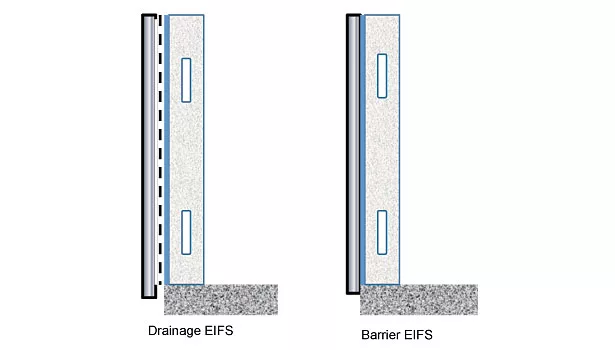
When EIFS was first brought to the U.S., it was sold as a lightweight insulating cladding/barrier system. It was the original continuous insulation cladding and applied to many commercial buildings. Eventually, it became very popular in the housing industry. It is through the housing segment that EIFS took a bat to the knees. The barrier system was thought to be insufficient as a weather barrier and was thought to cause all forms of construction maladies. EIFS battled the misinterpretations and sensationalized attacks and was victorious in presenting the facts. I will say it: barrier EIFS is still an excellent high performance exterior cladding compared to other exterior claddings.
Throughout the market “righting” period of the EIF systems, code changes were made that have changed the way EIFS is installed today. The biggest change was that in 2009, the International Building Code listed EIFS in Section 1408. The code states that any structure classified as Type V construction and Group R1, R2, R3 and R4 occupancies, drainage EIFS must be installed. These systems with drainage must incorporate a drainage plane and a water-resistive barrier complying with section 1404.2. In plain English, the barrier EIF system must have a continuous WRB and drainage plane between it and the exterior sheathing.
MOISTURE ISSUES
The barrier in any EIF system is the basecoat and mesh layer. This layer will not allow the penetration of moisture and functions as the moisture-intrusion-preventing workhorse of the system. The finish provides some level of prevention but is actually the decorative layer of the system. Not to omit the foam part, which is integral to the definition of EIFS, but it is not really part of the water resistive characteristics of EIFS. What makes EIFS unique is that the barrier is a monolithic, continuous, working component. Barrier EIFS Achilles heel is in the stopping and starting areas of the cladding, the point where EIFS stops and other things like windows and doors, start. A good sealant joint at this transition area is absolutely necessary.
Most of the issues related to moisture issues in barrier EIFS claddings began at these sealant joints, with some sealant joints being omitted completely. In exploring the issues it was discovered that the moisture intrusion was found at the windows and doors and not in the center of the wall. The barrier had not leaked at all. I have spoken to some plastering contractors in the Pacific Northwest who installed barrier EIFS on their own homes 15 to 20 years ago and still have no moisture issues. They all state that the system they put on their houses were done “properly” with sealant joints where they belong, proper base coat thickness and occasional maintenance like re-sealing and washing the dirt off the surface. Those guys agreed—barrier EIFS works just fine.
DRAINAGE EIFS
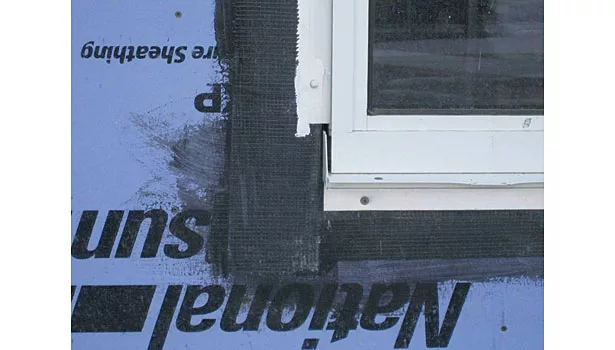
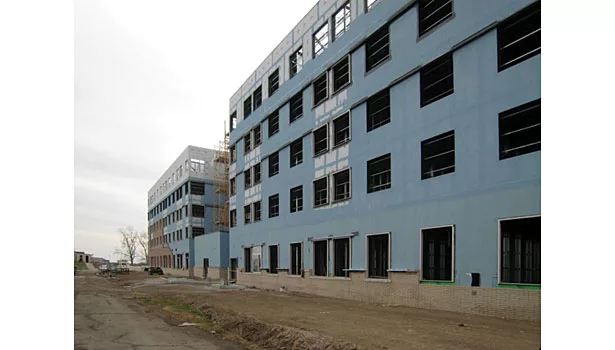
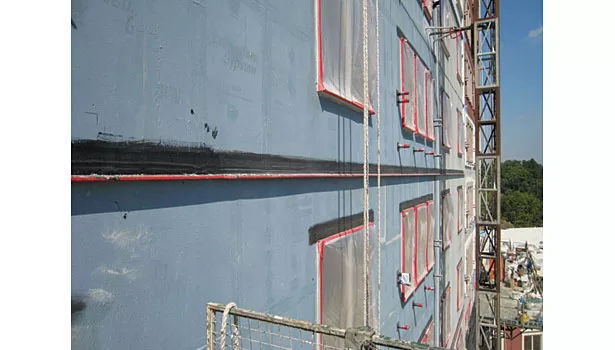
Drainage EIFS sort of super-charges the stand alone barrier EIF systems. The addition of a drainage plane and a continuous secondary WRB also incorporated into the fenestrations, does add to an already good system, the barrier version. Like any other type of exterior cladding with a WRB, paper and sheet goods may be used as the WRB in an EIF system. Continuing in the tradition of high-performance, all of the EIFS manufacturers have developed liquid applied secondary WRB’s and also have versions that can function as air barriers. These liquid applied versions can be troweled, sprayed or rolled onto the sheathing surface and like the name implies, are continuous, without breaks or laps (like the sheet-goods versions). Working with the secondary WRB is the fenestration flashing component. These liquid flashings were also created by the EIFS manufacturers. Like their adjacent WRB partner, these flashings are liquid applied, continuous and blend right into the WRB. The entire surface of the exterior then becomes covered by a single, flexible protection layer.
Now add in a drainage plane which can drain incidental moisture intrusion, and you have a cladding that can insulate, protect from moisture intrusion and yes, look good. Moisture has a way to enter into any cladding as vapor or water, but for the most part it is the water version that causes the big problems. One must consider that when it comes to incidental water/moisture intrusion, the key word is incidental. With EIFS it is an “incident” like a crack in the cladding or complete omission of a sealant joint or poor detailing that can allow water to get in. Drainage EIFS has a built-in defense mechanism to deal with these incidents, becoming the “suspenders” to the barrier system “belt.” It is interesting to note that EIFS drainage systems were invented and installed long before the EIFS debacle and subsequent code changes. But back then they were thought of as not really needed in the drier climates and only practical in high-rise or very wet climates.
COMPLETING THE EIFS ENSEMBLE
Sealants and flashings complete the EIFS ensemble and are installed in both the barrier and drainage versions. Flashings are a very important component of any EIF system even though they are not considered part of the EIF system. I am not talking about the liquid applied version used in the fenestrations and in conjunction with the WRB; I’m talking about the metal components used to divert water to the exterior of the cladding, the pan, step, head and cap, to name a few. Flashings should be installed with any cladding though and have been illustrated in construction documents since we started building modern construction. You will see them illustrated in most of the EIFS manufacturer’s details, because the EIFS industry has always advocated incorporating flashings with their systems.
The same is true for sealants. With the EIF systems, the sealant joint is a very important component. Because of the insulating component, the foam, EIF systems absorb the thermal shock a building exterior goes through daily. EIFS exhibits minimal thermal movement, while the other building components, like doors and windows, don’t. A properly designed and installed sealant joint between the two, functions as the chaperone at the thermal dance, allowing each side to move as they wish, while maintaining integrity. EIFS on its own performs so well as a cladding that some have assumed the integration of flashings and sealants was not critical, perhaps thought of as extras, not really needed or a cost savings. This has proven to be a wrong assumption.
So as I mentioned earlier, barrier EIFS does work just fine. In fact there are many buildings clad with only barrier EIFS functioning and looking good. The proper installation, including the sealants and flashing, is a determining factor in the success of EIFS as a barrier cladding. Barrier EIFS simply lacks a back-up contingency for a moisture incident, but as an insulating cladding does stand the test of time. Drainage EIFS reflects our modern improvements in construction. It improves on a proven cladding, giving it a second chance for the what-the-heck scenario. By protecting the sheathing with a barrier and allowing incidental water to drain away, drainage EIFS steps it up in the high performance cladding category. As a building owner, design professional or contractor, the selection of barrier or drainage EIFS depends first on the code requirements and second on cost or performance. Both are time proven claddings, both superior insulating claddings and both cost effective and aesthetically pleasing.
Looking for a reprint of this article?
From high-res PDFs to custom plaques, order your copy today!




.webp?height=200&t=1657144561&width=200 "DensElement Wall Assembly EIFS B (1).jpg")
