Walls & Ceilings logo
search
cart
facebook twitter linkedin youtube youtube Spotify Podcasts Apple Podcasts Spotify Podcasts Apple Podcasts
  • Sign In
  • Create Account
  • Sign Out
  • My Account
Walls & Ceilings logo
  • NEWS
  • TOPICS
    • Drywall
    • Stucco/EIFS
    • Ceilings
    • Steel Framing
    • Fireproofing
    • Interior Plaster
    • Building Envelope
    • Insulation
    • Technology
    • Interior
    • Exterior
    • Women In Construction
  • COLUMNS
    • Up Front
    • All Things Gypsum
    • Art & Craft of Plastering
    • Stucco Stop
    • Steel Deal
    • Industry Voices
  • PRODUCTS
    • Buzz Guide
  • EVENTS
    • Industry Events
    • Webinars
    • BUILD Expo
  • MEDIA
    • Videos
    • Podcasts
    • Photo Galleries
    • BUILD26 Videos
    • Take our Quiz!
    • Infographics
  • EXCLUSIVE
    • Newsletters
    • Top 50 Contractors
    • Contractor of the Year
    • State of the Industry
    • W&C Store
    • Market Research
    • CEUs
    • Sponsor Insights
    • Custom Content & Marketing Services
  • DIRECTORY
  • EMAGAZINE
    • eMagazine
    • Advertise
    • Archive Issues
  • SIGN UP!
Building Envelope

‘Building within a Building’ for Savings
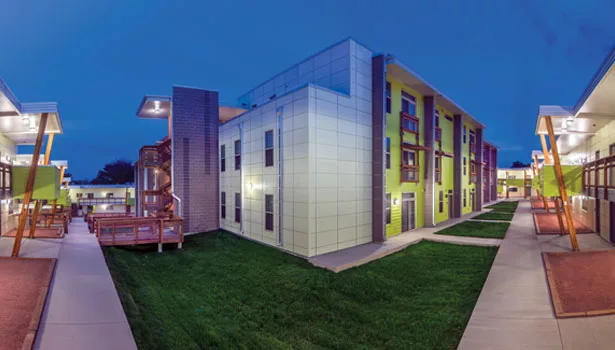
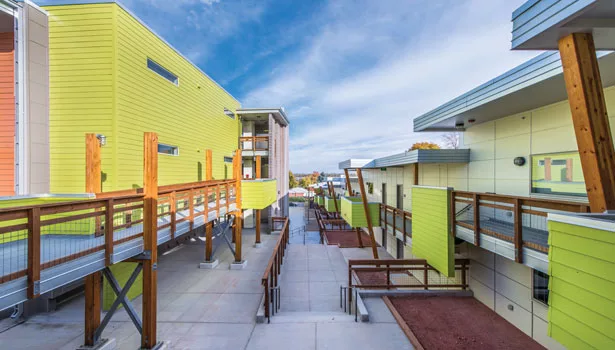
image 1-SS
Daniel O'Connor
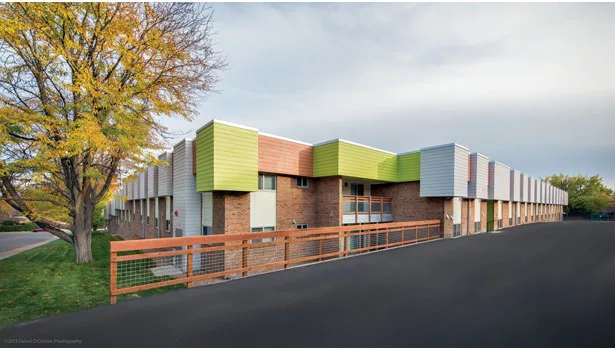
The dedication and innovation of the project team have helped to turn an eyesore into a vibrant, active and healthier community. Image by Daniel Oâ??Connor
image 3
Daniel O'Connor
The tight site was challenging, and careful sequencing and re-sequencing of trades had to be employed.
image 4
Daniel O'Connor
Creative design helped to make a four-story building all but disappear behind a two-story building.
image 1-SS
image 3
image 4
November 25, 2014

No one in the modern era really believes that a castle built in, say, the 12th century is energy efficient, but a castle, with an outer wall and a keep within the wall, is what the South Lowell Apartments in Denver resembles from an aerial view. Perhaps that’s why the project team chose to use the phrase “square donut” instead.

Castle, donut or whatever term one chooses to describe the project, the fact is that this 100,200-square-foot multifamily residence designed as affordable housing is far more energy efficient than any castle. Additionally, much of the cost savings realized on the project—construction of which included renovating the original 73,581-square-foot building and adding 26,620 square feet of new construction—are due to the apartment building’s design.

A Structure in Need

The Denver Housing Authority (DHA) knew for some time that it needed to renovate its South Lowell Apartments public housing complex. In a prescient move, the DHA assembled its project team early, enabling architect WORKSHOP8 and builder Pinkard Construction to help identify the physical needs on the subject property in the early phases. What they found was a number of challenges.

“The original structure was built in 1973 and had not had a great deal of maintenance in the intervening time. Both the walls and roof were leaking, and there were significant mold issues, as well as asbestos,” says C. Joseph Vigil IV, AIA, architect and founding partner of Boulder, Colo.-based WORKSHOP8. “We concluded that a rehab would cost about $5 million. If we started from scratch, we determined we could get 98 units on the site at a cost of $15 million.”

But because the project team had been assembled early by DHA, a third option was proposed. This new option called for renovating the existing building and its 68 units. A new 28-unit building would then be built on the courtyard bordered by the existing structure, creating the donut or castle-like “building within a building” concept. Not only did this third choice give DHA the same number of units as proposed in the second option, but the cost came right in between the first two options at $10 million. Achieving this optimal situation may not have been possible had the team not been fully assembled in the early stages.

The creative solution created some very nicely scaled courtyards between the buildings. These courtyards—which feel much different from those of complexes of a similar scale—give the residents a sense of intimacy, ownership and privacy.

The work carried out by the project team also gave South Lowell a very different feel from what was previously there. While some of the existing electrical system was reused, the existing building received all new windows, a new roof, new mechanical and domestic hot water systems, and all new finishes within the units. The exterior also received a substantial facelift, including a new second-level walkway that connects the existing building to the new building. Thanks to that new walkway, residents on the second floor of the renovated building can now take advantage of an elevator included in the design of the new structure.

South Lowell Apartments

  • Location: Denver
  • Type: Affordable Multifamily Housing

  • Scope of Work: Renovation/Addition

  • Size: 100,200 square feet (73,581 square feet renovated; 26,620 square feet new construction)

  • Cost: $19 million total ($10 million construction)

  • Sustainability: Built to Enterprise Green Communities Standards

Project Team

  • Architect: WORKSHOP8

  • Owner: Denver Housing Authority

  • Developer: South Lowell Redevelopment LLLP

  • General Contractor: Pinkard Construction

  • Energy Modeler + Sustainability Consultant: Group14

  • Soils Engineer: Terradyne D/MBE

  • Civil Engineer: Latitude 39 WBE

  • Landscape Architect: three sixty design WBE

  • MEP Engineer: Gehring & Associates W/MBE

  • Structural Engineer: LT Engineering WBE

  • Abatement Contractor: Engineered Demolition

“By thinking ‘inside the box,’ we were able to meet the owner’s goals for the project,” says Vigil. “Additionally, by placing our new units on the interior of the site, we were able to ‘hide’ a 4-story structure in a neighborhood of 2-story buildings. As far as the neighbors are concerned, we were able make a 28-unit, 4-story structure disappear.”

Engineering a Vision

The South Lowell Apartments project is not aiming for LEED certification, but sustainability was a necessary consideration. It features ENERGY STAR appliances and energy-efficient fixtures, and it’s a high-density project with access to open spaces, mass transit and local retail shops. The project effectively manages rainwater, but it also takes an extra measure to care for the health of its occupants with generous light and ventilation and low to zero VOCs in the interior finishes. All of the aforementioned qualities were a part of Enterprise Green Communities Criteria.

The mission of Enterprise is to create opportunity for low- and moderate-income people through affordable housing in diverse, thriving communities, according to its website. In 2004, the organization created the Green Communities Criteria to promote the incorporation of environmentally conscious design elements and the adoption of sustainable practices into the development and rehabilitation of affordable housing. There are eight criteria categories, and each measures different aspects of sustainable design based on all project types (single family, low-rise multifamily) and construction types (new construction, moderate rehab and substantial rehab). Enterprise states that its program differentiates itself by placing special emphasis on resident health and well-being and also by considering the budget challenges that are inherent in affordable housing.

In the State of Colorado, any project that is funded through Colorado Housing and Finance Authority (CHaFA) is required to build to Enterprise Green Communities standards. “A good portion of the funding for this project came for Energy Performance Contracting (EPC),” says Vigil. “EPC is a HUD program that gives funds for existing structures to be made more energy efficient. So adding insulation, replacing windows and replacing the heating systems with much more energy efficient systems all qualify for these funds. DHA could not have afforded to rehab the existing units without access to these funds and the energy saving elements that were implemented in the existing building.”

Where some saw blight, DHA saw opportunity. Such a notion wasn’t wasted on the project team, which did its best to fulfill the client’s needs. That was one of the biggest takeaways Vigil had from the South Lowell project. “Do not underestimate the value inherent in an existing structure,” he says. “The fact that a structure is old, inefficient and riddled with asbestos and mold doesn’t mean there isn’t an opportunity to be had by updating and repurposing.” 

KEYWORDS: Colorado multi-family buildings residential building sustainability

Share This Story

Looking for a reprint of this article?
From high-res PDFs to custom plaques, order your copy today!

Recommended Content

JOIN TODAY
To unlock your recommendations.

Already have an account? Sign In

  • Abercrombie & Fitch

    EIFS in 2026: How Specialty Finishes Are Redefining Exterior Wall Systems

    As building codes, owner expectations, and design demands...
    Stucco/EIFS
    By: Regi Mendoza
  • proper air and vapor control

    From Energy Efficiency to Moisture Management: Why Air and Vapor Control Matter

    How proper air and vapor control within building...
    Building Envelope
    By: Benjamin Meyer AIA, LEED AP
  • Linear Metal Ceiling Beam Baffles

    Top 25 Ceiling Contractors of 2026

    Suspended ceilings demand precision, code compliance and...
    Ceilings
    By: John Wyatt and Tanja Kern
You must login or register in order to post a comment.

Report Abusive Comment

Manage My Account
  • eMagazine Subscription
  • Newsletters
  • Online Registration
  • Manage My Preferences
  • Subscription Customer Service

More Videos

Sponsored Content

Sponsored Content is a special paid section where industry companies provide high quality, objective, non-commercial content around topics of interest to the Walls & Ceilings audience. All Sponsored Content is supplied by the advertising company and any opinions expressed in this article are those of the author and not necessarily reflect the views of Walls & Ceilings or its parent company, BNP Media. Interested in participating in our Sponsored Content section? Contact your local rep!

close
  • medical professionals moving a patient on a stretcher through the halls of a medical building
    Sponsored byNational Gypsum Company

    What Does High Performance Mean When It Comes To Gypsum Boards?

Popular Stories

Linear Metal Ceiling Beam Baffles

Top 25 Ceiling Contractors of 2026

Wichita Biomedical Campus

Wichita Drywall Worker Dies After Scaffolding Fall

QXO Just Changed the Game-Here's What Contractors Are Asking

QXO Just Changed the Game-Here's What Contractors Are Asking

Less compound

Joint Compound Market to Reach $9.7B by 2033

Events

June 24, 2026

The Bright Side & Benefits of Designing with Integrated Lighting

Credits 1 AIA LU/HSW; 0.1 ICC CEU

This course will explore the pivotal role architects and lighting design play in creating safer, more sustainable spaces. Learn how to avoid common lighting mistakes and make informed decisions that create the best visual environment for occupants. 

January 1, 2030

Webinar Sponsorship Information

For webinar sponsorship information, visit www.bnpevents.com/webinars or email webinars@bnpmedia.com.

See our full library of webinars

View All Submit An Event

Products

2026 National Painting Cost Estimator

2026 National Painting Cost Estimator

See More Products

Related Articles

  • cold weather building envelope

    A Building Envelope for Cold Weather

    See More
  • ATAS Richmond Fournier Facility

    InSpire HP Recognized as a Top Building Product for 2023

    See More
  • removingsealant

    Preventative Maintenance is a Must for Building Exteriors

    See More

Related Products

See More Products
  • bim 3e.jpg

    BIM Handbook: A Guide to Building Information Modeling for Owners, Designers, Engineers, Contractors, and Facility Managers, 3rd Edition

  • building codes illustated.jpg

    Building Codes Illustrated: A Guide to Understanding the 2021 International Building Code, 7th Edition

  • 0470872616.jpg

    Sustainable Renovation: Strategies for Commercial Building Systems and Envelope

See More Products

Events

View AllSubmit An Event
  • October 8, 2026

    2026 IIBEC Building Enclosure Symposium (BES+)

    The Building Enclosure Symposium will be an interactive experience convening the best experts in the building enclosure industry. The two-day event offers cutting-edge information regarding the design, construction, maintenance and repair of modern and/or older building enclosures. Geared towards building enclosure professionals, architects, consultants, engineers, design professionals, contractors and specialists in waterproofing, fenestration, cladding and exterior wall systems.
View AllSubmit An Event

Related Directories

  • International Institute for Lath & Plaster

×

Connect with the industry’s leading resource for unparalleled insights and education.

Join thousands of industry professionals today. Shouldn’t you know what they know?

JOIN NOW
  • RESOURCES
    • Advertise
    • Contact Us
    • Directories
    • Store
    • Want More
  • SIGN UP TODAY
    • Create Account
    • eMagazine
    • Newsletters
    • Customer Service
    • Manage Preferences
  • SERVICES
    • Marketing Services
    • Reprints
    • Market Research
    • List Rental
    • Survey/Respondent Access
  • STAY CONNECTED
    • LinkedIn
    • Facebook
    • Instagram
    • YouTube
    • X
  • PRIVACY
    • PRIVACY POLICY
    • TERMS & CONDITIONS
    • DO NOT SELL MY PERSONAL INFORMATION
    • PRIVACY REQUEST
    • ACCESSIBILITY

Copyright ©2026. All Rights Reserved BNP Media, Inc. and BNP Media II, LLC.

Design, CMS, Hosting & Web Development :: ePublishing