Walls & Ceilings logo
search
cart
facebook twitter linkedin youtube youtube Spotify Podcasts Apple Podcasts Spotify Podcasts Apple Podcasts
  • Sign In
  • Create Account
  • Sign Out
  • My Account
Walls & Ceilings logo
  • NEWS
  • TOPICS
    • Drywall
    • Stucco/EIFS
    • Ceilings
    • Steel Framing
    • Fireproofing
    • Interior Plaster
    • Building Envelope
    • Insulation
    • Technology
    • Interior
    • Exterior
    • Women In Construction
  • COLUMNS
    • Up Front
    • All Things Gypsum
    • Art & Craft of Plastering
    • Stucco Stop
    • Steel Deal
    • Industry Voices
  • PRODUCTS
    • Buzz Guide
  • EVENTS
    • Industry Events
    • Webinars
    • BUILD Expo
  • MEDIA
    • Videos
    • Podcasts
    • Photo Galleries
    • BUILD26 Videos
    • Take our Quiz!
    • Infographics
  • EXCLUSIVE
    • Newsletters
    • Top 50 Contractors
    • Contractor of the Year
    • State of the Industry
    • W&C Store
    • Market Research
    • CEUs
    • Sponsor Insights
    • Custom Content & Marketing Services
  • DIRECTORY
  • EMAGAZINE
    • eMagazine
    • Advertise
    • Archive Issues
  • SIGN UP!
ColumnsBuilding EnvelopeExterior

How Much Rain does a Rainscreen Screen?
By Chris Dixon
rainscreening systems

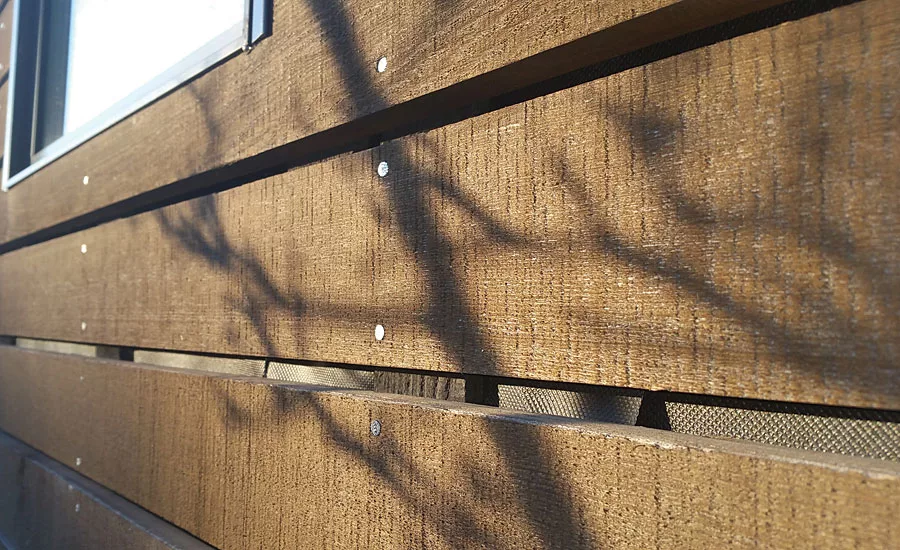
This image illustrates an open jointed cladding system with self-adhering flashing fully exposed to UV (not a warrantable installation) and open laps in the weather resistant barrier (now the primary line of defense) allowing water penetration.

rainscreening systems

This is an example of the high number of joints and openings commonly incorporated into an open joint cladding system. AAMA 509 requires only two joints for the mockup, which is often not representational of the designed assembly.
rainscreening systems

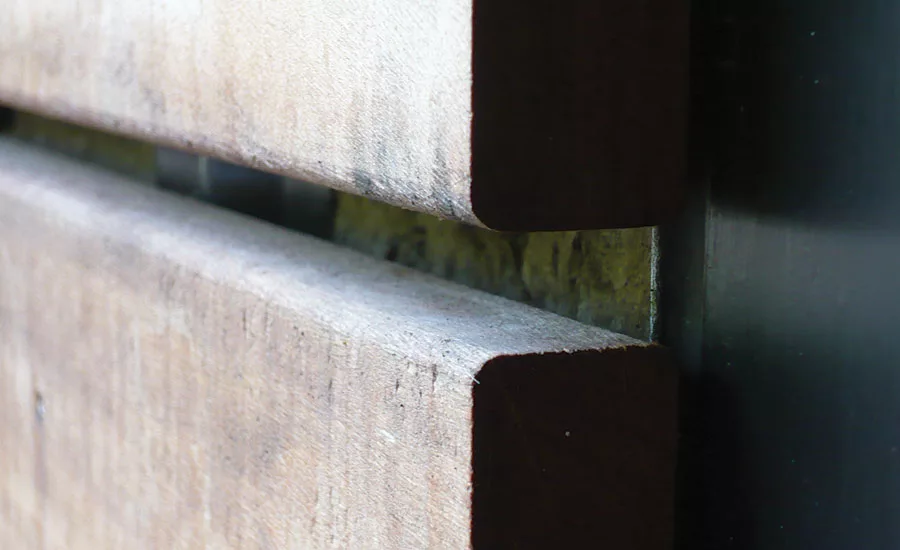
An example of an open joint cladding showing fully exposed mineral fiber continuous insulation which absorbs and holds water it collects long after being wetted.

rainscreening systems
March 1, 2016

Rainscreen is perhaps one of the most misunderstood and misapplied terms in use among design professionals and building product manufacturers today. This has led to a wide range of inexact theories about what a rainscreen is, how it performs, what it looks like, and under what circumstances it is used. Disregarding a decades-long accumulation of evidence and knowledge, an emerging trend is developing in which people believe it is perfectly acceptable to generously perforate a building’s exterior cladding without concern about the inevitable consequence of water penetration in doing so. By simply labeling these claddings as rainscreens, many are satisfied that everything is hunky dory. 

Rainscreen means different things to different people. To many design professionals, it is synonymous with a state-of-the-art cladding system that does all things well under any circumstance, and looks cool. To product manufacturers, the term is used as a marketing strategy to increase sales—the mere mention of the term in product literature provides a sense of security designers are looking for when considering a rainscreen. To building envelope consultants, the term is closely linked with job security, as in, “you can pay me now to help design this correctly, or you can pay me later when leaks develop.” 

The Force

Arguably, the first occurrence of the term rainscreen appeared in a 1963 Canadian Building Digest(CBD-40) paper Rain Penetration and its Control by C.K. Garden:

“In essence the outer layer [cladding] is then an open rainscreen that prevents wetting of the actual wall or air barrier of the building.”

In this groundbreaking paper, Garden thoroughly and succinctly introduces the fundamentals of the “rainscreen principle,” which defines a complete exterior wall assembly that when designed and installed correctly, and this bears repeating, “prevents wetting of the actual wall or air barrier of the building.” This critically important feature of rainscreen claddings is, as of late, been dismissed by architects and manufacturers alike. 

Another Canadian article, Facts and Fictions of Rain-Screen Wallsby M.Z. Rousseau published in 1990, supports and expands upon Gardner’s work. Rousseau writes about the confusion among builders, architects, and engineers with regard to rainscreen walls and emphasizes that, to be considered a rainscreen, a cladding must be, “…designed and built according to what Kirby Garden referred to as the “open rain-screen principle,” whose basic premise is the control of all forces that can carry rain to the inside.” 

The forces Rousseau refers to are: Gravity, Surface Tension, Capillarity, Kinetic Energy, and Pressure Differences. 

In what is perhaps a misinterpretation of Garden’s term open rainscreen, a proliferation of “open joint” cladding systems are being wrapped around buildings in just about every major U.S. city. However, open joint claddings are very different from what Gardner and Rousseau describe, and fall well short of meeting performance requirements of the rainscreen principle. In most cases, open joint cladding systems allow unimpeded water and snow entry into the wall assembly, through the joints and holes deliberately created, wetting the backside of the cladding material, the air/weather barrier, and everything in between.

Understanding the System

In a 2006 AIA Best Practices paper The Rain Screen Principle, authors Michael J. Lough and David Altenhofen point out that open jointed systems are not claddings at all, and define them instead as “Grilled/Lattice Barriers,” along with the following caution:

“Don’t be fooled into thinking that all open joint multiple element systems are rainscreens; some are barely multiple element systems at all. An open joint cladding system which allows UV penetration and has a quasi-cavity is almost a face-sealed system in disguise.”

The authors point out that open joint claddings have no ability to resist all of the forces required to prevent water from entering a building. By poking holes in the cladding, the first line of defense has been eliminated, and what was previously the second line of defense—air/water barrier—now becomes the first, and only, line of defense against water penetration. This is known as a face sealed cladding, and is appropriately used only in the driest of U.S. climates. 

In his 2004 technical paper RR-0406, Building Scientist Joe Lstiburek introduced a cladding system U.S. map/chart to help designers select the most appropriate cladding depending on annual precipitation. The chart includes four distinct cladding systems, each with characteristics suited for different moisture loading. Of these four cladding systems, all except face sealed must be designed in accordance with Garden’s rainscreen principle in order to provide adequate moisture protection. The systems and corresponding precipitation are as follows:

  • Pressure Equalized/Pressure Moderated: Greater than 60 inches. 
  • Drained and Back Ventilated: 40-60 inches.
  • Drainage Plane/Drainage Space: 20-40 inches.
  • Face Sealed: Less than 20 inches.

With rainscreen and open joint claddings being misunderstand and misapplied, there have to be cladding system test standards to have effective systems. Part two of this article, to be featured in the April 2016 issue, will further discuss these necessary test standards. 

KEYWORDS: energy efficiency green building rainscreen sustainability waterproofing

Share This Story

Looking for a reprint of this article?
From high-res PDFs to custom plaques, order your copy today!

Chris Dixon is a registered architect, Certified Construction Specifier, and LEED AP. He serves on GBI's Green Globes Technical Committee and is a former USGBC Materials and Resources Technical Advisory Group member.

Recommended Content

JOIN TODAY
To unlock your recommendations.

Already have an account? Sign In

  • Abercrombie & Fitch

    EIFS in 2026: How Specialty Finishes Are Redefining Exterior Wall Systems

    As building codes, owner expectations, and design demands...
    Stucco/EIFS
    By: Regi Mendoza
  • proper air and vapor control

    From Energy Efficiency to Moisture Management: Why Air and Vapor Control Matter

    How proper air and vapor control within building...
    Building Envelope
    By: Benjamin Meyer AIA, LEED AP
  • Linear Metal Ceiling Beam Baffles

    Top 25 Ceiling Contractors of 2026

    Suspended ceilings demand precision, code compliance and...
    Ceilings
    By: John Wyatt and Tanja Kern
You must login or register in order to post a comment.

Report Abusive Comment

Manage My Account
  • eMagazine Subscription
  • Newsletters
  • Online Registration
  • Manage My Preferences
  • Subscription Customer Service

More Videos

Sponsored Content

Sponsored Content is a special paid section where industry companies provide high quality, objective, non-commercial content around topics of interest to the Walls & Ceilings audience. All Sponsored Content is supplied by the advertising company and any opinions expressed in this article are those of the author and not necessarily reflect the views of Walls & Ceilings or its parent company, BNP Media. Interested in participating in our Sponsored Content section? Contact your local rep!

close
  • medical professionals moving a patient on a stretcher through the halls of a medical building
    Sponsored byNational Gypsum Company

    What Does High Performance Mean When It Comes To Gypsum Boards?

Popular Stories

drywall contractor sanding ceiling

D.C. Drywall Contractors to Pay $302K in Worker Case

Wichita Biomedical Campus

Wichita Drywall Worker Dies After Scaffolding Fall

Okan Tower in Miami, Florida

OSHA Opens Investigation Into Fatal Okan Tower Column Collapse

Construction workers in safety vests install drywall

Gypsum Sales Hold Amid Market Shifts in the U.S.

Events

January 1, 2030

Webinar Sponsorship Information

For webinar sponsorship information, visit www.bnpevents.com/webinars or email webinars@bnpmedia.com.

See our full library of webinars

View All Submit An Event

Products

2026 National Painting Cost Estimator

2026 National Painting Cost Estimator

See More Products

Related Articles

  • rainscreens

    How Much Rain Does a Rainscreen Screen? (Part 2)

    See More
  • building restoration

    How Much Restoration Does Your Building Need?

    See More
  • Layers of exterior cladding

    What to Consider When Selecting a Rainscreen

    See More

Related Products

See More Products
  • business.png

    How to Succeed With Your Own Construction Business

  • bim 3e.jpg

    BIM Handbook: A Guide to Building Information Modeling for Owners, Designers, Engineers, Contractors, and Facility Managers, 3rd Edition

  • revisited.png

    Markup & Profit: A Contractor's Guide Revisited

See More Products

Events

View AllSubmit An Event
  • November 5, 2025

    RAiNA Conference 2025: Rainscreen Proficiency – The Parts, Precision and Performance

    If you’re passionate about the future of sustainable architecture and resilient construction, the RAiNA Conference 2025: Rainscreen Proficiency – The Parts, Precision and Performance is a must-attend event. This conference offers a unique opportunity to hear from top industry experts about the crucial role of rainscreens in modern construction. Attendees have the opportunity to be among the first to learn about pioneering ideas and groundbreaking projects, keeping them at the forefront of their field.
View AllSubmit An Event

Related Directories

  • RAiNA (Rainscreen Association in North America)

    Rainscreen Association in North America (RAiNA) is the leading authority on proper rainscreen design and construction. RAiNA is a diverse community of industry professionals who volunteer their time towards optimizing rainscreen performance expectations among a variety of stakeholders. They achieve this by influencing codes and standards, while increasing the safety and resilience for rainscreen assemblies and components
×

Connect with the industry’s leading resource for unparalleled insights and education.

Join thousands of industry professionals today. Shouldn’t you know what they know?

JOIN NOW
  • RESOURCES
    • Advertise
    • Contact Us
    • Directories
    • Store
    • Want More
  • SIGN UP TODAY
    • Create Account
    • eMagazine
    • Newsletters
    • Customer Service
    • Manage Preferences
  • SERVICES
    • Marketing Services
    • Reprints
    • Market Research
    • List Rental
    • Survey/Respondent Access
  • STAY CONNECTED
    • LinkedIn
    • Facebook
    • Instagram
    • YouTube
    • X
  • PRIVACY
    • PRIVACY POLICY
    • TERMS & CONDITIONS
    • DO NOT SELL MY PERSONAL INFORMATION
    • PRIVACY REQUEST
    • ACCESSIBILITY

Copyright ©2026. All Rights Reserved BNP Media, Inc. and BNP Media II, LLC.

Design, CMS, Hosting & Web Development :: ePublishing