Walls & Ceilings logo
search
cart
facebook twitter linkedin youtube youtube Spotify Podcasts Apple Podcasts Spotify Podcasts Apple Podcasts
  • Sign In
  • Create Account
  • Sign Out
  • My Account
Walls & Ceilings logo
  • NEWS
  • TOPICS
    • Drywall
    • Stucco/EIFS
    • Ceilings
    • Steel Framing
    • Fireproofing
    • Interior Plaster
    • Building Envelope
    • Insulation
    • Technology
    • Interior
    • Exterior
    • Women In Construction
  • COLUMNS
    • Up Front
    • All Things Gypsum
    • Art & Craft of Plastering
    • Stucco Stop
    • Steel Deal
    • Industry Voices
  • PRODUCTS
    • Buzz Guide
  • EVENTS
    • Industry Events
    • Webinars
    • BUILD Expo
  • MEDIA
    • Videos
    • Podcasts
    • Photo Galleries
    • BUILD26 Videos
    • Take our Quiz!
    • Infographics
  • EXCLUSIVE
    • Newsletters
    • Top 50 Contractors
    • Contractor of the Year
    • State of the Industry
    • W&C Store
    • Market Research
    • CEUs
    • Sponsor Insights
    • Custom Content & Marketing Services
  • DIRECTORY
  • EMAGAZINE
    • eMagazine
    • Advertise
    • Archive Issues
  • SIGN UP!
ColumnsBuilding EnvelopeExterior

How Much Rain Does a Rainscreen Screen? (Part 2)
By Chris Dixon
rainscreens

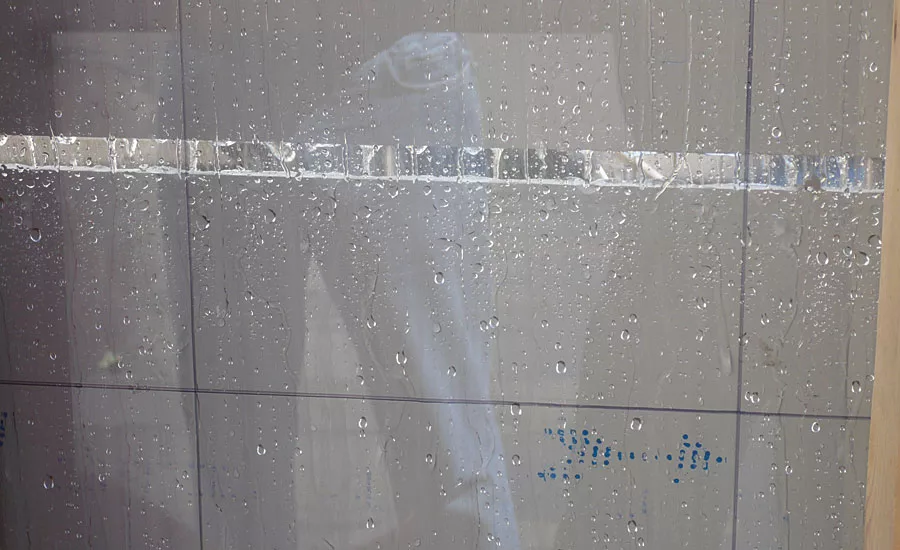
Open joint cladding mockup during AAMA 509 testing. Note the large amount of water accumulating and passing through the joint, depositing onto the air/water barrier represented by the clear plastic barrier.
rainscreens

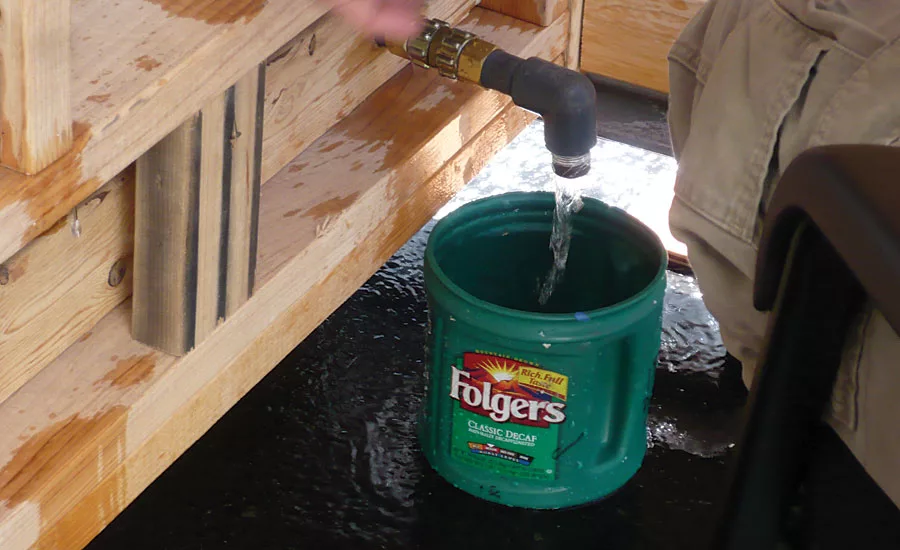
Open joint cladding mockup water collection during the AAMA 509 water penetration test. The water entering the bucket represents what has passed the joints, hit the air/water barrier, and collected in a trough at the bottom sill. The bucket was filled multiple times during the test.
rainscreens

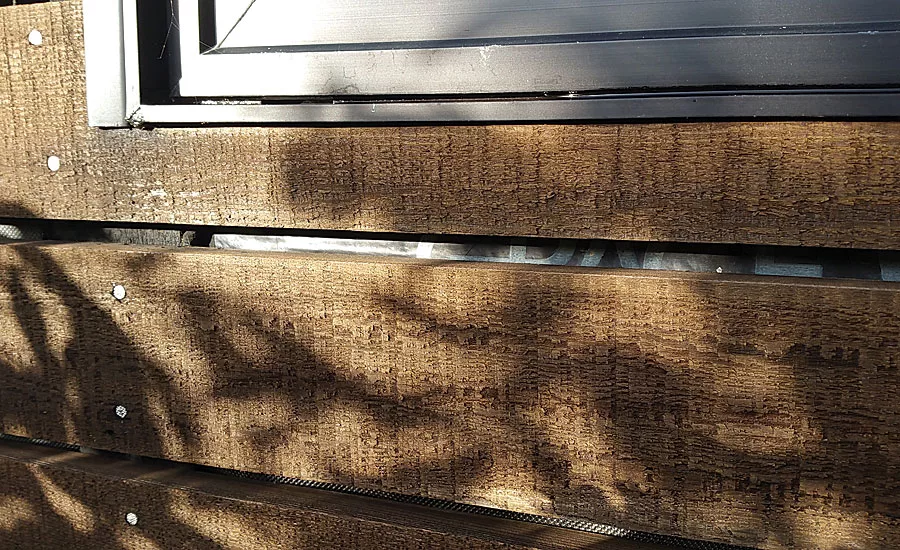
This images illustrate an open jointed cladding system with self-adhering flashing fully exposed to UV (not a warrantable installation) and open laps in the weather resistant barrier (now the primary line of defense) allowing water penetration.

rainscreens
rainscreens
rainscreens
April 1, 2016

Click here to read part 1: How Much Rain does a Rainscreen Screen?

In 2005 and 2009, respectively, the American Aluminum Manufacturer’s Association published test standards AAMA 508 and AAMA 509 for use in determining the performance of cladding systems designed to the rainscreen principle. Without laboratory testing to one of these standards, design professionals and owners are left to rely upon best guesses as to how each will actually perform. Cladding manufacturers and fabricators are beginning to test their systems to these standards, and requirements for this testing are beginning to find their way into designers’ construction documents as well.

There’s a Test for That

In an attempt to put to rest the misconception among design professionals and manufacturers that open jointed claddings adequately protect buildings from moisture, I enlisted the help of a local cladding fabricator and a local testing facility to test one in accordance with AAMA 509, Test and Classification Method for Drained and Back Ventilated Rainscreen Wall Cladding Systems.

The standard requires an 8-foot by 8-foot mockup with at least one vertical and one horizontal joint. I had the mockup built with two horizontal joints to more closely approximate the overabundance of joints typically designed into these systems. The AAMA 509 test is a dynamic water penetration test, which means that air pressure differential is simulated using a large fan/propeller facing the mockup. A spray rack is mounted between the fan/propeller and the mockup to simulate precipitation. AAMA 509 is not a pass/fail test, it is simply a method to observe and quantify the amount of water that gets past the cladding and is deposited on the air/water barrier as well as how much ventilation is provided. Laboratory results for this test are indicated in a chart showing the amount of ventilation and water collected. The highest performing claddings will show good ventilation and very little water contacting the air/water barrier.

A Ticking Time Bomb

The open joint cladding mock-up used in the 15-minute test period allowed an excessive amount of water through the joints. The small bucket used to collect water that was hitting the air/water barrier also filled quickly—many times—and a rate of water penetration was calculated to determining the total amount. Most cladding systems tested to AAMA 509 do not even fill one bucket. 

Because there are so many variations in cladding types, wall assemblies, building configuration and orientation, it is impossible to make a generalization that all open joint cladding systems will leak. There are several factors that influence whether or not an open joint cladding will allow moisture into a building, no matter how much annual precipitation there might be. A few of the most influential are:

Building Height: The higher the building, the greater the pressure difference driving rain into the cladding.

Overhangs: Even small overhangs provide substantial protection against wetting of the cladding; the deeper the overhang or recess, the greater the protection.

Building Orientation: In every geographic region, wind driven precipitation is predominate in a particular direction, the intensity and direction often changing with the season.

Backup Wall Assembly: Stud walls have very little ability to deal with added moisture, whereas mass walls such as concrete and fully grouted masonry can be exposed to moisture without consequence.

Keeping with Tradition

It is safe to say that fully exposed open joint cladding systems subject to the brunt of wind driven precipitation, in all but the driest of climates, will eventually allow moisture into the building. 

These systems are already being remediated by envelope consultants retained by owners to correct the problem. Using an open jointed cladding on a building in rainy climates presents greater risk than a more traditional cladding. In a 2011 RCI symposium paper, Design Considerations for Open-Joint Rainscreen Cladding Systems by Stephane Hoffman and Jose Estada, the authors conclude that, “Current building science theory suggests that best practice when designing and constructing a rainscreen assembly is to install a traditional closed-joint system… Until further research and observation are done on a greater sampling of these cladding systems to understand their limitations, it is a good approach to consider designing them to incorporate the same characteristics of the better-understood typical rainscreen.”

The authors also offer that when a “true (non-simulated) open-joint cladding is preferred,” incorporating an additional water shedding membrane to serve as the primary line of defense may result in a system that performs as a tried-and-true rainscreen assembly. There are products on the market available for this purpose, but here again; this material must be implemented in full accordance with the rainscreen principle as the primary line of defense to ensure satisfactory performance. 

KEYWORDS: energy efficiency green building rainscreen sustainability waterproofing

Share This Story

Looking for a reprint of this article?
From high-res PDFs to custom plaques, order your copy today!

Chris Dixon is a registered architect, Certified Construction Specifier, and LEED AP. He serves on GBI's Green Globes Technical Committee and is a former USGBC Materials and Resources Technical Advisory Group member.

Recommended Content

JOIN TODAY
To unlock your recommendations.

Already have an account? Sign In

  • Abercrombie & Fitch

    EIFS in 2026: How Specialty Finishes Are Redefining Exterior Wall Systems

    As building codes, owner expectations, and design demands...
    Stucco/EIFS
    By: Regi Mendoza
  • proper air and vapor control

    From Energy Efficiency to Moisture Management: Why Air and Vapor Control Matter

    How proper air and vapor control within building...
    Building Envelope
    By: Benjamin Meyer AIA, LEED AP
  • Linear Metal Ceiling Beam Baffles

    Top 25 Ceiling Contractors of 2026

    Suspended ceilings demand precision, code compliance and...
    Ceilings
    By: John Wyatt and Tanja Kern
You must login or register in order to post a comment.

Report Abusive Comment

Manage My Account
  • eMagazine Subscription
  • Newsletters
  • Online Registration
  • Manage My Preferences
  • Subscription Customer Service

More Videos

Sponsored Content

Sponsored Content is a special paid section where industry companies provide high quality, objective, non-commercial content around topics of interest to the Walls & Ceilings audience. All Sponsored Content is supplied by the advertising company and any opinions expressed in this article are those of the author and not necessarily reflect the views of Walls & Ceilings or its parent company, BNP Media. Interested in participating in our Sponsored Content section? Contact your local rep!

close
  • medical professionals moving a patient on a stretcher through the halls of a medical building
    Sponsored byNational Gypsum Company

    What Does High Performance Mean When It Comes To Gypsum Boards?

Popular Stories

drywall contractor sanding ceiling

D.C. Drywall Contractors to Pay $302K in Worker Case

Wichita Biomedical Campus

Wichita Drywall Worker Dies After Scaffolding Fall

Okan Tower in Miami, Florida

OSHA Opens Investigation Into Fatal Okan Tower Column Collapse

Construction workers in safety vests install drywall

Gypsum Sales Hold Amid Market Shifts in the U.S.

Events

January 1, 2030

Webinar Sponsorship Information

For webinar sponsorship information, visit www.bnpevents.com/webinars or email webinars@bnpmedia.com.

See our full library of webinars

View All Submit An Event

Products

2026 National Painting Cost Estimator

2026 National Painting Cost Estimator

See More Products

Related Articles

  • rainscreening systems

    How Much Rain does a Rainscreen Screen?

    See More
  • building restoration

    How Much Restoration Does Your Building Need?

    See More
  • Environmental Product Declarations–The New Benchmark? (Part 2)

    See More

Related Products

See More Products
  • business.png

    How to Succeed With Your Own Construction Business

  • bim 3e.jpg

    BIM Handbook: A Guide to Building Information Modeling for Owners, Designers, Engineers, Contractors, and Facility Managers, 3rd Edition

  • revisited.png

    Markup & Profit: A Contractor's Guide Revisited

See More Products

Events

View AllSubmit An Event
  • November 5, 2025

    RAiNA Conference 2025: Rainscreen Proficiency – The Parts, Precision and Performance

    If you’re passionate about the future of sustainable architecture and resilient construction, the RAiNA Conference 2025: Rainscreen Proficiency – The Parts, Precision and Performance is a must-attend event. This conference offers a unique opportunity to hear from top industry experts about the crucial role of rainscreens in modern construction. Attendees have the opportunity to be among the first to learn about pioneering ideas and groundbreaking projects, keeping them at the forefront of their field.
View AllSubmit An Event

Related Directories

  • RAiNA (Rainscreen Association in North America)

    Rainscreen Association in North America (RAiNA) is the leading authority on proper rainscreen design and construction. RAiNA is a diverse community of industry professionals who volunteer their time towards optimizing rainscreen performance expectations among a variety of stakeholders. They achieve this by influencing codes and standards, while increasing the safety and resilience for rainscreen assemblies and components
×

Connect with the industry’s leading resource for unparalleled insights and education.

Join thousands of industry professionals today. Shouldn’t you know what they know?

JOIN NOW
  • RESOURCES
    • Advertise
    • Contact Us
    • Directories
    • Store
    • Want More
  • SIGN UP TODAY
    • Create Account
    • eMagazine
    • Newsletters
    • Customer Service
    • Manage Preferences
  • SERVICES
    • Marketing Services
    • Reprints
    • Market Research
    • List Rental
    • Survey/Respondent Access
  • STAY CONNECTED
    • LinkedIn
    • Facebook
    • Instagram
    • YouTube
    • X
  • PRIVACY
    • PRIVACY POLICY
    • TERMS & CONDITIONS
    • DO NOT SELL MY PERSONAL INFORMATION
    • PRIVACY REQUEST
    • ACCESSIBILITY

Copyright ©2026. All Rights Reserved BNP Media, Inc. and BNP Media II, LLC.

Design, CMS, Hosting & Web Development :: ePublishing