How to Get the Most Out of Direct Fastening
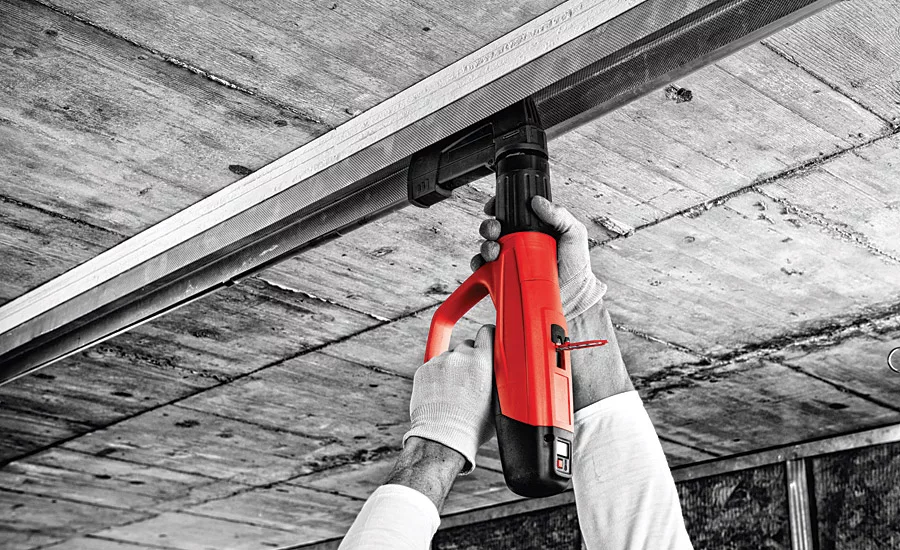
Direct fastening technology is a technique in which materials are attached to steel, concrete or masonry by use of a tool driving special hardened nails or studs. Materials to be attached include steel, wood, insulation and some kinds of plastic. Fastener driving power is generated by a powder load (a cartridge containing combustible propellant powder, also known as a booster), combustible gas, compressed air or, most recently, electric power provide by a rechargeable battery.
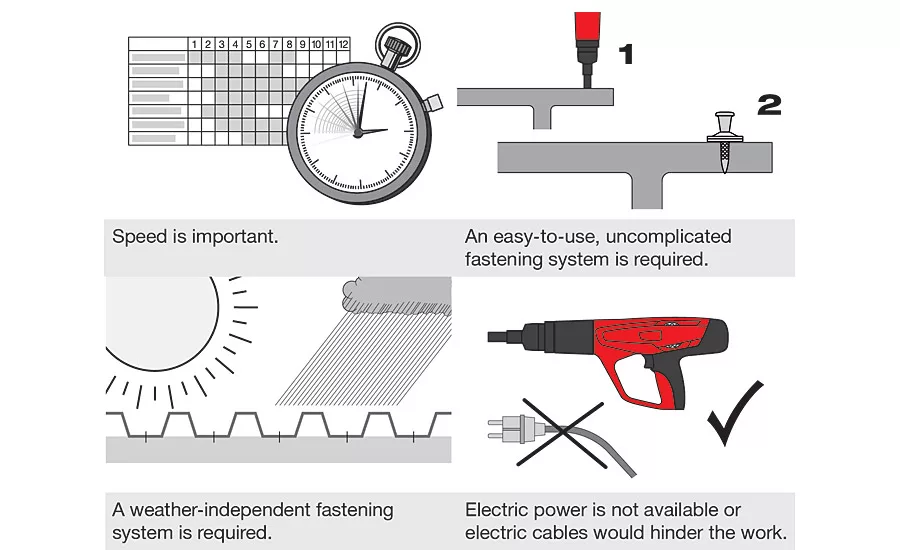
When used appropriately, direct fastening methods can increase the productivity by a factor of as much as five times depending on the alternative method used and the type of application. The alternative methods can be drilling and anchoring, screw fastening, welding, clamping, etc. For drywall contractors, the following applications are generally well-suited for direct fastening methods (subject to local code approvals).
- Deflection clips for curtain wall attachments
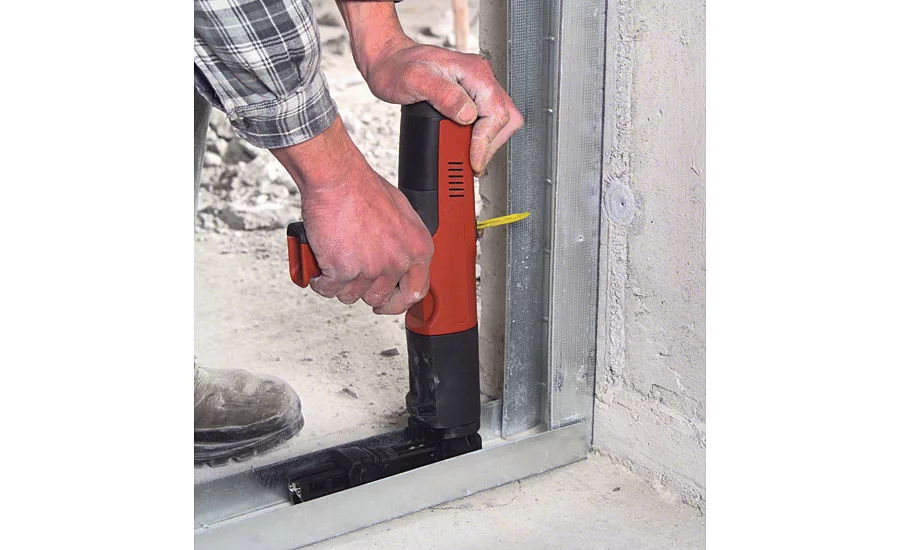
- Perimeter track fastening to the building structure
- Interior track fastening to the building structure
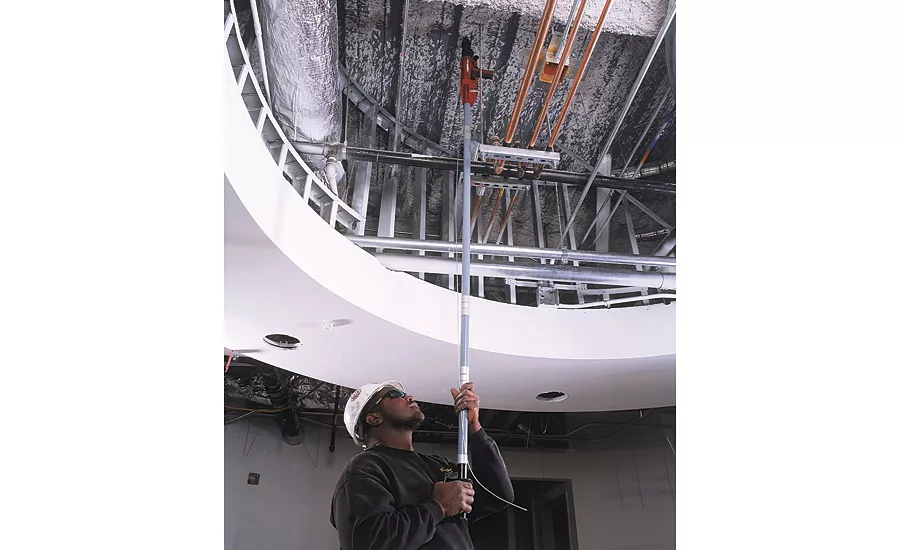
- Suspended ceilings
Important factors to consider in order to get the most out of direct fastening methods include training and safety, tool and fastener selection and proper installation.
Training and Safety
In the United States, powder-actuated tools used in construction work are governed by 29 CFR 1926.302(e) which requires: “Only employees who have been trained in the operation of the particular tool in use shall be allowed to operate a powder-actuated tool.” Operators must be trained on each model of powder-actuated tool they use. While there is no specific Federal or State OSHA training regulation for gas-actuated tools and battery-actuated tools, training is never-the-less good practice, and is some cases may be required by employers or project rules.
Operator training is typically offered by the tool manufacturer. These companies recognize the need for operator training and work to provide a convenient training service for their customers. Training services can be in the form of a face-to-face meeting whereby a manufacturer’s representative comes to a designated office or construction site upon request to conduct the training. There are companies that even go so far as to train designated personnel at a construction company to train their own employees on the safe operation of that manufacturer’s direct fastening tool. In some cases, direct fastening operator training can be found on the manufacturer’s website.
Select the Right Tool and Fastener
Contractors wanting to use direct fastening methods have a wide array of tools and fasteners to meet their financial and application needs. Tools available from different manufacturers can be divided into the following categories.
Powder-actuated Tools
Use powder load blank cartridges (typically .27 caliber) to drive a fastener:
Single shot: Load one fastener and one cartridge at a time (low production applications).
Semi-automatic: Manual cycling of the tool is required to reset the drive piston and advance a cartridge strip of 10 (medium setting volume applications). Some models are available with a fastener magazine as well, eliminating the need for loading individual fasteners.
Full-automatic: No manual cycling required. Cartridge advance and piston reset is accomplished without any manual cycling of the tool (high volume applications). As with semi-automatic, some models have a fastener magazine option.
Benefits
Versatility: Widest range of nail lengths to attach either 2x4 or drywall track material to concrete or steel. Typically the highest published load capacity.
Power: The highest driving energy direct-fastening system. Varying power levels allows the operator to dial in the application for the proper fastener setting into all but the highest-strength steel, poured concrete or concrete block.
Portable: No external power supply or equipment required.
Gas-actuated tools
Uses a self-contained canister of combustible gas such as propane to provide the energy for driving the fastener.
High capacity magazine holding up to 40 fasteners.
Nail lengths to attach thin materials such as drywall track or a 1x4 to concrete and some steel.
Full automatic operation—no manual cycling required.
Benefits
Productive: High capacity magazine and gas cartridge requiring less reloading for high volume repetitive fastenings.
Low maintenance: Very little cleaning required.
Portable: No external power supply or equipment required.
Pneumatic tools:
These tools use compressed air to provide energy for driving the fastener. While pneumatic tools are fairly common on many construction sites, models capable of fastening to steel and concrete are typically larger and require higher pressure than their wood-to-wood cousins.
High capacity nail magazine can hold up to 100 fasteners.
Nail lengths for thin materials such as drywall track to concrete and some steel.
Benefits
Productive: Less reloading than other types of fastening tools.
Battery-actuated tools:
Power source is an 18v rechargeable battery.
High capacity magazine holds up to 20 fasteners.
Rechargeable battery lasts up to 750 fastenings between charges.
Nail lengths to attach thin materials such as drywall track or a 1-by-4 to concrete and some steel.
Benefits
Productive: High capacity magazine requiring less reloading for repetitive fastenings.
Low Maintenance: Very little cleaning required.
18v rechargeable battery: No propellants. No hazardous material disposal concerns.
Quiet: Can be used in most areas where noise is a factor.
Selection of proper fasteners is determined by the application. In many cases, design requirements and/or building codes will dictate criteria that narrow the selection, such as fastener embedment (e.g. 1-inch in concrete, 1/2-inch embedment in steel), diameter of the fastener, load capacity in shear and tension, and/or corrosion resistance.
Job site conditions can drive selection of the tool and type of power required. On some projects, contractors come across very hard steel or very hard concrete due to the age of the building and/or type of aggregate used. In such conditions, contractors may have to use a tool with higher power and adjust the power setting as necessary. Always conduct test fastenings at the job site to ensure the selected system can be successfully installed.
Proper Installation is Key
Another important factor is on-site personnel need to pay close attention to proper fastener installation. This is critical for a safe environment and to realize full productivity benefits of direct fastenings and minimize re-work. The use of fastening systems for which the manufacturer provides application guidelines and a technical advisory service helps ensure that designers select proper solutions, and installers are aware of how to use the system properly.
When used correctly, direct fastening methods can significantly improve productivity on a job site for drywall contractors. Owners, project managers and superintendents should pay special attention to training and safety, application specifications and selection of proper fastener and tool for correct installation to ensure that the work performed meets or exceeds the requirements outlined in specifications or by building code. When in doubt, contractors should consult with representatives of manufacturers of direct fastening tools and fastener
Looking for a reprint of this article?
From high-res PDFs to custom plaques, order your copy today!