Acoustic Metamaterials
The Cloaked Room
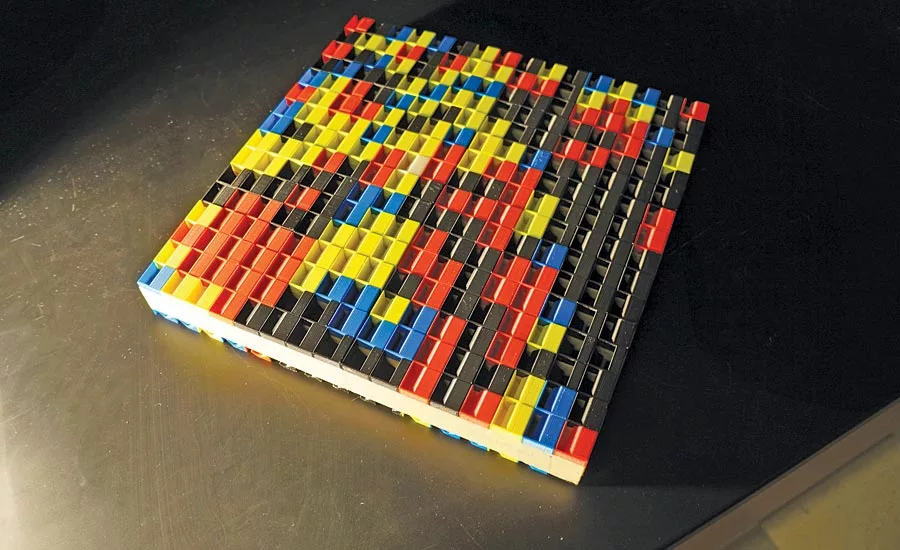
A close up look at the metamaterial device that can create acoustic holograms. Each grid or block contains a spiral of one of 12 various densities, each of which slows sound waves by a specific amount. Photo courtesy of Abel Xie and Steve Cummer, Duke University.
In 2010, researchers at the University of Illinois in Champaign demonstrated the first broadband acoustic cloaking device. Basically a doughnut of acoustic metamaterial, the device caused a steel cylinder and other small objects placed in the center to fade from the view of a sonar scan.
Besides the promise of attaining invisibility and other strange effects, this demonstration—although too small to be of practical use—has exploded the research interest in developing practical acoustic metamaterials. Since 2008, the U.S. Navy has awarded $2.5 million in Small Business Innovation Research grants to Acentech Inc., Physical Optics Corp., Weidlinger Associates Inc., CFD Research Corp., Triton Systems Inc., Sensormetrix, and Eclipse Energy Systems Inc., for the development of acoustic metamaterials.
Presently, the funded research has the goal of producing a torpedo-sized cloaking device. Since acoustic metamaterial development is getting a lot of funding and research, I’m guessing it won’t be long before there are products on the market claiming to use this new technology to achieve unusually high acoustic performance. To prepare for that onslaught, here is a basic introduction to what acoustic metamaterials are, how they work, and where they might benefit the industry.
What is an Acoustic Metamaterial?
Back in 1968, Russian physicist Victor Veselago was playing around with wave equations and wondering what would happen if certain properties/values were negative. Sound equations are little more than those which describe the back-and-forth motion of a child on a swing. Making one term negative would be the same as turning the swing upside down; it would flop to one side and stay there. Making the second term negative would be the same as replacing the child with helium balloons; the swing would move to one side and stay there. But making both terms negative turns the swing into a helium balloon on a string; it oscillates, but upside down. This meaning* that if a material could be developed with one of its properties negative, it would be a perfect barrier, not allowing any wave to pass through it.
As exciting a possibility as this is, the discovery of a material with both properties negative would allow sound and even light to be bent around objects, causing them to become invisible. Since then, similar to the alchemists’ search for the philosopher’s stone that can turn lead into gold, material scientists have been searching for these negative term materials that can turn items invisible and that possess other fantastic properties.
In 1999, with double negative materials still on the horizon, Rodger Walser of the University of Texas in Austin realized the next best thing might be to develop materials that act as though they have negative terms. This could be accomplished by what he termed “metamaterials,” constructed like block fortresses, each block only 1/100 to 1/4 inch in size, stacked side by side, course over course and as deep as needed. Each cell would be engineered as a self-contained miniature communication center to receive sound waves from adjoining blocks, make modifications and then transmit the changed sound waves to adjacent cells. If you think this analogy of a mini-communication center sounds crazy, Boeing owns the patent for this literal description of metamaterial (U.S. Patent 9,525,944) in which each cell contains actual microphones, electronic audio equipment, speakers and transmitting networks connecting the entire matrix.
State of the Art
Rather than use embedded electronics to make the metamaterial concept work, other metamaterial architectures have been developed that use miniature structures, perforations, tuned cavities and ducts to selectively modify sound and vibration. Methods of manufacturing metamaterials include 3-D printing, lamination and aggregate composite.
The ability of 3-D printing to construct objects as layers matrices comprised of individually defined cells makes additive manufacturing a favorite among metamaterial researchers. Precise control of the cell geometry is needed to create the precise acoustic effects.
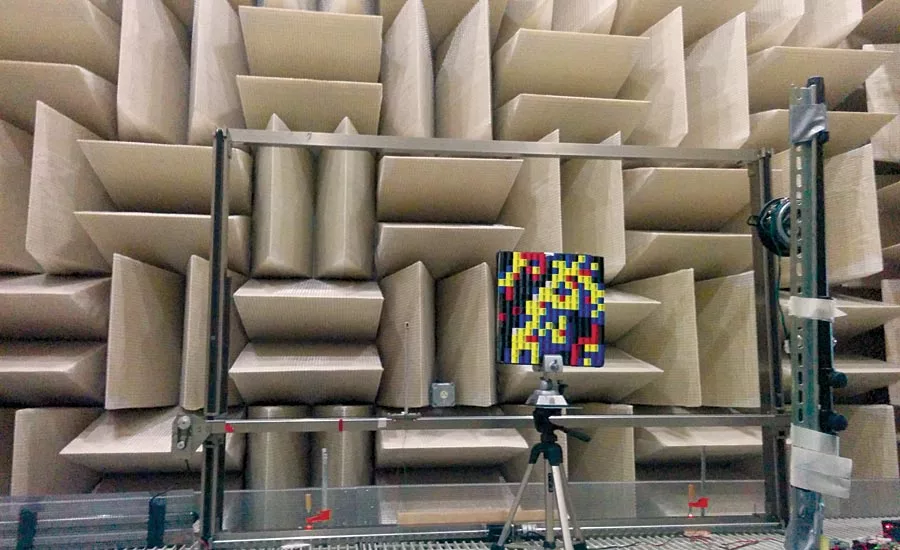
Additive manufacturing was used by the University of Illinois team to create its 2010 acoustic cloak. Researchers at Duke University’s Center of Metamaterials and Integrated Plasmonics used 3-D printing in 2014 to create the world’s first three-dimensional cloak, which hides objects from detection from any angle. Then in 2016, Duke University’s Pratt School of Engineering researchers used 3-D printing to create a metamaterial panel encoded with a simple acoustic hologram.
If the desired metamaterial properties are grouped by layers, then lamination is a natural method of construction. In U.S. Patent 9,390,702, Acoustic Metamaterials, Inc., of New York describes their microperf absorber as a laminated metamaterial.
For metamaterials only requiring one or two different types of cells, the aggregate composite method of construction makes sense. Typically, the aggregate in these structures are metal microspheres that have an outer coating of rubber. Just as gravel is added to cement to make concrete, these microspheres can be added to binders such as gypsum and hardened to form a semi crystalline structure having unique properties. The U.S. Navy is developing this manufacturing method to create metamaterials that can absorb explosive shock.
Acoustic Metamaterials in Your Future
Although the cloaked room may be far in the future, acoustic metamaterials are poised to make some small improvements within the wall and ceiling industry:
- Improved sound isolation of gyp board: The sound isolation of typical walls and ceiling construction could be improved by 5 dB or more, if not for the coincidence dip of gyp board. This problem could be solved through metamaterial design and lamination or aggregate composite manufacturing of new gyp board types.
- Hearing protection: Hearing protectors can be designed as low pass filters, allowing normal conversation between workers while blocking loud, high frequency noise.
- Acoustic clouds: Acoustic clouds hung from the ceilings of auditoriums may be designed to reflect sound in any desired direction regardless of their angle, even allowing the ceiling to remain flat if desired.
- Acoustic imaging (hologram): Acoustic holograms may be encoded into room panels, making the room sound like some other space.
- Precise diffraction: Panels can be designed to either increase or reduce scattering cross section for all directions of incident sound. The limit to scattering reduction leads to acoustic cloaking.
- One-way acoustic mirrors: Surfaces may be designed to let noise out of a room while blocking noise from entering.
Presently there are nearly 500 patents and applications for acoustic metamaterials for architectural use. A large portion of these do not jive with the laws of physics (cell dimensions are too large compared with the wavelengths involved) or are already well known methods re-couched in the language of metamaterials.
Although we may start to see construction materials marketed as acoustic metamaterials before we see viable ones, there are some hard problems still to solve. Most of the desirable effects of the present acoustic metamaterials only occur at narrow, high frequencies. Methods of providing broadband response within the human hearing range are needed. The desired acoustic effects are demonstrated, but not of the quality needed for the building consumer/user. And finally, the methods of construction must be translated into those that can turn the products into mass-produced commodities.
Duke University researchers used 3-D printing to create a metamaterial panel encoded with a simple acoustic hologram.
Looking for a reprint of this article?
From high-res PDFs to custom plaques, order your copy today!