One Coat and Three Coat Stucco

In the April Issue, I cited a trend by regaling a tale-of-woes-begotten for an unfortunate group of gorillas who were hosed. Through their learned behavior, which was passed along to the next group, the metaphorical hosing continued. Remember when you played “telephone (or telegraph)” where the first person in a line or circle of participants whispered a phrase into the next person’s ear who then repeated what they heard into the next person’s ear and so on until the last person said aloud what they had heard? I suppose some of the participants may have purposely changed a word or two but we definitely did have some laughs at the final phrase. The whole point is to show how we each pass along our understandings of learned information. I offer that we tend to “improve” the knowledge or processes we learn, and then pass them along as such, “improvements.” This begs the million-dollar question: what if you are wrong?
I witnessed a similar passing of knowledge in my local plastering industry, where we went through a genesis of sorts. The plastering industry of the past had a knowledgeable and highly skilled plastering workforce. The stucco world was three coat with EIFS just peeking its way in as a high-performance cladding. In fact, during the freshman years of the EIFS industry, only the “certified” applicators could apply it, of which most were union applicators. This was the era of a strong union market, where every person who was educated in their particular craft and further, was required to continue their education. Each person was trained, skilled and proud of it.
From 3 to 1
Then the erosion began where members retired, the market slowed down and some of the men were forced to pick up jobs in the non-union sector so they could feed their families. The knowledge they took with them then educated the non-union contractors who were consequently able to step into the bigger jobs because they now had a more educated work force. Because they could bid these larger jobs cheaper, it drove down the price normally charged by the union shops. Moreover, as we all know, once a price is dropped, it is almost impossible to get it back up.
Today, in areas like the four-corner states, there is little to no formal training available, at least not to the degree enjoyed by our fore-plasterers. Most of what is known is what has been passed on or brought in through practices done in other countries and at a lower price point. Most of the original skilled plasterers are either retired or writing columns in great magazines. I’m not judging here, just stating fact, as I know it.
So, all the rhetoric I just spewed out is leading to the subject of this month’s article: the application of one coat stucco.
One coat stucco is far from new as it was introduced in the 1970s as a fast and efficient cladding, a time saver to the three coat time constraints of a thirty-day start to finish. Personally, I like one coat and find it to be a durable and an efficient stucco cladding. During the early years, it was primarily targeted for the housing industry and rarely used on commercial buildings. Because we had the knowledgeable three coat plasterers eventually doing the new one coats, care was taken to apply it similar to a three-coat application. The stucco was applied to the nominal thickness and then it was hard floated, always. I remember there being wet curing people who did nothing else but follow the plaster crews and wet cure houses. The brown was allowed to cure for a couple of weeks and was then finished. One coat soon became popular and was naturally introduced into the commercial market. It is the go-to stucco cladding today.
Whatever Floats Your Boat
Like the gorillas and the game of telephone, the passage of stucco knowledge began to become diluted, passed as “because” without understanding “why.” Changes offered for the better processes that allowed for a faster, quicker and cheaper application. I was an unwitting part of this trend in the early ’80s when on a large two-story apartment complex; I was tasked as the “scarifier” guy.
On this particular project, our crew browned with one coat and instead of floating, I used an old scratch darby with scarifier scratchers fastened to it to make vertical groves in the freshly darbied mud. The next day we would throw a sideways lace over the scarified surface. It was fast and the cracks were all but invisible. On another project shortly after, I was introduced to a green sponge float.
On this project, the wall was darbied smooth and instead of hard floating, we were using green sponge floats to make a swirled sand look in the brown coat. The next day, we laced a texture over the swirls, again, fast and the cracks were barely noticeable. We did wet cure the two projects like normal although it was only the modification of the floating step that had changed. Since it was with one coat, there was no need to hard float on texture projects, only the sand finish projects. It wasn’t until I worked with my brother that we began to always hard-float one coat because he didn’t like green sponge floats.
News Travels Fast
Today there is an epidemic of sorts. The news was telling of massive lawsuits against failing stucco on housing tracts. News of soft one coat, cracked one coat, leaking one coat. One begins to wonder: Is it the one coat? Has the formulation changed to the point of it being an inferior product? Has downward pricing forced the manufacturers’ hand? Wonder no more, the answer is no!
The Blame Game
Here is what I have seen with today’s learned application process:
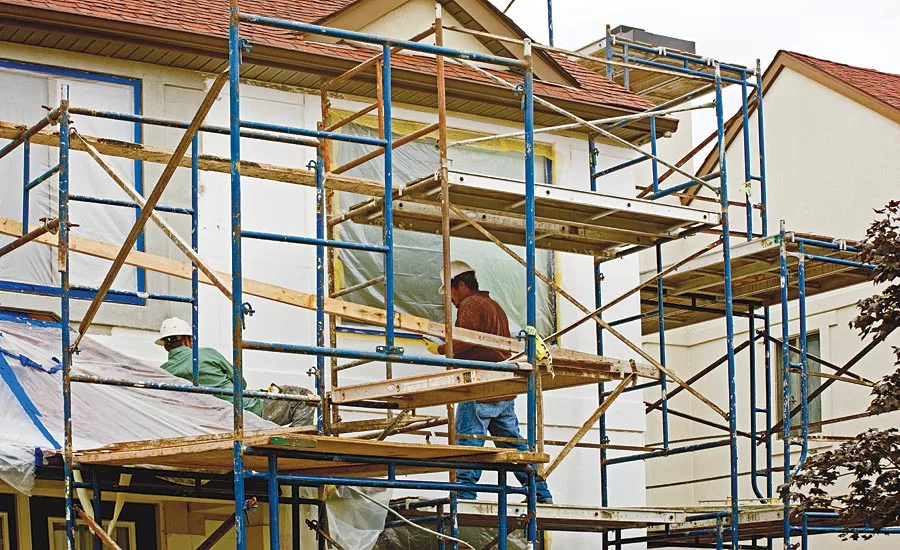
The stucco is applied to the wire lath, by either spraying or is laid on with a slicker (I hear rumors of stop signs being cut in half and used as slickers). Spraying is good but slickers don’t allow for proper embedment of the lath into the stucco. The brown coat is leveled off, sometimes with a darby and other times with large hand trowels. Immediately after, an “applicator” follows with a green sponge float and a bucket of water. The person dips the sponge float into the water and splashes water from the soaked float onto the wet one coat, then draws the float over the surface, smoothing it out and knocking down any lines or high spots. Brown coat done. The next day or so they texture and then have to wait seven days before the house can be painted. Notice I didn’t mention any wet curing?
Here is what happens to the stucco. Because it wasn’t allowed to hydrate before additional water was splashed on, the surface of the stucco is further weakened by dilution. There still exist tiny capillary tubes through the thickness of the stucco, which cannot be filled with the crystals formed during hydration. After the stucco dries and without further hydration (wet curing) the stucco cannot reach a proper densification or tensile strength. Bottom line is it’s soft and porous with a higher chance of cracking potential, and in all likelihood will remain that way.
The one coat manufacturers are being blamed for soft stucco and cracking, the paint manufacturers are being blamed for inferior paint, the acrylic manufacturers are being blamed for the finish not spanning over the cracks, the products are being blamed not the applicators. Where have we gone wrong? I know, let’s blame the gorillas.
Looking for a reprint of this article?
From high-res PDFs to custom plaques, order your copy today!



