Walls & Ceilings logo
search
cart
facebook twitter linkedin youtube youtube Spotify Podcasts Apple Podcasts Spotify Podcasts Apple Podcasts
  • Sign In
  • Create Account
  • Sign Out
  • My Account
Walls & Ceilings logo
  • NEWS
  • TOPICS
    • Drywall
    • Stucco/EIFS
    • Ceilings
    • Steel Framing
    • Fireproofing
    • Interior Plaster
    • Building Envelope
    • Insulation
    • Technology
    • Interior
    • Exterior
    • Women In Construction
  • COLUMNS
    • Up Front
    • All Things Gypsum
    • Art & Craft of Plastering
    • Stucco Stop
    • Steel Deal
    • Industry Voices
  • PRODUCTS
    • Buzz Guide
  • EVENTS
    • Industry Events
    • Webinars
    • BUILD Expo
  • MEDIA
    • Videos
    • Podcasts
    • Photo Galleries
    • BUILD26 Videos
    • Take our Quiz!
    • Infographics
  • EXCLUSIVE
    • Newsletters
    • Top 50 Contractors
    • Contractor of the Year
    • State of the Industry
    • W&C Store
    • Market Research
    • CEUs
    • Sponsor Insights
    • Custom Content & Marketing Services
  • DIRECTORY
  • EMAGAZINE
    • eMagazine
    • Advertise
    • Archive Issues
  • SIGN UP!
Technology

Tracking the Health of Your Employees

It’s Imperative That The Construction Industry Find Ways To Track The Health And Safety Of Their Employees.
By Mike Merrill
Employee Safety
June 3, 2020

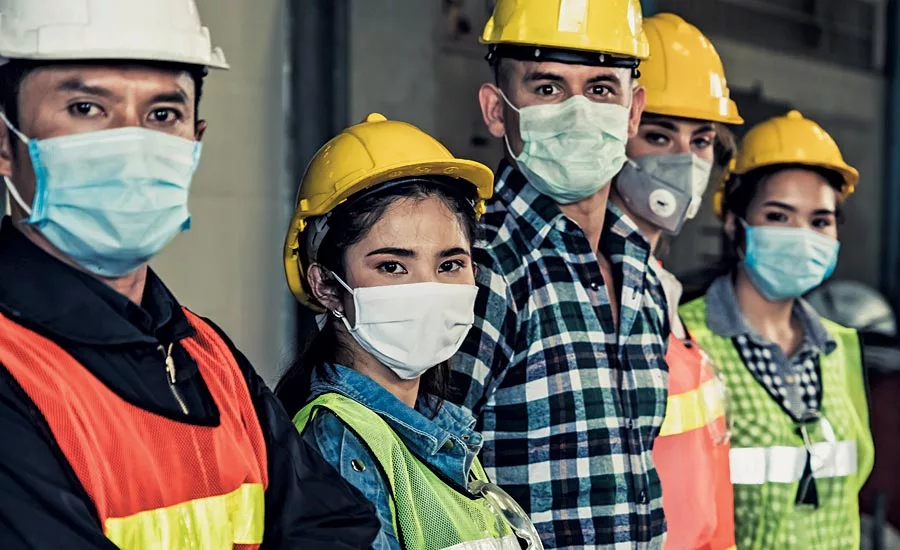
The construction industry is scrambling to stay compliant and implement new safety regulations to protect employees from the sudden outbreak of COVID-19. In late April, the Equal Employment Opportunity Commission revised its guidance on the Americans with Disabilities Act to bring clarity to updates from the Center for Disease Control, directing the construction industry to check employees daily for COVID-19 symptoms.

Contractors are rushing to meet the guidelines and many are turning to technology to get it done. Instead of having a more complex situation on their hands where physical files and documents would need to be produced and maintained, a contractor can use a resource management program to easily test, document and share results increasing safety and productivity without compromising anyone’s privacy. 

Here is a summary of the new ADA guidelines and how a resource management solution simplifies how private information is handled and protected:


Medical Information Can Be Collected From Healthy and Sick Employees

During a pandemic, employees can be questioned about any of the COVID-19 related symptoms as they enter job sites and if they claim to be sick. Symptoms include shortness of breath, fever, chills, cough and sore throat. But in order to remain in compliance with the ADA, their answers must be maintained in a confidential medical record.

Most employers are requiring screenings before employees enter the jobsite. As such, employees must be paid for waiting to be screened/tested and while they are waiting for results from said screening/test. Employers will also need to have consent from the employee to perform the testing or screening. The speed of which the questionnaire can be taken and any needed tests administered is of utmost importance for an employer. Slow testing will affect profits and labor productivity. Fortunately, a mobile form app allows employees to login and answer COVID-19 screening questions on their own. But, here’s the problem with using a stand-alone mobile forms app collecting COVID-19 health screening data. As stated before, most contractors are already conducting COVID-19 health screenings before employees enter the job site and before an employee has access to their timesheet or time clock on a manual “Punch Clock”. Because of this, employees may not be aware of the need to document their clock-in time at the moment they begin waiting for a screening or test, and this can present issues with wage and hour law compliance. 

Employees are required by law to be paid while they are completing health screenings and waiting for their results if they can’t access the jobsite without completing them. With a resource management platform, employees clock in from their mobile device as they are waiting to get screened or tested and then are prompted with health screenings to make sure they’re paid for the time it takes to fill out the health screening form upon clock-in. Similarly, if an employee hits clock-out on his app, it won’t clock him out until the health screening is filled out. The health screening mobile form can be quickly updated to reflect any new COVID-19 symptoms based on recommendations from the CDC.


Employers Can Mandate Medical Tests

Medical testing and screening of employees must be job related and is necessary for business. Due to the COVID pandemic, employers can test employees entering a jobsite for the virus because it is a direct threat to the health of others. The tests and screenings must be accurate and reliable and be administered in such a way as to not be discriminatory. It’s expected that all employees will be screened or tested before they enter the jobsites.  

Mobile forms can also assist in tracking the medical results, as the tests themselves take a short amount of time to administer but have a delay before the results are received. The pandemic questionnaire can have a field to capture whether a test has been taken or not. Once the test is completed and the results are received, the form can be updated reflecting the outcome. 

If someone tests positive for COVID-19, contractors can easily find all the employees that worked at the job location. A resource management solution automatically GPS stamps each employee at clock-in/-out, and every time they change a task. Using face recognition that compares employee profile photos to the clock-in or -out photos, management can have confidence that they have identified the right employees that would have come into contact with the positive-tested employee. Management can quickly see everyone who worked that day with accurate live field data with GPS stamps and face recognition to determine if they want those employees to get tested or to ask if they came into contact with the positive employee.


All Medical Information Must Be Stored Separately, Including Questionnaires and Tests

The ADA requires that all medical information collected from employees be stored separately from their personal file in a confidential medical file. This includes all questionnaires, self-identifications, test results and temperature checks. This information must be kept private with the same safeguards as any other medical information. In the instance of an employee contracting COVID-19, that information may be shared with public health agencies.

Using real-time mobile forms and with easy-to-use and flexible permissions, a contractor can make sure that the medical information submitted on the forms are only accessible by employees that have a legal business purpose to view the information. Their data remains confidential and can only be accessed by anyone with the appropriate permissions in the software to do so. It’s typical that supervisors and health and safety managers have access to view an employee’s confidential medical information. The permissions to access the confidential medical data can be automated to ensure ADA compliance and the employee’s privacy. For example, if a new health and safety coordinator for the southwest region was hired, they would have access to all the COVID-19 screening forms for all of the employees in the southwest region as soon as they’re hired.


Conclusion

Developing a COVID-19 safety program that’s compliant with the wage and hour laws, ADA and EEOC can be complicated and it is recommended that legal and safety experts be utilized in the creation of any plan. At a minimum, CDC and ADA guidelines are a meaningful start. Once a plan is in place, the implementation should be streamlined with a resource management platform that includes mobile forms prompted on clock-in or -out, robust permissions including automated permission profiles, and live field data tracking. 

KEYWORDS: COVID-19 DEI (Diversity, equity, and inclusion) technology

Share This Story

Looking for a reprint of this article?
From high-res PDFs to custom plaques, order your copy today!

Mike merrill headshot

With 10 years as a construction and real estate entrepreneur and 18 years as a technology executive, Mike Merrill, co-founder of WorkMax by AboutTime Technologies, brings strong leadership and expert knowledge. In addition, he’s the host of The Mobile Workforce Podcast where gathers industry experts to inspire change and finds out what it takes to profitability manage mobile workforces. With Mike’s depth of knowledge of the construction industry and mobile workforce technology, he’s a highly sought after author by leading industry trade publications and speaker at industry conferences. When he isn’t working, Mike is an athletic outdoorsman and is spending time with his wife and four kids.

Recommended Content

JOIN TODAY
To unlock your recommendations.

Already have an account? Sign In

  • Abercrombie & Fitch

    EIFS in 2026: How Specialty Finishes Are Redefining Exterior Wall Systems

    As building codes, owner expectations, and design demands...
    Stucco/EIFS
    By: Regi Mendoza
  • proper air and vapor control

    From Energy Efficiency to Moisture Management: Why Air and Vapor Control Matter

    How proper air and vapor control within building...
    Building Envelope
    By: Benjamin Meyer AIA, LEED AP
  • Linear Metal Ceiling Beam Baffles

    Top 25 Ceiling Contractors of 2026

    Suspended ceilings demand precision, code compliance and...
    Ceilings
    By: John Wyatt and Tanja Kern
You must login or register in order to post a comment.

Report Abusive Comment

Manage My Account
  • eMagazine Subscription
  • Newsletters
  • Online Registration
  • Manage My Preferences
  • Subscription Customer Service

More Videos

Sponsored Content

Sponsored Content is a special paid section where industry companies provide high quality, objective, non-commercial content around topics of interest to the Walls & Ceilings audience. All Sponsored Content is supplied by the advertising company and any opinions expressed in this article are those of the author and not necessarily reflect the views of Walls & Ceilings or its parent company, BNP Media. Interested in participating in our Sponsored Content section? Contact your local rep!

close
  • medical professionals moving a patient on a stretcher through the halls of a medical building
    Sponsored byNational Gypsum Company

    What Does High Performance Mean When It Comes To Gypsum Boards?

Popular Stories

Linear Metal Ceiling Beam Baffles

Top 25 Ceiling Contractors of 2026

Wichita Biomedical Campus

Wichita Drywall Worker Dies After Scaffolding Fall

QXO Just Changed the Game-Here's What Contractors Are Asking

QXO Just Changed the Game-Here's What Contractors Are Asking

An interior drywalling work in progress

Boost Profits with AI Scheduling

Events

June 24, 2026

The Bright Side & Benefits of Designing with Integrated Lighting

Credits 1 AIA LU/HSW; 0.1 ICC CEU

This course will explore the pivotal role architects and lighting design play in creating safer, more sustainable spaces. Learn how to avoid common lighting mistakes and make informed decisions that create the best visual environment for occupants. 

January 1, 2030

Webinar Sponsorship Information

For webinar sponsorship information, visit www.bnpevents.com/webinars or email webinars@bnpmedia.com.

See our full library of webinars

View All Submit An Event

Products

2026 National Painting Cost Estimator

2026 National Painting Cost Estimator

See More Products

Related Articles

  • Smart Business
    What Your Employees Can Do to Earn More Money

    See More
  • Influencing Your Employees

    See More
  • contractor mental health 2

    Increasing Mental Health Awareness, Safety in Construction With Technology

    See More

Related Products

See More Products
  • business.png

    How to Succeed With Your Own Construction Business

  • barrys.jpg

    Barry's Advanced Construction of Buildings, 4th Edition

See More Products

Related Directories

  • Radius Track Corp.

    Radius Track is focused on developing cold-formed metal framing systems for curved and complex buildings. We collaborate with Project Teams – from pre-construction through installation – so that we can holistically develop and fabricate cost-effective, constructable, precision-crafted framing systems that honor the design intent. We offer a scalable delivery method to deliver small to large projects for stick-based systems or fully unitized assemblies. Applications include roofs, facades, walls, ceiling, soffits, domes and any other type of curved surface... from simple to complex... structural or non-structural.
  • Infrastructure Health & Safety Assn.

    IHSA is a leader in health and safety education. Through skills-based training, auditing, and evaluation, we provide safety solutions to those who perform high-risk activities such as working at heights, working with energized high-voltage power systems, driving motor vehicles, transporting dangerous goods, working on suspended access equipment, and utility line clearing.
×

Connect with the industry’s leading resource for unparalleled insights and education.

Join thousands of industry professionals today. Shouldn’t you know what they know?

JOIN NOW
  • RESOURCES
    • Advertise
    • Contact Us
    • Directories
    • Store
    • Want More
  • SIGN UP TODAY
    • Create Account
    • eMagazine
    • Newsletters
    • Customer Service
    • Manage Preferences
  • SERVICES
    • Marketing Services
    • Reprints
    • Market Research
    • List Rental
    • Survey/Respondent Access
  • STAY CONNECTED
    • LinkedIn
    • Facebook
    • Instagram
    • YouTube
    • X
  • PRIVACY
    • PRIVACY POLICY
    • TERMS & CONDITIONS
    • DO NOT SELL MY PERSONAL INFORMATION
    • PRIVACY REQUEST
    • ACCESSIBILITY

Copyright ©2026. All Rights Reserved BNP Media, Inc. and BNP Media II, LLC.

Design, CMS, Hosting & Web Development :: ePublishing