Decoding UL and cUL Full-Scale Fire Testing for Horizontal Membrane Assemblies
IMAGE CREDIT: Who Is Danny?/Shutterstock.com
The built environment is truly only as good as the sum of its parts, and as the demands of the spaces where we live, work, learn, and play increase, the materials and products that comprise them must evolve with those demands. So, too, must the means by which we test, measure, and verify the efficacy of these products.
Across the industry, building products in residential and commercial structures are receiving increasing scrutiny for their life safety performance. On many projects, occupant wellbeing focuses on what inhabitants can see, hear, and feel—the way the design details come together to stir excitement, invoke tranquility, and otherwise appeal to the senses.
But even more critical to occupant wellbeing is what cannot be seen, heard, or felt: the building components that may not contribute to the aesthetic value of a space but are nevertheless crucial to life safety. There is heightened awareness of everything from indoor air quality to sustainable materials among manufacturers, contractors, and specifiers alike.
The net result is that the manufacturing, testing, and certification of building products are becoming more rigorous in helping to ensure safer, more sustainable, more livable structures.
Fire Prevention Floor Over Floor
At or near the top of the list of concerns is fire safety. Today’s commercial, multi-family, and institutional buildings must comply with hundreds of International Building Code and National Building Code of Canada fire safety codes to protect occupants in the event of a fire.
Building products designed to help prevent the spread of fire can allow occupants precious time to evacuate. Even minutes in emergency situations can mean the difference between life or death.
Vertical separators are one part of the equation in preventing or slowing the spread of fire and smoke. Horizontal separators are often overlooked as another. Fire can spread floor over floor just as easily as it can spread between spaces divided by partitions on a single floor. Specifiers must therefore also make horizontal fire and smoke separation a central part of the planning and design of multi-story building projects.
This is where horizontal shaftwall assemblies come into play. These key building components require specific consideration to meet code compliance and keep the people who occupy commercial, multi-family, and institutional buildings safe. And as more and more projects incorporate horizontal shaftwall assemblies, the demand for full-scale ASTM E119 and CAN/ULC-S101 fire-rated products is also growing.
Horizontal membrane assemblies are non-loadbearing structures that are particularly beneficial in providing fire-resistance ratings for spaces that can’t incorporate typical floor-ceiling assemblies (which include subflooring or floor toppings) or roof-ceiling assemblies (which often include the roofing system), as specified in the UL, cUL and ULC assemblies. This means horizontal membranes offer alternatives for use in corridors, occupied space and plenum separation, exit stairways, and other areas where a standard floor-ceiling or roof-ceiling assembly is not architecturally feasible.
Code Compliance + Life Safety Assurance
While horizontal shaftwall systems are not new, limitations in testing capabilities in the marketplace has kept full-scale testing per ASTM E119 and CAN/ULC-S101 from proliferating widely in the past. That trend is beginning to change at the manufacturing level, but design and specification must follow suit.
The first step is awareness. Because full-scale tested products have not yet become an industry norm, awareness among specifiers remains low.
Currently, the industry relies largely on evaluation reports issued by third-party companies to certify building product fire code compliance. Evaluation reports are based primarily on small-scale testing, or they use vertically tested assemblies in a horizontal orientation. These methods may not provide the same fire resistance when tested in a full-scale, horizontal orientation, per ASTM E119 or CAN/ULC-S101.
Architects and Specifiers, however, are no longer limited to evaluation reports alone. Manufacturers now have the capabilities to conduct full-scale UL, cUL and ULC testing. With stringent procedures, full-scale testing offers a more accurate picture of the way fire-rated horizontal membrane assemblies will perform in real-world applications. Full-scale testing therefore provides architects and specifiers additional assurances that the products they specify are suitable for life safety for the occupants.
Decoding the Test Methods
With more of the gypsum industry beginning to understand the benefits of full-scale testing, some manufacturers now provide multiple full-scale testing options. Several manufacturers even provide one and two-hour horizontal membrane systems that meet ASTM E119 and CAN/ULC-S101.
The following graphics illustrate the various methods used by one industry manufacturer for full scale testing of horizontal membrane systems.
UL/cUL I507: This testing protocol provides a one-hour fire resistance rating, using a minimum 6”, 33 mil steel stud, and three layers of 5/8” type X, 5/8” moisture- and mold-resistant type X, or 5/8” type C drywall.

UL/cUL I514: This testing protocol provides a two-hour fire resistance rating, using a minimum 6”, 33 mil steel stud, four layers of 5/8” type C, with resilient channel between the third and fourth layer.

UL/cUL I515 one and two-hour testing: UL/cUL I515 utilizes 1” gypsum shaftliner plus two layers of 5/8” type X, 5/8” moisture- and mold-resistant type X, or 5/8” type C drywall for a one-hour rating. The two-hour rating utilizes 1” gypsum shaftliner plus three layers of 5/8” type C drywall, with resilient channel between the middle and face layers.
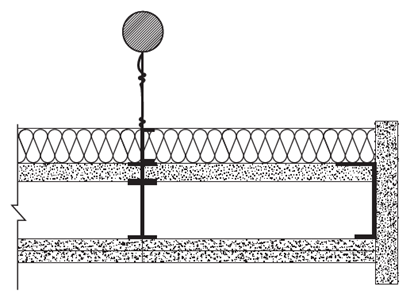 UL/cULI515 one-hour test
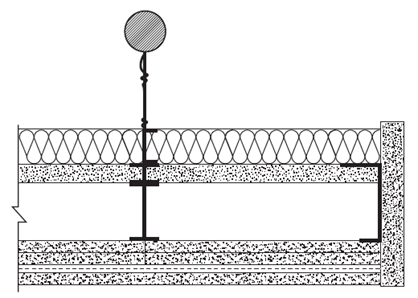 UL/cUL I515 two-hour test
Additional Benefits
With many manufacturer’s products, the use of full-scale fire-rated assemblies can also meet additional objectives in today’s building standards, particularly in the area of health and sustainability.
Look for gypsum products that include Health Product Declarations (HPDs), many of which are third-party verified, for additional transparency in the material makeup. Many products also offer product-specific Type III Environmental Product Declarations, and select products even meet GREENGUARD® Gold and CDPH V1.2 requirements.
As the demand continues to grow for enhanced life safety, occupant comfort, and sustainability in the buildings people occupy, it is imperative for the industry to adopt more full-scale testing of products. Ultimately, the built environment will become safer and more livable — which benefits developers, builders, architects, and occupants alike.
Looking for a reprint of this article?
From high-res PDFs to custom plaques, order your copy today!