Walls & Ceilings logo
search
cart
facebook twitter linkedin youtube youtube Spotify Podcasts Apple Podcasts Spotify Podcasts Apple Podcasts
  • Sign In
  • Create Account
  • Sign Out
  • My Account
Walls & Ceilings logo
  • NEWS
  • TOPICS
    • Drywall
    • Stucco/EIFS
    • Ceilings
    • Steel Framing
    • Fireproofing
    • Interior Plaster
    • Building Envelope
    • Insulation
    • Technology
    • Interior
    • Exterior
    • Women In Construction
  • COLUMNS
    • Up Front
    • All Things Gypsum
    • Art & Craft of Plastering
    • Stucco Stop
    • Steel Deal
    • Industry Voices
  • PRODUCTS
    • Buzz Guide
  • EVENTS
    • Industry Events
    • Webinars
    • BUILD Expo
  • MEDIA
    • Videos
    • Podcasts
    • Photo Galleries
    • BUILD26 Videos
    • Take our Quiz!
    • Infographics
  • EXCLUSIVE
    • Newsletters
    • Top 50 Contractors
    • Contractor of the Year
    • State of the Industry
    • W&C Store
    • Market Research
    • CEUs
    • Sponsor Insights
    • Custom Content & Marketing Services
  • DIRECTORY
  • EMAGAZINE
    • eMagazine
    • Advertise
    • Archive Issues
  • SIGN UP!
CeilingsInsulation

A Good Study

NEW STUDY REVEALS KEY INSIGHTS ABOUT RESIDENTIAL SOUND ISOLATION.
By Benjamin Shafer
WC0322-FEAT-Pabco-p1FT-Home_Acoustics_349426504_cropped_article-SQ.jpg
March 23, 2022

The importance of sound control in single family residences is changing. Homes are increasingly serving as offices, exercise rooms and theaters resulting in a greater need for quiet spaces and privacy. This has resulted in an increased need for sound isolation in the home.

There are several ways to improve sound isolation in the home including mass, absorption, decoupling and damping. Little, if any, sound isolation testing has been done to evaluate how these various sound control options perform. PABCO Gypsum executed an extensive research study to quantify this information for the benefit of residential building construction professionals.


Improving Sound Isolation in Homes

Sound control treatments commonly used in homes are categorized into four general types: mass absorption, decoupling and damping:

  • Mass: Adding gypsum layers increases the overall mass of the partition
  • Absorption: Adding insulation to the wall cavity such as fiberglass or stone wool insulation
  • Decoupling: Acoustically isolating the gypsum wallboard from the building structure by adding fiberboard as an intermediary layer, the most common treatment for homes
  • Damping: Minimizing sound vibration through the wall using constrained layer damped (CLD) gypsum panels, multilayer composite panels comprised of gypsum wallboard and viscoelastic polymers


Fundamentals of Building Sound Isolation

Sound transmission loss is currently the most widely known and in-depth measurement of sound isolation in buildings throughout North America. The STL is measured in a laboratory by creating sound with loudspeakers in one room (source room) measuring this noise with microphones, and then measuring the sound transmitted through a partition sample in an adjoining room (receiving room) also with microphones.

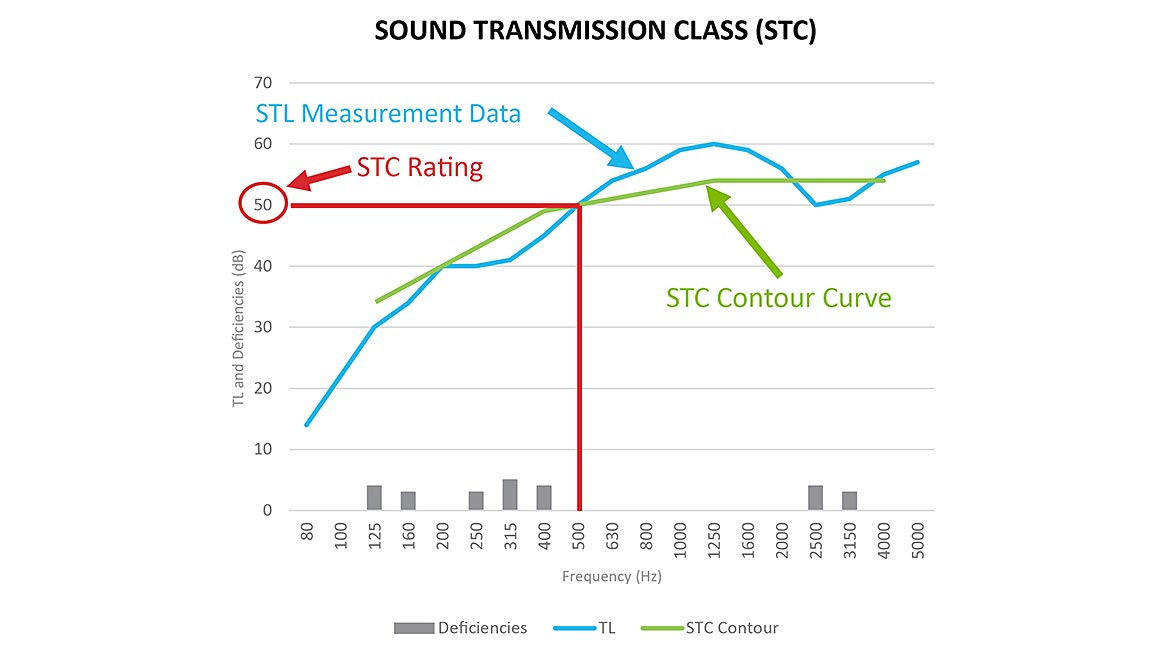
The measured receiving room sound levels are essentially subtracted from the measured source room sound levels. The resulting decibel (dB) STL values are then provided in 1/3 octave band frequencies from 125 Hz to 4,000 Hz. These STL values can be used to calculate the single-number STC (Sound Transmission Class) rating using a contour curve-fit method (See Figure 1).
WC0322-FEAT-Pabco-Fig1-STC_Example_Plot_article.jpg

Figure 1: Calculation of sound transmission class (STC) from sound transmission loss (STL) data. The measurement frequencies in Hertz in 1/3-octave bands are shown on the horizontal axis, and the STL values in decibels are shown on the vertical axis.


Test Methodology

STL testing was completed in accordance with the ASTM E90-09 Standard Test Method for Laboratory Measurement of Airborne Sound Transmission Loss of Building Partitions and Elements. It was conducted at a third-party accredited laboratory, North Orbit Acoustical Laboratory located in Dyersville, Iowa, in May 2020.

All tests were conducted on 3½-inch, 2x4 single wood framing with studs spaced 16 inch on center, wood framing commonly used in the construction of single-family homes.

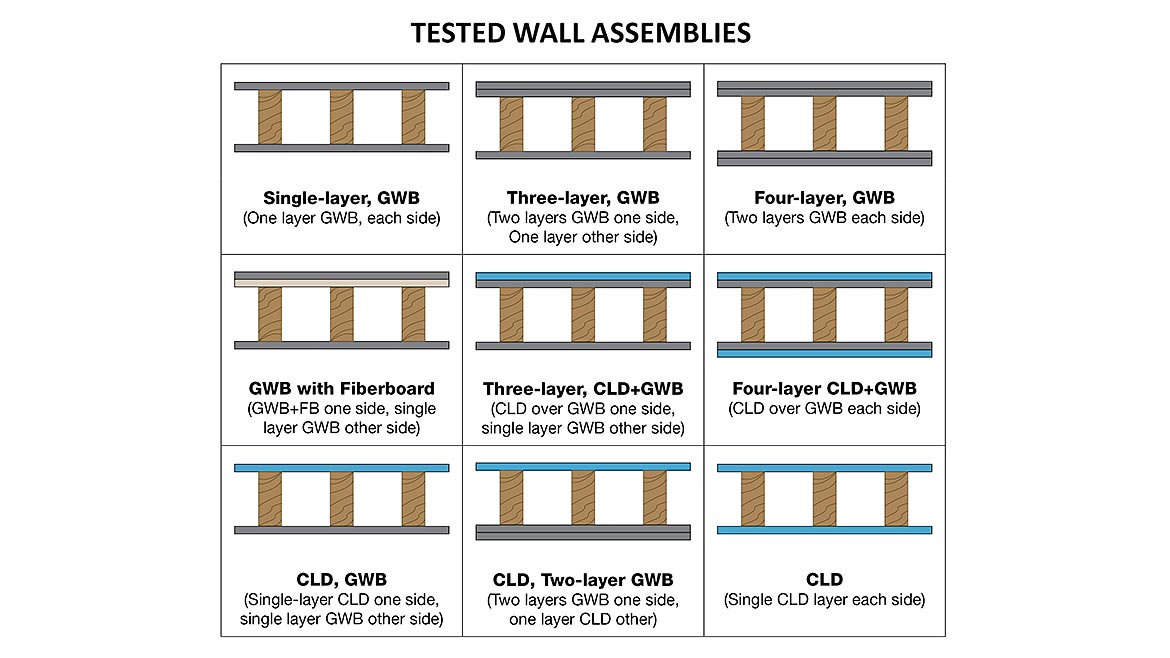
Nine different wall assembly configurations were tested in the laboratory (See Figure 2). All wallboard used in the study including the constrained layer damped board was 1/2 inch regular, the drywall commonly used in single family housing. In addition, three cavity types were installed in each assembly: no insulation, 3½ inch R-13 fiberglass insulation and 3-inch stone wool unfaced insulation.
 WC0322-FEAT-Pabco-Fig2-16-oc-wood-assembly-table_article.jpg

Figure 2: Illustrates the nine wall assemblies used for this study. GWB=Gypsum Wallboard, FB=Fiberboard, CLD=Constrained Layer Damped panel.


Test Results

Mass: Adding a second and third layer of wallboard onto the base assembly (one layer of gypsum wallboard (GWB) on both sides) provided a 4-STC point increase in performance and between a 3-8 dB increase in STL over the frequency range reported by the laboratory.

Absorption: Adding fiberglass or stone wool insulation to the wall cavity resulted in a 3-STC point increase; slightly less than the addition of mass. The effect of the insulation was different across the measured frequencies—little to no improvement in STL at low frequency, a large improvement in the lower mid-frequency range of 10 dB and then a steady 5 dB improvement throughout the higher frequencies measured. No statistically significant difference was found between the fiberglass and stone wool insulation types.

Decoupling: Installing the GWB over a decoupling fiberboard panel increased the STC rating by 6 points. The STL performed consistently 5 dB better than the baseline GWB until 1,000 Hz, at which point the STL difference gradually increased to 15 dB at the high-frequency range.

Damping: Two different configurations of damping were tested—retrofit (where the constrained layer damped (CLD) panel was installed over the existing GWB) and direct-attached as would be the case for new construction. The retrofit damped configurations resulted in a 7-12 STC point increase vs. the baseline GWB performance. The STL difference varied with the largest improvement in the high frequency range, upwards of 25+ dB difference. The direct-attached CLD configurations resulted in a similar increase in both STC and dB STL difference from the baseline assembly.
WC0322-FEAT-Pabco-Fig3-STC-rating-table.jpg

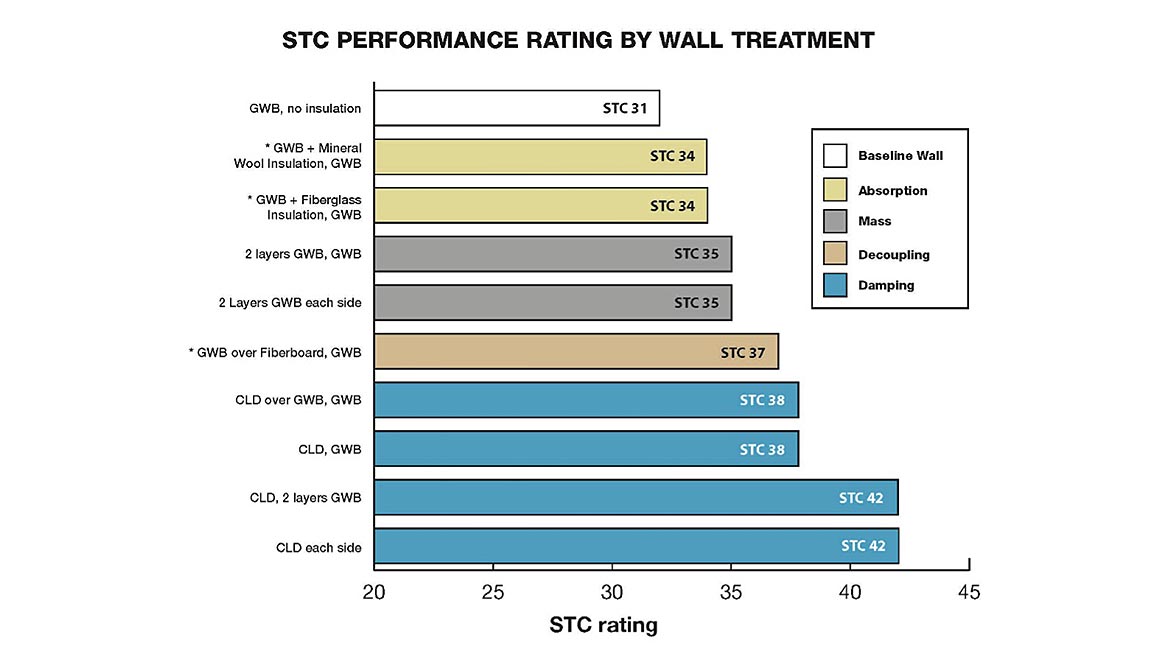
Figure 3: STC rating of mass, absorption, decoupling, and damping as compared to the single layer gypsum wallboard assembly with no insulation. The test configurations are shown on the vertical axis and the STC values are shown on the horizontal axis. All wallboard used in the study was ½” thick and all assemblies are without insulation unless indicated.


Conclusion

The STC rating compared to the baseline GWB partition without insulation and every other treatment—mass, absorption, decoupling and damping—is shown in Figure 3. The most marked improvements in performance occurred when the damped panels were added to the assembly. Adding fiberglass or stone wool insulation or additional panels provided only nominal improvements in sound isolation performance. The decoupling treatment provided slightly better performance than the mass and absorption, but less than the damping treatments.


Note: The test report numbers used in the study included: NOAL 20-0501, 20-0506, 20-0514, 20-0502, 20-0503, 20-0531, 20-0509, 20-0510, 20-0520, 20-0521, and 20-0522.


KEYWORDS: acoustics gypsum residential building STC (sound transmission class)

Share This Story

Looking for a reprint of this article?
From high-res PDFs to custom plaques, order your copy today!

Wc0322 feat pabco p2 author ben schafer

Benjamin Shafer serves as technical services manager, Acoustic Systems for PABCO Gypsum, where he coordinates building sound isolation design with acoustical consultants, architects and building professionals. He conducts product research and development and has authored and edited several technical documents and industry guidebooks. He is an active member of several technical organizations, including the Acoustical Society of America, Institute of Noise Control Engineering, ASTM, and more. He is also the author of multiple papers on various topics in acoustics.

Recommended Content

JOIN TODAY
To unlock your recommendations.

Already have an account? Sign In

  • Abercrombie & Fitch

    EIFS in 2026: How Specialty Finishes Are Redefining Exterior Wall Systems

    As building codes, owner expectations, and design demands...
    Stucco/EIFS
    By: Regi Mendoza
  • proper air and vapor control

    From Energy Efficiency to Moisture Management: Why Air and Vapor Control Matter

    How proper air and vapor control within building...
    Building Envelope
    By: Benjamin Meyer AIA, LEED AP
  • Linear Metal Ceiling Beam Baffles

    Top 25 Ceiling Contractors of 2026

    Suspended ceilings demand precision, code compliance and...
    Ceilings
    By: Tanja Kern and John Wyatt
You must login or register in order to post a comment.

Report Abusive Comment

Manage My Account
  • eMagazine Subscription
  • Newsletters
  • Online Registration
  • Manage My Preferences
  • Subscription Customer Service

More Videos

Sponsored Content

Sponsored Content is a special paid section where industry companies provide high quality, objective, non-commercial content around topics of interest to the Walls & Ceilings audience. All Sponsored Content is supplied by the advertising company and any opinions expressed in this article are those of the author and not necessarily reflect the views of Walls & Ceilings or its parent company, BNP Media. Interested in participating in our Sponsored Content section? Contact your local rep!

close
  • medical professionals moving a patient on a stretcher through the halls of a medical building
    Sponsored byNational Gypsum Company

    What Does High Performance Mean When It Comes To Gypsum Boards?

Popular Stories

drywall contractor sanding ceiling

D.C. Drywall Contractors to Pay $302K in Worker Case

Wichita Biomedical Campus

Wichita Drywall Worker Dies After Scaffolding Fall

Okan Tower in Miami, Florida

OSHA Opens Investigation Into Fatal Okan Tower Column Collapse

data center and logos

USG, Subzero Engineering Form Data Center Alliance

Events

January 1, 2030

Webinar Sponsorship Information

For webinar sponsorship information, visit www.bnpevents.com/webinars or email webinars@bnpmedia.com.

See our full library of webinars

View All Submit An Event

Products

2026 National Painting Cost Estimator

2026 National Painting Cost Estimator

See More Products

Related Articles

  • Apla-Tech receives good reports in study

    See More
  • Plaster Man
    A Good Product is Like a Good Book

    See More
  • Smart Business: Are You a Good Boss?

    See More

Related Products

See More Products
  • revisited.png

    Markup & Profit: A Contractor's Guide Revisited

  • bim 3e.jpg

    BIM Handbook: A Guide to Building Information Modeling for Owners, Designers, Engineers, Contractors, and Facility Managers, 3rd Edition

  • building codes illustated.jpg

    Building Codes Illustrated: A Guide to Understanding the 2021 International Building Code, 7th Edition

See More Products

Events

View AllSubmit An Event
  • September 16, 2026

    ICAA Convention & Trade Show

    The ICAA Convention & Trade Show is bigger and better than ever! ICAA is a full gathering of the industry, with record breaking attendance numbers on the books last year. Our show is a unique opportunity for exhibitors and attendees from all over the country to do business while scoping out the latest insulation products and innovations.
View AllSubmit An Event
×

Connect with the industry’s leading resource for unparalleled insights and education.

Join thousands of industry professionals today. Shouldn’t you know what they know?

JOIN NOW
  • RESOURCES
    • Advertise
    • Contact Us
    • Directories
    • Store
    • Want More
  • SIGN UP TODAY
    • Create Account
    • eMagazine
    • Newsletters
    • Customer Service
    • Manage Preferences
  • SERVICES
    • Marketing Services
    • Reprints
    • Market Research
    • List Rental
    • Survey/Respondent Access
  • STAY CONNECTED
    • LinkedIn
    • Facebook
    • Instagram
    • YouTube
    • X
  • PRIVACY
    • PRIVACY POLICY
    • TERMS & CONDITIONS
    • DO NOT SELL MY PERSONAL INFORMATION
    • PRIVACY REQUEST
    • ACCESSIBILITY

Copyright ©2026. All Rights Reserved BNP Media, Inc. and BNP Media II, LLC.

Design, CMS, Hosting & Web Development :: ePublishing
