ICF Storm Shelters: Transforming K-12 School Safety and Resilience Against Tornadoes and Hurricanes
Insulating concrete forms are changing K-12 school construction by providing ICC-500 compliant storm shelters that combine safety, durability, energy efficiency, and multipurpose functionality.

When it comes to student safety, nothing should be left to chance—especially in regions prone to severe storms. With tornadoes and hurricanes becoming more frequent and intense, school districts are under increasing pressure to include hardened safe rooms that comply with the International Code Council’s ICC-500 Standard for the Design and Construction of Storm Shelters.
One construction method gaining widespread attention is insulating concrete forms. These rigid foam blocks are stacked and filled with reinforced concrete, combining structural walls, insulation, and finish attachment in a single integrated system. This composite design offers major advantages for educational construction while meeting ICC-500 requirements efficiently.
Why Schools Need Shelters More Urgently Than Ever
Tornado risk is expanding beyond the traditional Tornado Alley. Recent destructive outbreaks have hit Tennessee, Mississippi, Georgia, the Carolinas, Kentucky, Ohio and even Maryland. NOAA reported more than 1,100 tornadoes in 2023, well above average.
States including Oklahoma, Alabama, Louisiana, Missouri, Kentucky and Texas now mandate ICC-500 compliant storm shelters in new K-12 construction, often supported through state or FEMA funding. Others, such as Illinois, Indiana and Arkansas, are considering legislation linking school funding to ICC-500 shelter inclusion.
These policy shifts reflect the evolving expectations for school safety as natural disasters become more frequent and severe.
A Framework for Storm Shelter Design: ICC-500 and FEMA P-361
The ICC-500 standard, developed by the International Code Council and the National Storm Shelter Association, sets minimum requirements for structural integrity, life safety, and habitability for tornado- and hurricane-exposed shelters. Referenced in both the International Building Code and International Residential Code, ICC-500 is now the prevailing standard across most jurisdictions.
For schools, ICC-500 compliance includes:
- Wind-load design up to 250 mph (EF-5 tornado resistance)
- Missile (flying debris) impact protection per ASTM E1886 and E1996
- Occupant capacity and square footage per child/adult
- Emergency lighting, backup power, ventilation, and ADA accessibility
FEMA P-361, while voluntary, is widely regarded as the gold standard, offering enhanced guidance on best practices, building placement, operations, and eligibility for FEMA-funded shelters.
Why ICFs Are an Ideal Solution for ICC-500 School Storm Shelters
Insulating concrete forms are exceptionally well-suited for K-12 schools because they create an insulated structural envelope that integrates easily with other building materials. Choosing ICFs delivers benefits during construction and throughout the building’s lifespan.
1. Structural Strength and Debris Impact Resistance
Monolithic ICF walls exceed wind and debris impact requirements. In standardized testing, ICF assemblies consistently withstand missile impact tests simulating tornado debris, including 12-foot-long, 15-pound wood 2x4s launched at 100 mph.
2. Thermal and Acoustic Performance
High R-values and superior sound attenuation—often achieving an STC rating of 55 or higher—allow ICF shelters to double as cafeterias, music rooms, or gymnasiums, enhancing both daily school operations and emergency preparedness.
3. Faster Construction and Fewer Trades
ICFs combine structure, insulation, moisture and vapor barriers, and finish attachment in a single system, reducing the number of trades needed. Schools report construction schedules shortened by 20 to 25 percent compared to concrete masonry, steel frame, or cast-in-place concrete systems.
4. Exceptional Durability and Fire Resistance
ICFs provide a minimum three-hour fire rating, resist mold, mildew and pests, and offer long-term durability. Lower maintenance costs, enhanced resilience, and reduced insurance premiums free up funding for educational needs.
Designing ICC-500 Compliant Shelters
Although ICFs offer inherent strength, full compliance requires careful coordination. Architects and engineers must ensure a complete structural load path from roof to foundation. ICFs integrate well with precast or cast-in-place concrete roofs, but anchorage and wind uplift resistance must be meticulously addressed.
Reinforcement and Missile Impact Requirements
ICF shelters typically require reinforcement beyond standard concrete walls. Only assemblies with verified ICC-500 missile impact testing are permitted. Doors, louvers, vents and openings must also meet ICC-500 debris criteria.
HVAC, Life Safety, and Accessibility
Shelters must include:
- Independent ventilation systems with minimum air exchange rates
- Backup power and emergency lighting capable of operating for at least two hours
- ADA-compliant exits, access routes, and accessible restrooms if occupancy exceeds two hours
- Clear signage and protected routes to the shelter
FEMA P-361 provides additional guidance for long-duration operability during catastrophic events.
Final Thoughts
Integrating ICC-500 compliant ICF storm shelters into K-12 schools is more than a code requirement—it is an investment in safety, operational performance, and community resilience. ICFs allow districts to meet the most demanding standards while gaining high-performance building envelopes and multipurpose spaces at lower life-cycle costs. For districts planning new facilities or additions, ICF storm shelters are a smart, safe, and sustainable choice.
Case Study: Jennings Creek Elementary, Bowling Green, Ky.
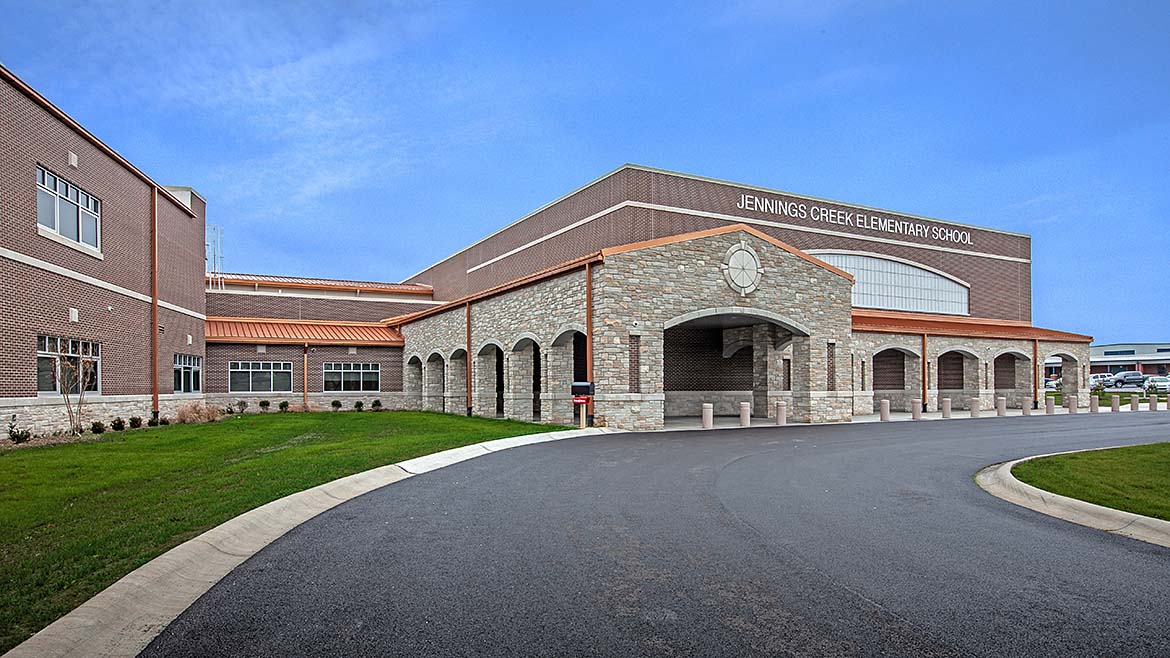
Photo courtesy of Sherman Carter Barnhart Architects - Louisville, Ky.
In December 2021, Jennings Creek Elementary School, built with a complete ICF exterior envelope, survived a deadly tornado outbreak that devastated much of Western Kentucky. The school remained structurally intact, serving as a command and coordination center for first responders and a stabilizing resource for the community—real-world proof of ICF resilience.
Although ICF materials may have a slightly higher initial cost, labor savings, faster schedules, and long-term energy efficiency often make ICF shelters cost-competitive or even less expensive than concrete masonry or conventional steel construction.
The American Concrete Association reports that ICF schools can achieve 40 to 60 percent annual energy savings compared to standard construction, with Energy Use Intensity ratings often in the low 20s. FEMA Hazard Mitigation and Pre-Disaster Mitigation grants can fund up to 75 percent of eligible storm shelter costs when designs comply with FEMA P-361 in qualifying regions.
Case Study: Purcell Elementary Storm Shelter Addition
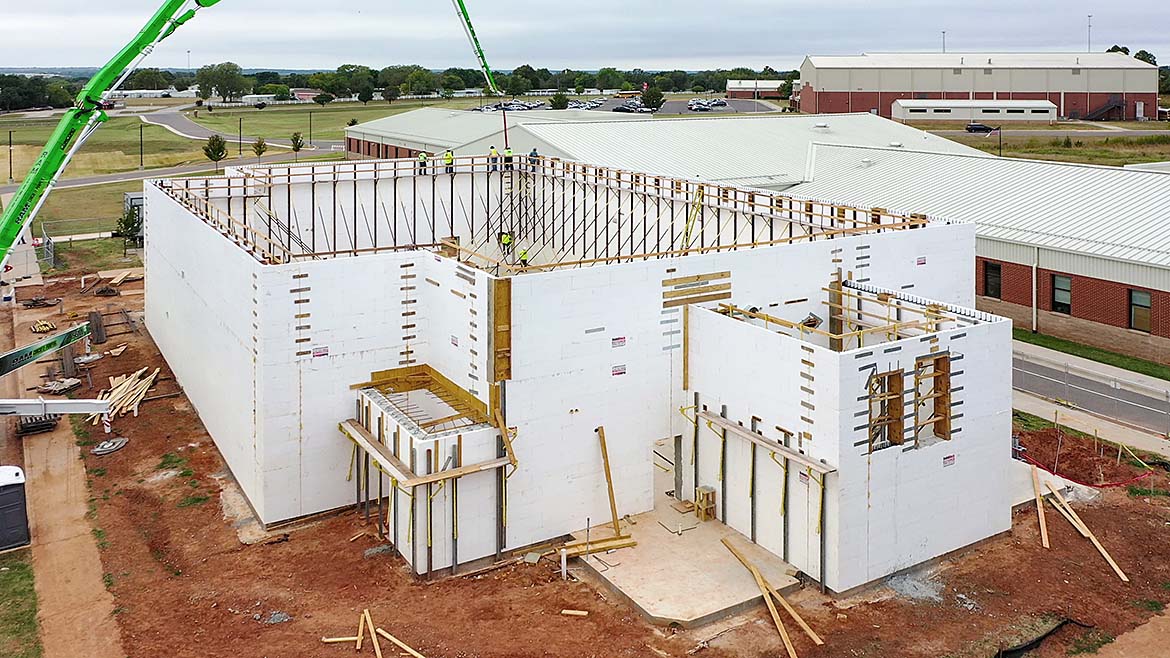
Photo courtesy of BuildBlock Building Systems LLC - Oklahoma City, Okla.
Purcell Elementary School in Oklahoma is constructing a new ICC-500 compliant, ICF-based storm shelter designed to withstand EF5 tornado forces. Unlike Jennings Creek, this is a targeted addition complementing the existing gymnasium and campus layout, providing emergency resources for the wider community.
Looking for a reprint of this article?
From high-res PDFs to custom plaques, order your copy today!