EIMA 2026 Annual Meeting
EIMA Charts Path Forward at Inaugural Washington Meeting
Momentum is building for EIFS, yet EIMA's CEO says reclaiming the industry's 2006 peak will require a bigger lift.
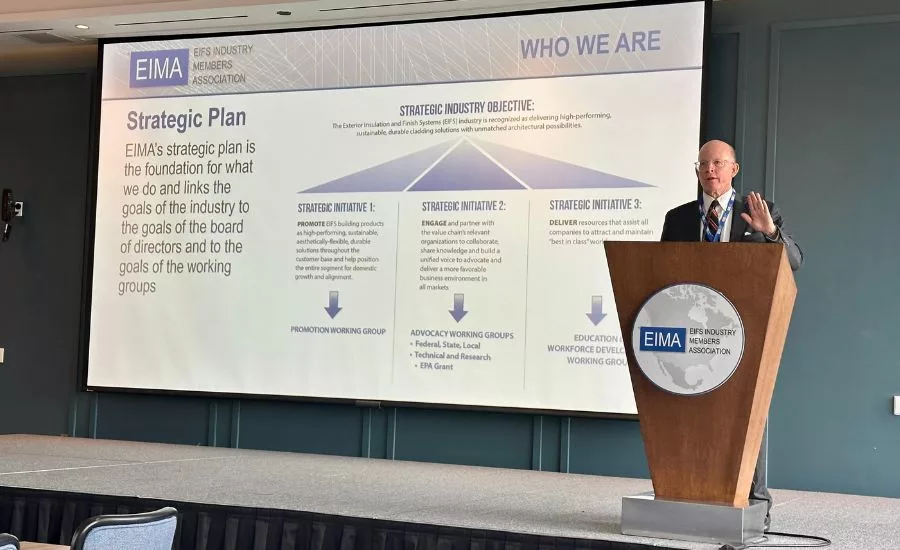
EIMA CEO Stephen Sears said the residential construction market — representing roughly 25% of total U.S. construction spending — remains significantly underpenetrated by EIFS products.
Key Takeaways
- The EIFS industry is growing but hasn't fully recovered: U.S. construction spending has surpassed $2 trillion, yet EIFS manufacturers' net sales remain below their 2006 peak, falling 7.5 percent last year.
- Washington is now a priority. EIMA held its first-ever Capitol Hill fly-in and its first annual meeting in Washington, D.C., signaling a strategic shift toward federal engagement.
- Bigger ambitions will require bigger resources: With a modest operating budget, EIMA's ability to expand advocacy, marketing and education efforts is constrained.
The EIFS industry is riding a construction market that has surpassed $2 trillion in total spending but the sector still has work to do to fully capitalize on that growth, EIFS Industry Members Association CEO Stephen Sears told members at the group's annual meeting in Washington.
Sears noted that while industry conditions have improved considerably since the pandemic, manufacturers' net sales remain below their 2006 peak (down 7.5 percent last year alone) and residential construction, which accounts for roughly 25 percent of total U.S. construction spending, remains an underpenetrated market for EIFS products.
Part of the challenge, Sears said, traces back to design and installation problems from the 1990s that continue to shadow the industry's reputation with some specifiers and building owners, particularly those who have been in the market longer.
"We're still not quite there yet," Sears said.
Market Opportunity and Ongoing Challenges
U.S. construction spending has grown significantly since 2018, rising from roughly $1.3 trillion to more than $2 trillion, even with a slight dip in 2025. Manufacturers' new orders for construction materials have held steady between $60 billion and $70 billion annually. Despite that backdrop, EIFS has struggled to expand its share—particularly in residential construction, which Sears described as a significant missed opportunity.
"By not engaging in that same space, we're leaving a lot on the table," he said.
Workforce shortages and regulatory pressures at the local level continue to weigh on the industry, though EIFS remains included in most building codes nationwide.
First Capitol Hill Fly-in Builds Advocacy Push
The Washington meeting, the association's first in the nation's capital, coincided with EIMA's inaugural Capitol Hill fly-in, which brought roughly 25 industry representatives directly to lawmakers and congressional staff from both parties.
Rafaël Bao, CEO of Adex Systems Inc., said the delegation made the case for energy efficiency, affordable housing and job creation.
"The staffers understood they didn't just have a lobbyist, they had the full industry represented," Bao said.
Workforce and job creation proved to be particularly resonant themes across the political aisle.
"Whether they were Republican or Democrat, you want to make sure that your constituents work," Bao said.
He called for sustained engagement and sharper policy messaging going forward. "We need to come back to Washington and keep at it—and we need to develop a specific ask as an industry."
Nathan Katz, national sales manager for facades, roofing and wall finishing at Saint-Gobain ADFORS, said congressional meetings were largely productive, with staff asking detailed questions about training and workforce development.
"They were very interested in learning more about EIFS and the benefits it provides," Katz said, adding that the ability to present clear workforce pathways helped strengthen the industry's message.
Training initiatives were a central theme in committee discussions, including a multi-day plasterers competition held at this year's World of Concrete. Participants said expanding grassroots promotion of contractor-led training programs could help grow the talent pipeline.
On the technical side, the group is working on updates to an EIFS standard set to expire next year, with proposed revisions including new finishes and expanded material options. Additional collaboration with the Environmental Risk Management Institute is also under consideration.
Promotion, Outreach and Industry Alignment
Chip Blome, national merchandising manager for exteriors at L&W Supply, said the association is working to streamline communications and expand outreach to architects and specifiers, consolidating multiple touch points into a single monthly outreach and expanding tools such as project mapping and architectural presentations.
"Our goal is to make the association the source for this information," Blome said. "If we have one voice with one message, we're going to get further than multiple messages."
Sears said the association's strategic plan—executed through multiple working groups covering advocacy, technical services, education and market expansion—will continue to set the direction.
"All of our working groups tie back to the strategic plan," he said. "We all have to be rowing in the same direction."
Expanding the association's impact, Sears acknowledged, will likely require additional investment.
"If we want to do more than we're doing, we probably will need more resources," he said.
He closed with a note of measured optimism, drawing on his background in advertising to argue that perception, however entrenched, can be changed.
"Marketing can work. Perception changing can work, but it takes time and consistency."
Looking for a reprint of this article?
From high-res PDFs to custom plaques, order your copy today!