GA Corner
Tile Backer Rules for Showers and Baths
GA-216-2024 explains approved gypsum panels, fastening, and tile substrate rules.
Question: What types of gypsum panels can I use behind tile in a bath or shower? If tile is supposed to be waterproof, why does it matter what panel type is behind it? Can't I just use whatever drywall I have left on the truck?
Answer: Great question, and one that catches a lot of contractors off guard. The short answer: no, and GA-216-2024 Application and Finishing of Gypsum Panel Products is very specific about why in Section 14 of the publication.
So, what does GA-216-2024 actually require?
The only gypsum panels allowed for use as a base for tile in wet areas under the International Building Code is one conforming to ASTM C1178/C1178M Standard Specification for Coated Glass Mat Water-Resistant Gypsum Backing Panel. Under the International Residential Code, panels must conform to either ASTM C1178/C1178M or ASTM C1278/C1278M Standard Specification for Fiber-Reinforced Gypsum Panel. Standard gypsum wallboard does not meet these standards and is not permitted as a tile substrate in wet areas such as tub and shower compartments.
Older practices involving “greenboard” water-resistant gypsum board in tub and shower surrounds are no longer permitted in wet areas under current model building codes.For a full list of gypsum panel product types, their defined uses, and corresponding ASTM standards, download the free GA-223-2024 Gypsum Panel Products: Types, Uses, and Standards.
Can I use foil-backed panels or install over a vapor retarder?
No on both counts. Gypsum panels used as a base for tile or wall panels in wet areas shall not be foil-backed and shall not be applied over any vapor retarder.
How high does the tile actually need to go?
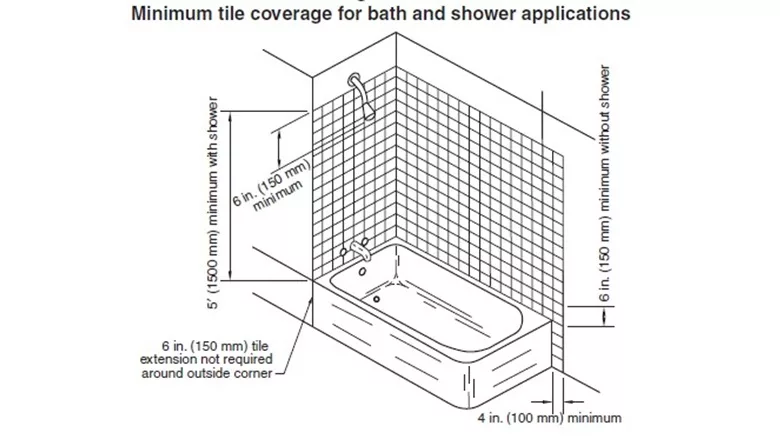
Higher than you might think. Appendix 2.2.6 in GA-216-2024 states tiles or wall panels shall overlap the top lip of the receptor or tub and cover completely: at least 6 inches above the tub rim for tubs without showerheads; at least 5 feet above the tub rim (or 6 inches above the showerhead, whichever is higher) for tubs with showerheads; and at least 6 feet above the shower dam (or 6 inches above the showerhead, whichever is higher) for shower stalls.
What about how the panel is installed and fastened?
Water-resistant gypsum panels conforming to ASTM C1178/C1178M or ASTM C1278/C1278M shall be applied perpendicularly, with the factory edge spaced a minimum of 1/4 inch above the lip of the receptor, tub, or sub-pan. In areas to receive tile, water-resistant gypsum backing board or glass mat water-resistant gypsum backing panels shall be attached with nails or screws spaced not more than 8 inches on center. Panels applied using adhesive only shall not be used as a base to receive tile.
Does the framing behind the tile matter?
Yes. GA-216-2024 Section 14.2 specifies that where ceramic tile is installed over gypsum panels, steel studs shall have a minimum base metal thickness of 0.0329 inch and be at least 3-1/2 inches deep for residential applications (3-5/8 inches for commercial), spaced no more than 16 inches on center.
Any finishing notes before the tile goes on?
Joints and fastener heads shall be finished to a minimum Level 2, as described in GA-214 Levels of Finish for Gypsum Panel Products, and treatment of joints under tile in wet areas shall use thin-set or tile adhesive, not joint compound.
The bottom line: tile hides a lot, but it does not compensate for the wrong substrate. GA-216-2024 makes the rules clear. Use the right panel, install it correctly, and the system will perform.
Looking for a reprint of this article?
From high-res PDFs to custom plaques, order your copy today!