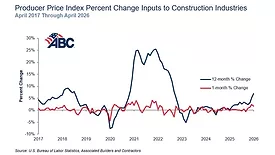
Construction input prices jumped 0.4% to 0.6% in November, marking the fastest annual increase since January 2023. With aluminum, steel, and energy costs climbing amid tariffs, contractors are raising bids, passing on costs, and planning cautiously—even as some remain optimistic about margins next year.
U.S. construction input prices rose modestly in September—marking five consecutive months of increases—while year-over-year costs remain significantly higher amid uncertainty over the impact of new material tariffs.
U.S. construction input prices rose modestly in September—marking five consecutive months of increases—while year-over-year costs remain significantly higher amid uncertainty over the impact of new material tariffs.
Construction input prices increased 0.2% in May compared to the previous month, according to an Associated Builders and Contractors analysis of U.S. Bureau of Labor Statistics’ Producer Price Index data.
Increases in nonresidential construction employment were tempered by declines in residential construction jobs; average hourly earnings up 4.7 percent as unemployment rate falls to 3.5 percent.
Increases in nonresidential construction employment were tempered by declines in residential construction jobs; average hourly earnings up 4.7 percent as unemployment rate falls to 3.5 percent.
Demand appeared strong on balance heading into 2024, but persistent shortage of skilled workers, lagging federal investments in infrastructure and tighter financing conditions may limit growth in outlays
Total construction spending increased by 0.9 percent in December and 13.9 percent year-over-year, as gains in residential and public segments offset mixed results among private nonresidential markets, according to an analysis of federal spending data the Associated General Contractors of America released Feb. 1.
National nonresidential construction spending increased by 0.4 percent in December, according to an Associated Builders and Contractors analysis of data published Feb. 1 by the U.S. Census Bureau. On a seasonally adjusted annualized basis, nonresidential spending totaled $1.174 trillion.
National nonresidential construction spending decreased 0.1 percent in November, according to an Associated Builders and Contractors analysis of data published by the U.S. Census Bureau on Jan. 2. On a seasonally adjusted, annualized basis, nonresidential spending totaled $1.143 trillion.
New spending data comes as construction association gets ready to release industry’s predictions for construction spending trends in 2024, need for new workers and planned investments in AI and other tech
Total construction spending increased by 0.4 percent in November, as a pickup in homebuilding and some private nonresidential markets offset a downturn in public spending, according to an analysis of federal spending data the Associated General Contractors of America released Jan. 2.