All Things Gypsum
Gypsum Board Townhouse Separation Wall Systems
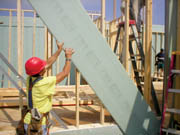
One of the most significant gypsum board system successes of the modern (i.e., post-World War II) gypsum board era, however, was actually a very simple adaptation of a previously developed product. That system is the gypsum board townhouse separation wall system (or as it is known in some regions, the area separation wall system).
Gypsum board townhouse separation wall systems are direct descendants of the gypsum board shaftwall systems that were first introduced into the non-residential marketplace in the '60s. Shaftwall systems use gypsum board liner panels placed between metal studs to create strong, durable duct and elevator shafts for use in high-rise buildings. In the '70s, the concept of using liner panels placed between studs was adapted to residential townhouse construction and the townhouse separation wall was born.
To develop the separation wall, industry research experts had to resolve a very basic riddle: how to comply with the specific model code requirements for a townhouse separation wall, while simultaneously creating an easy-to-install system. Their situation was confounded by basic model building code language that still considers a townhouse separation wall to be a firewall and mandates that it satisfy two basic requirements:
• It must be continuous from the foundation to the underside of the protected roof sheathing or continue through the roof to form a parapet.
• It must be designed to allow for collapse of the construction on the side of the wall exposed to fire without collapsing the separation wall.
For the research crews, satisfying the first requirement was relatively simple. For liner panels, once placed in studs, could easily be stacked end-to-end in a continuous fashion up to the height of a typical three-story townhouse and could incorporate a parapet. Keeping the wall in place following a fire required a more thoughtful solution, however, for it is the natural tendency of a structure to pull down the walls that it supports as it collapses during an intense fire.
That quandary was solved by the development of the L-shape aluminum separation wall clip. The system designers figured out that if they fastened the separation wall to the adjacent structure by using an L-shaped aluminum clip at each stud, at each floor or roof/ceiling intersection, sufficient lateral support would be provided for the wall when the structure on the opposite side of the wall collapsed. The clips they used were manufactured from aluminum and designed to maintain their full integrity until exposed to temperatures in excess of 1,100 degrees F.
The system was (and still is) designed so that when one side was exposed to a fire of that intensity, the clips would soften and break away, allowing the adjacent structure on that side of the system to collapse without pulling down the fire-resistive separation wall. The clips on the opposite side of the separation wall remained intact, since temperatures on that side were far below the point at which the clip will soften. Consequently, the fire-resistive wall system would remain standing, sparing the adjacent living space from significant damage.
In today's townhouse market, units are often constructed without parapets-the vertical segment of the wall that extends through the roof to a specific height, usually 30 to 36 inches above the roofline. Building codes generally allow for the elimination of a parapet in townhouse or apartment construction when the roof is covered with a code-specified minimum (usually a Class C) roofing material and the roof is constructed with either noncombustible material, fire retardant treated wood or a layer of 5/8-inch-thick type-X gypsum board placed immediately beneath combustible roof sheathing for a distance of at least 4 feet on either side of the separation wall.
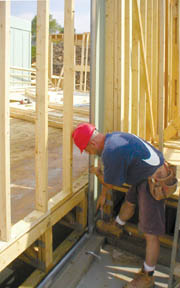
Gypsum board separation wall components
Gypsum board separation wall componentsGypsum board separation walls are typically constructed in either a solid (H-stud) or cavity-type configuration. The solid variety consists of three basic components:
• Gypsum liner panels that are 1 inch thick, 24 inches wide and either 8, 10, 12 or 14 feet long. Panels are manufactured with a noncombustible core and are surfaced with a facing material on the front, back, and along the edges.
• Metal framing members consisting of 2-inch-wide H-studs and U-shaped track.
• "Break away" L-shape aluminum clips that soften at relatively low temperatures.
Since they were first introduced in the townhouse and apartment construction market, gypsum board separation walls have gained a reputation for being easy and convenient to install and secure. For example, liner panels and metal components can be easily stacked, allowing the separation wall to be inserted during the framing phase of construction. Gypsum board separation walls must be installed using the components and installation methods described in the applicable fire test or listing. The installation should not deviate from that described in the test report, nor should the system include materials that were not evaluated in the original fire test.
Constructing a gypsum board separation wall system
Both solid and cavity-type gypsum board separation wall systems weigh no more than 10 pounds per square foot when erected-far less than comparable solid separation walls made of masonry or concrete. In most construction, gypsum board's light weight eliminates the need for costly footers or foundation modifications and it allows the systems to be erected directly onto a poured concrete slab.Solid systems are erected vertically one floor at a time. Two layers of 1-inch-thick liner panel are secured at the foundation by being inserted into 2-inch-wide tracks. The panels are held in place by 2-inch H-studs, and are erected sequentially along the track. Gypsum board separation walls can be erected up to four stories in height but should never be used as structural elements of a building. Due to variations in limiting height between systems, the gypsum board manufacturer should be consulted to determine the maximum height attainable with a specific system.
Each completed floor (story) of separation wall is capped with an inverted piece of track. Following the erection of the adjacent structural building frame, a new track is installed on the top of the completed floor of panels and the stacking process is repeated. Adjoining walls of framing members-typically referred to as "flanking walls"-are installed immediately adjacent and parallel to each side of the separation wall system. The flanking walls may provide support for the individual floors or the roof structure of the dwelling and when finished with gypsum board, are the visible surfaces of the separation wall system.
Solid separation wall systems must be disconnected from adjacent combustible framing members to be fully code compliant. The space requirement is easily met by setting the adjacent wood-framing members at least 3/4-inch to 1 inch away from the liner panels; the specific distance is established by the applicable fire test. If the space requirement cannot be met, the visible faces of the H-studs must be covered with 6-inch-wide gypsum board batten strips, full sheets of gypsum board or mineral fiber insulation.
Building codes typically require the space between the separation wall and the adjacent floor joists to be fire-blocked to prevent fire from spreading vertically between floors. This can be achieved easily when building with gypsum board separation walls by inserting continuous pieces of 1-inch gypsum board liner panel, mineral fiber insulation or other code-compliant material into the gap between the wall assembly and the adjacent floor joists. To ensure that it remains securely in place, fire-blocking material should be firmly attached to adjacent construction.
Cavity-type separation walls are constructed with components typically incorporated into either steel stud partition systems or gypsum board shaft wall enclosures, such as those used to enclose an elevator shaft or duct shaft in a multi-story building. As with solid systems, cavity-type separation walls are erected vertically, beginning with the installation of track at the foundation.
Once the fire-resistive portion of a solid-type separation wall system is erected and necessary electrical and mechanical work is in place, the adjacent flanking walls are finished with interior gypsum wallboard. The finished wallboard surfaces are visible to the dwelling occupants. Joints and fastener heads in the visible layers of the gypsum board separation wall system may require finishing to comply with the requirements of the applicable fire or sound test.
Where joint finishing is required by a fire test, it typically can be accomplished by applying a single coat of joint treatment and joint tape to the face layer board joints (Level 1 as described in "Recommended Levels of Gypsum Board Finish, GA-214") and a single coat of joint treatment to the fastener heads. Additional joint treatment may be applied to satisfy aesthetic requirements. Joints between individual pieces of liner panel in a solid system are protected by the H-studs and do not require joint treatment material.
With their inherent fire-resistive properties, gypsum board separation walls have become the wall systems of choice for an increasing number of multifamily designers and builders. Moreover, they fully comply with the requirements of all model building codes currently enforced in the United States.
Looking for a reprint of this article?
From high-res PDFs to custom plaques, order your copy today!




