Walls & Ceilings logo
search
cart
facebook twitter linkedin youtube youtube Spotify Podcasts Apple Podcasts Spotify Podcasts Apple Podcasts
  • Sign In
  • Create Account
  • Sign Out
  • My Account
Walls & Ceilings logo
  • NEWS
  • TOPICS
    • Drywall
    • Stucco/EIFS
    • Ceilings
    • Steel Framing
    • Fireproofing
    • Interior Plaster
    • Building Envelope
    • Insulation
    • Technology
    • Interior
    • Exterior
    • Women In Construction
  • COLUMNS
    • Up Front
    • All Things Gypsum
    • Art & Craft of Plastering
    • Stucco Stop
    • Steel Deal
    • Industry Voices
  • PRODUCTS
    • Buzz Guide
  • EVENTS
    • Industry Events
    • Webinars
    • BUILD Expo
  • MEDIA
    • Videos
    • Podcasts
    • Photo Galleries
    • BUILD26 Videos
    • Take our Quiz!
    • Infographics
  • EXCLUSIVE
    • Newsletters
    • Top 50 Contractors
    • Contractor of the Year
    • State of the Industry
    • W&C Store
    • Market Research
    • CEUs
    • Sponsor Insights
    • Custom Content & Marketing Services
  • DIRECTORY
  • EMAGAZINE
    • eMagazine
    • Advertise
    • Archive Issues
  • SIGN UP!
Columns

The Bridge
Referencing Techniques: Profiling
By J.M. Syken
September 27, 2001
Jeff discusses one of the lesser known techniques of referencing.

Figure 1
One of the least known and used methods of referencing in the estimating process is based on a common delineation technique used by architects, engineers and interior designers--it is generally referred to as profiling.

The most common and simplest use of profiling occurs when there is a chance in elevation from one surface to another. Essentially, a profile is a vertical section imposed on a plan or elevation. In reality, a plan is a horizontal cross section of a floor/area typically cut just above the window sill. Profiles typically found on plans and elevations highlight contours, curves, setbacks, steps, pilasters, vaults, domes, etc.

I was always aware of profiling and its effective use on drawings but I used it as an information source--not as a referencing tool. It was not until I went into the plaster and EIFS business for two years in the early '90s that I discovered its effective use as a referencing technique for estimating. It is very common for plaster work--particularly ornamental plaster--to include curved surfaces, domes, vaults, coves, pilasters and niches. To highlight these conditions on the drawings, I noticed an increased use of profiling by the architects/interior designers for this trade's work. To indicate the presence of a cove around the perimeter of a room or a dome in the center, there would often be imposed on the RCP a profile showing the cove, flat ceiling and dome. I found this to be very helpful in understanding what was going on without having to refer to sections and or elevations to understand the complexities of the ceiling work.

Figure 2

A picture is worth a thousand words

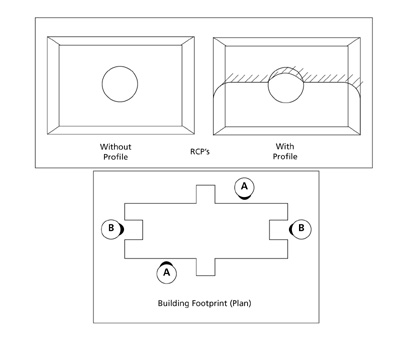
Though it was and is more prevalent in ornamental plaster work than in drywall, the designer did not always include a profile. I found that to fully understand an RCP, I was superimposing a profile on the plan myself in many instances if it was not previously indicated. Above is an example of an RCP for a room without and with a profile. The room has a perimeter cove and center dome.

The RCP with a profile is much more informative and easily understood. Useful as profiling was for the plaster trade, I found profiling to be especially useful and necessary for performing quantity surveys for EIFS. With EIFS, one is dependent on the building elevations to define the scope of the work and determine quantities. This requires coordination with floor plans and sections. The building elevations are the main source for determining quantities that include surface area of EIFS, reveals, cornices, bands, rustication, color, material and system changes. Profiling the building elevations to define such conditions proved extremely helpful for the purpose of color coding and determining quantities accurately.

The example of profiling to the side shows a building's footprint (plan) and accompanying exterior building elevations (figure 1).

This example graphically illustrates the profile's effectiveness. The front/rear ("A") elevations have a protrusion in the middle of the elevation(s). The side(s) ("B") have a recess in the middle of the elevation(s). The building's footprint confirms this. Without the superimposed profile, you would have to refer to the footprint to know this. With the profile, it's a no-brainer.

As a further measure, I will superimpose the profile on each elevation to scale on the elevation. This eliminates the need to measure off of the plan to determine quantities. With the depth and height of the protrusion and/or recess indicated on the elevation(s), I simply distinguish them as separate quantities determinable from the elevation(s).

Profiles are effective wherever there is a change in elevation or height between surfaces. Currently, I am working on a project inclusive of a lecture hall with tiered seating. To understand the height changes--which affect the light-gauge framing that supports it--I superimposed a profile (to scale) of the height changes between tiers on the floor plan. I used sections and elevations to determine these height changes and coordinated it with the plan. I use profiles whenever I need to understand the two-dimensional plan in three-dimensional terms quickly and easily. Profiles give the lines on the paper enhanced meaning and depth of understanding. Using them effectively makes the estimator's task easier and more efficient. Like other forms of referencing, it requires an investment in time on one's part but pays back immediately.

Share This Story

Looking for a reprint of this article?
From high-res PDFs to custom plaques, order your copy today!

Jeffrey M. Syken is a consulting estimator in private practice. He is a lecturer on the subject of trade estimating, as well as the author of a book on the subject entitled "Principles of Trade Estimating" available from Bni Building News.

Recommended Content

JOIN TODAY
To unlock your recommendations.

Already have an account? Sign In

  • Abercrombie & Fitch

    EIFS in 2026: How Specialty Finishes Are Redefining Exterior Wall Systems

    As building codes, owner expectations, and design demands...
    Stucco/EIFS
    By: Regi Mendoza
  • proper air and vapor control

    From Energy Efficiency to Moisture Management: Why Air and Vapor Control Matter

    How proper air and vapor control within building...
    Building Envelope
    By: Benjamin Meyer AIA, LEED AP
  • Linear Metal Ceiling Beam Baffles

    Top 25 Ceiling Contractors of 2026

    Suspended ceilings demand precision, code compliance and...
    Ceilings
    By: John Wyatt and Tanja Kern
You must login or register in order to post a comment.

Report Abusive Comment

Manage My Account
  • eMagazine Subscription
  • Newsletters
  • Online Registration
  • Manage My Preferences
  • Subscription Customer Service

More Videos

Sponsored Content

Sponsored Content is a special paid section where industry companies provide high quality, objective, non-commercial content around topics of interest to the Walls & Ceilings audience. All Sponsored Content is supplied by the advertising company and any opinions expressed in this article are those of the author and not necessarily reflect the views of Walls & Ceilings or its parent company, BNP Media. Interested in participating in our Sponsored Content section? Contact your local rep!

close
  • medical professionals moving a patient on a stretcher through the halls of a medical building
    Sponsored byNational Gypsum Company

    What Does High Performance Mean When It Comes To Gypsum Boards?

Popular Stories

Linear Metal Ceiling Beam Baffles

Top 25 Ceiling Contractors of 2026

Wichita Biomedical Campus

Wichita Drywall Worker Dies After Scaffolding Fall

QXO Just Changed the Game-Here's What Contractors Are Asking

QXO Just Changed the Game-Here's What Contractors Are Asking

Less compound

Joint Compound Market to Reach $9.7B by 2033

Events

June 24, 2026

The Bright Side & Benefits of Designing with Integrated Lighting

Credits 1 AIA LU/HSW; 0.1 ICC CEU

This course will explore the pivotal role architects and lighting design play in creating safer, more sustainable spaces. Learn how to avoid common lighting mistakes and make informed decisions that create the best visual environment for occupants. 

January 1, 2030

Webinar Sponsorship Information

For webinar sponsorship information, visit www.bnpevents.com/webinars or email webinars@bnpmedia.com.

See our full library of webinars

View All Submit An Event

Products

2026 National Painting Cost Estimator

2026 National Painting Cost Estimator

See More Products

Related Articles

  • The Bridge
    Referencing Techniques: Wall-Type Schematic Schedule (Part 1)

    See More
  • The Bridge
    Referencing Techniques: Wall-Type Schematic Schedule (Part 3)

    See More
  • The Bridge
    Referencing Techniques: Wall-Type Schematic Schedule (Part 4)

    See More

Related Products

See More Products
  • Architectural Acoustics: Principles and Practice, 2nd Edition

  • Drywall: Professional Techniques for Great Results, 4th Edition

See More Products

Events

View AllSubmit An Event
  • December 10, 2025

    Next-Level Drywall Corners: Live Demo of Precision Grooving Techniques

    On-Demand This webinar will feature a live demonstration that showcases an innovative approach to creating clean, accurate drywall corners using portable grooving technology.
View AllSubmit An Event

Related Directories

  • Estimating Edge

    Built by trade experts, The EDGE Estimator is a professional-grade all-in-one takeoff and estimating software solution. It’s robust and detailed enough for bids of any size and is intuitively designed to help both new and seasoned estimating professionals work smarter, bid sharper, and build better.
×

Connect with the industry’s leading resource for unparalleled insights and education.

Join thousands of industry professionals today. Shouldn’t you know what they know?

JOIN NOW
  • RESOURCES
    • Advertise
    • Contact Us
    • Directories
    • Store
    • Want More
  • SIGN UP TODAY
    • Create Account
    • eMagazine
    • Newsletters
    • Customer Service
    • Manage Preferences
  • SERVICES
    • Marketing Services
    • Reprints
    • Market Research
    • List Rental
    • Survey/Respondent Access
  • STAY CONNECTED
    • LinkedIn
    • Facebook
    • Instagram
    • YouTube
    • X
  • PRIVACY
    • PRIVACY POLICY
    • TERMS & CONDITIONS
    • DO NOT SELL MY PERSONAL INFORMATION
    • PRIVACY REQUEST
    • ACCESSIBILITY

Copyright ©2026. All Rights Reserved BNP Media, Inc. and BNP Media II, LLC.

Design, CMS, Hosting & Web Development :: ePublishing