Walls & Ceilings logo
search
cart
facebook twitter linkedin youtube youtube Spotify Podcasts Apple Podcasts Spotify Podcasts Apple Podcasts
  • Sign In
  • Create Account
  • Sign Out
  • My Account
Walls & Ceilings logo
  • NEWS
  • TOPICS
    • Drywall
    • Stucco/EIFS
    • Ceilings
    • Steel Framing
    • Fireproofing
    • Interior Plaster
    • Building Envelope
    • Insulation
    • Technology
    • Interior
    • Exterior
    • Women In Construction
  • COLUMNS
    • Up Front
    • All Things Gypsum
    • Art & Craft of Plastering
    • Stucco Stop
    • Steel Deal
    • Industry Voices
  • PRODUCTS
    • Buzz Guide
  • EVENTS
    • Industry Events
    • Webinars
    • BUILD Expo
  • MEDIA
    • Videos
    • Podcasts
    • Photo Galleries
    • BUILD26 Videos
    • Take our Quiz!
    • Infographics
  • EXCLUSIVE
    • Newsletters
    • Top 50 Contractors
    • Contractor of the Year
    • State of the Industry
    • W&C Store
    • Market Research
    • CEUs
    • Sponsor Insights
    • Custom Content & Marketing Services
  • DIRECTORY
  • EMAGAZINE
    • eMagazine
    • Advertise
    • Archive Issues
  • SIGN UP!

The Straight Scoop on Curves

By Frank Wheeler
March 1, 2006


We've been there before. The architect has created a great looking interior and has drawn lots of curves into the design. The owner loves it. The subcontractor loves getting the job. But he's a little worried about his crew's ability to handle all of those curves. Framing and finishing curves so they become an architectural statement rather than an embarrassment is critically important. After all, the subcontractor's reputation and future business with the architect is on the line. Everyone wants the work to be done right. And the subcontractor wants to make some kind of a reasonable profit, too.

The design features traditional Cherokee symbols while incorporating the art deco style for which Tulsa is known.

So, how does he make sure the curves will be smooth and uniform-just like the architect drew them? An option may be to use curvable track products that help workers make better curves in less time.

Such an example is Green Country Interiors, of Tulsa, Okla., the subcontractor that used more than 11,000 linear feet of hand-curveable track on the Cherokee Hotel and Casino, in Tulsa.

Green Country decided to use Flex-C Trac as opposed to the traditional method of "cutting and snipping" for various reasons but mostly due to the time/labor savings. The cutting and snipping method can take upwards of 20 to 30 minutes per 10-foot piece. By using the flexible track product, the subcontractor's labor was cut down to as little as five minutes per 10-foot piece. Since labor is one of the major expenses, it is encouraged that contractors compare overall costs of both methods.


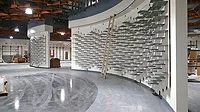
More than 11,000 linear feet of curveable track was used at the new Cherokee Hotel and Casino, Tulsa, to create sweeping elliptical walls and complex soffits.

Task at hand

"The project was demanding," says Billy Tobey, vice president and general manager of Green Country Interiors, commenting on the Cherokee Hotel and Casino. "We were challenged to find a way to save money without sacrificing the integrity of the final appearance."

This hotel has an elaborate interior that was designed to look and feel like Las Vegas. The interior design features traditional Cherokee symbols and incorporates art deco in its styling (this architectural movement is common in Tulsa). The seven-story hotel includes 80,000 square feet of gaming space. Its floorplan features numerous curved soffits and theme elements that rely heavily on compound radiuses.

The company was faced with day-to-day design modifications that had to be accommodated within an already-tight schedule. The first hurdle the subcontractor had to overcome was the design and value engineering process. The original basic set of drawings was found to be incomplete in the area of details. Challenged to find a way to not incur additional costs, yet not compromise the integrity of the original plans, Green Country was able to meet the demands of day-to-day modifications to the framing. With a job that included several varying curves, radiuses and integrated themes, the foremen of the company were heavily relied on to display their "know-how" to achieve the set goals of the jobs, working closely with the General Contractor Flintco Cos.


The curvable tracks helped the progression of the project since the products can be shaped by hand (on the job site) to form whatever curves were needed. Once all of these were formed, screws were run along one side of the track to lock it in place and then anchored to the floor. Additionally, Green Country had to install an identical mirror image curved track to the structure above. From there, the studs were slid into the track and anchored with screws through the track flanges. For curved soffits, contractors building a similar type of project will want to approach the framing similarly but suspend it by the top track.

Another reason the subcontractor used hand curveable track was to help create the best-looking finished product. Since curves are often the focal point of the building, it's good when the subcontractor can meet and exceed the expectations of the architect and owner. When tapers and finishers are given a smooth curved surface on which to apply their mud, they usually return the favor and make everyone proud.


If you read this article, please circle number 336.

Share This Story

Looking for a reprint of this article?
From high-res PDFs to custom plaques, order your copy today!

Frank Wheeler is the manager and owner of Flex-Ability Concepts LLC, as well as the inventor of the Flex-C Trac product line.

Recommended Content

JOIN TODAY
To unlock your recommendations.

Already have an account? Sign In

  • Abercrombie & Fitch

    EIFS in 2026: How Specialty Finishes Are Redefining Exterior Wall Systems

    As building codes, owner expectations, and design demands...
    Stucco/EIFS
    By: Regi Mendoza
  • proper air and vapor control

    From Energy Efficiency to Moisture Management: Why Air and Vapor Control Matter

    How proper air and vapor control within building...
    Building Envelope
    By: Benjamin Meyer AIA, LEED AP
  • Linear Metal Ceiling Beam Baffles

    Top 25 Ceiling Contractors of 2026

    Suspended ceilings demand precision, code compliance and...
    Ceilings
    By: John Wyatt and Tanja Kern
You must login or register in order to post a comment.

Report Abusive Comment

Manage My Account
  • eMagazine Subscription
  • Newsletters
  • Online Registration
  • Manage My Preferences
  • Subscription Customer Service

More Videos

Sponsored Content

Sponsored Content is a special paid section where industry companies provide high quality, objective, non-commercial content around topics of interest to the Walls & Ceilings audience. All Sponsored Content is supplied by the advertising company and any opinions expressed in this article are those of the author and not necessarily reflect the views of Walls & Ceilings or its parent company, BNP Media. Interested in participating in our Sponsored Content section? Contact your local rep!

close
  • medical professionals moving a patient on a stretcher through the halls of a medical building
    Sponsored byNational Gypsum Company

    What Does High Performance Mean When It Comes To Gypsum Boards?

Popular Stories

Linear Metal Ceiling Beam Baffles

Top 25 Ceiling Contractors of 2026

Wichita Biomedical Campus

Wichita Drywall Worker Dies After Scaffolding Fall

QXO Just Changed the Game-Here's What Contractors Are Asking

QXO Just Changed the Game-Here's What Contractors Are Asking

Less compound

Joint Compound Market to Reach $9.7B by 2033

Events

June 24, 2026

The Bright Side & Benefits of Designing with Integrated Lighting

Credits 1 AIA LU/HSW; 0.1 ICC CEU

This course will explore the pivotal role architects and lighting design play in creating safer, more sustainable spaces. Learn how to avoid common lighting mistakes and make informed decisions that create the best visual environment for occupants. 

January 1, 2030

Webinar Sponsorship Information

For webinar sponsorship information, visit www.bnpevents.com/webinars or email webinars@bnpmedia.com.

See our full library of webinars

View All Submit An Event

Products

2026 National Painting Cost Estimator

2026 National Painting Cost Estimator

See More Products

Related Articles

  • NAIMA Logo

    Setting the Record Straight on Low-Carbon Insulation and Buildings

    See More
  • cycle gear

    Controlling Curves

    See More
  • Flex-Ability Concepts Gila River Indian Community Center Picture 2

    Curves Reflect Cycle of Life and the Importance of Gathering at the Gila River Indian Community Center

    See More

Related Products

See More Products
  • building codes illustated.jpg

    Building Codes Illustrated: A Guide to Understanding the 2021 International Building Code, 7th Edition

  • Lean Builder book cover - front.jpg

    The Lean Builder

See More Products
×

Connect with the industry’s leading resource for unparalleled insights and education.

Join thousands of industry professionals today. Shouldn’t you know what they know?

JOIN NOW
  • RESOURCES
    • Advertise
    • Contact Us
    • Directories
    • Store
    • Want More
  • SIGN UP TODAY
    • Create Account
    • eMagazine
    • Newsletters
    • Customer Service
    • Manage Preferences
  • SERVICES
    • Marketing Services
    • Reprints
    • Market Research
    • List Rental
    • Survey/Respondent Access
  • STAY CONNECTED
    • LinkedIn
    • Facebook
    • Instagram
    • YouTube
    • X
  • PRIVACY
    • PRIVACY POLICY
    • TERMS & CONDITIONS
    • DO NOT SELL MY PERSONAL INFORMATION
    • PRIVACY REQUEST
    • ACCESSIBILITY

Copyright ©2026. All Rights Reserved BNP Media, Inc. and BNP Media II, LLC.

Design, CMS, Hosting & Web Development :: ePublishing