All Things Gypsum: Meeting Code Requirements with Gypsum Sheathing
Zoning laws and building codes have long recognized the inherent risk of constructing structures in close proximity. For example, the 2006 International Residential Code (IRC) requires the exterior walls on houses built within five feet of the lot-line that separates adjacent dwellings to have a one-hour fire-resistance rating. There are many ways to meet these requirements, but one of the most affordable is to use fire-resistance-rated gypsum sheathing as a component part of a system that provides the one-hour rating.
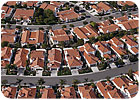
Information published by the National Association of Home Builders indicates that the average new single-family house is approximately 50 percent larger than it was a few decades ago. Couple that with decreasing land availability in many new residential neighborhoods, and one can almost lean out the window to borrow a cup of sugar from a neighbor. This may be great for getting to know the family next door (including their business, now that you can hear the noisier ones without wanting to), but it does not bode well for your house if your neighbor’s house catches on fire.
Zoning laws and building codes have long recognized the inherent risk of constructing structures in close proximity. For example, the 2006 International Residential Code (IRC) requires the exterior walls on houses built within five feet of the lot-line that separates adjacent dwellings to have a one-hour fire-resistance rating. Similar distance-related requirements are contained within the International Building Code and were a part of the three predecessor model codes-BOCA, Standard, and Uniform-that were sunset in 2000.
There are many ways to meet these requirements, but one of the most affordable is to use fire-resistance-rated gypsum sheathing as a component part of a system that provides the one-hour rating. Using gypsum sheathing in these conditions offers several benefits for both residential and light commercial construction.
It is also considered to be a non-combustible material as defined by model building codes. As a consequence, it can be easily integrated into building types that mandate the use of non-combustible materials, specifically exterior wall assemblies.
Gypsum sheathing is also dimensionally stable, structurally resilient, and has been tested and shown to resist cracking. It can be readily incorporated into walls that resist seismic or wind loads. In many instances gypsum sheathing can perform as both a fire-resistant and structural element of an exterior wall system. This may eliminate the need to incorporate additional building materials into the wall system.
In addition, while building codes rarely address the issue, “green” standards are increasingly prescribing environmental requirements for sound transmission between structures. Gypsum sheathing is the right density and composition to isolate and impede the passage of unwanted noise. Many sound attenuating building system designs use gypsum products as the primary material for preventing the passage of sound from one area to another. The use of gypsum sheathing provides a layer of sound protection that helps insulate occupants from exterior noise sources.
Nonetheless, there are several differences between installing interior gypsum board and gypsum sheathing that warrant discussion.
First and foremost, forget in general finishing the joints between sheets of gypsum sheathing. There are exceptions to this rule, primarily systems where the sheathing is used as part of a drainage management system and has been specifically tested with sealed joints, but, because the sheathing is a substrate that gets covered with any number of exterior claddings – including most types of siding, masonry veneer, stucco, and several others – the joints between individual sheets of sheathing typically do not require finishing. This includes situations when it is used in a fire-resistive system; language in building codes and evaluation reports typically exempts gypsum sheathing systems from finishing requirements in these circumstances.
To keep gypsum sheathing in serviceable condition, it is necessary to store it off the ground and stacked flat on supports or risers that are close enough to each other to prevent the board from sagging. In addition, a unit of gypsum board typically comes from the manufacturer to the dealer encased in plastic shipping wrap. This wrapping must be removed so that any moisture trapped inside the wrapping can escape; however, the board must then be protected from the elements until it is installed.
Paper-faced gypsum sheathing is manufactured to endure one-month’s exposure to the elements under normal weather conditions. If paper-faced gypsum sheathing has been in place for over a month before the siding or other cladding material is installed, or the anticipated weather is expected to be relatively severe, a water-resistive barrier must be mechanically installed over the sheathing before the cladding material is installed. Gypsum sheathing manufactured with facing other than paper may have a different exposure capability or exposure requirements. Consultation with the specific manufacturer is suggested in each instance.
Some sheathing is also manufactured with a tongue-and-groove (T&G) edge configuration. Unlike interior gypsum board, T&G-edge board has to be installed with the joints oriented perpendicular to framing members and with the “tongue” facing up and the “groove” facing down. Doing otherwise increases the potential for moisture to migrate between adjacent sheets of board.
When attaching to wood framing, the fasteners must penetrate a sufficient depth into the wood to ensure the board stays attached. For attachment of 1/2-inch gypsum sheathing, nails and staples must be 1 1/2 inches long, and screws must be 1 1/4 inches long. For attachment of 5/8-inch gypsum sheathing, nails must be 1 3/4 inches long, and staples and screws must be 1 5/8 inches long. Screws used to attach 1/2-inch gypsum sheathing to steel framing must be 1 inch long, and screws used to attach 5/8-inch gypsum sheathing to steel framing must be 1 1/4 inches long.
Gypsum sheathing offers an impressive number of benefits when used in residential and light commercial construction. The fire-resistance, sound attenuation, ease and speed of application, availability, and low cost of gypsum sheathing can help builders and contractors meet their customers’ needs affordably and meet code requirements for fire-resistance-rated construction.
For more information on gypsum sheathing, you can download the following documents from the Gypsum Association’s website at www.gypsum.org : GA-253-07, Application of Gypsum Sheathing; and GA-254-07, Fire-Resistant Gypsum Sheathing.
Information published by the National Association of Home Builders indicates that the average new single-family house is approximately 50 percent larger than it was a few decades ago. Couple that with decreasing land availability in many new residential neighborhoods, and one can almost lean out the window to borrow a cup of sugar from a neighbor. This may be great for getting to know the family next door (including their business, now that you can hear the noisier ones without wanting to), but it does not bode well for your house if your neighbor’s house catches on fire.
Zoning laws and building codes have long recognized the inherent risk of constructing structures in close proximity. For example, the 2006 International Residential Code (IRC) requires the exterior walls on houses built within five feet of the lot-line that separates adjacent dwellings to have a one-hour fire-resistance rating. Similar distance-related requirements are contained within the International Building Code and were a part of the three predecessor model codes-BOCA, Standard, and Uniform-that were sunset in 2000.
There are many ways to meet these requirements, but one of the most affordable is to use fire-resistance-rated gypsum sheathing as a component part of a system that provides the one-hour rating. Using gypsum sheathing in these conditions offers several benefits for both residential and light commercial construction.
WHY IT WORKS
First and foremost, gypsum board is naturally fire-resistant and, in a situation where a system’s fire-resistance is mandated, is easily incorporated into systems that provide a specific fire resistance. The mineral itself contains chemically combined water that is released as steam when subjected to the heat of a fire. Type X fire-resistance-rated gypsum sheathing contains additional core additives that enable it to resist the spread of flames and smoke longer than regular gypsum products.It is also considered to be a non-combustible material as defined by model building codes. As a consequence, it can be easily integrated into building types that mandate the use of non-combustible materials, specifically exterior wall assemblies.
Gypsum sheathing is also dimensionally stable, structurally resilient, and has been tested and shown to resist cracking. It can be readily incorporated into walls that resist seismic or wind loads. In many instances gypsum sheathing can perform as both a fire-resistant and structural element of an exterior wall system. This may eliminate the need to incorporate additional building materials into the wall system.
In addition, while building codes rarely address the issue, “green” standards are increasingly prescribing environmental requirements for sound transmission between structures. Gypsum sheathing is the right density and composition to isolate and impede the passage of unwanted noise. Many sound attenuating building system designs use gypsum products as the primary material for preventing the passage of sound from one area to another. The use of gypsum sheathing provides a layer of sound protection that helps insulate occupants from exterior noise sources.
APPLICATION AND USE
Gypsum sheathing is installed much the same way that interior gypsum board is, so any competent drywall contractor will be very comfortable installing gypsum sheathing. It can be easily cut using a variety of tools including a utility knife or power saw. It can be quickly attached to wood framing using nails, screws, or staples; it can be easily attached to steel framing with screws. It is available in four-foot widths and several lengths, so it can cover larger areas than other four-by-eight panel products that are often used for exterior sheathing.Nonetheless, there are several differences between installing interior gypsum board and gypsum sheathing that warrant discussion.
First and foremost, forget in general finishing the joints between sheets of gypsum sheathing. There are exceptions to this rule, primarily systems where the sheathing is used as part of a drainage management system and has been specifically tested with sealed joints, but, because the sheathing is a substrate that gets covered with any number of exterior claddings – including most types of siding, masonry veneer, stucco, and several others – the joints between individual sheets of sheathing typically do not require finishing. This includes situations when it is used in a fire-resistive system; language in building codes and evaluation reports typically exempts gypsum sheathing systems from finishing requirements in these circumstances.
To keep gypsum sheathing in serviceable condition, it is necessary to store it off the ground and stacked flat on supports or risers that are close enough to each other to prevent the board from sagging. In addition, a unit of gypsum board typically comes from the manufacturer to the dealer encased in plastic shipping wrap. This wrapping must be removed so that any moisture trapped inside the wrapping can escape; however, the board must then be protected from the elements until it is installed.
Paper-faced gypsum sheathing is manufactured to endure one-month’s exposure to the elements under normal weather conditions. If paper-faced gypsum sheathing has been in place for over a month before the siding or other cladding material is installed, or the anticipated weather is expected to be relatively severe, a water-resistive barrier must be mechanically installed over the sheathing before the cladding material is installed. Gypsum sheathing manufactured with facing other than paper may have a different exposure capability or exposure requirements. Consultation with the specific manufacturer is suggested in each instance.
Some sheathing is also manufactured with a tongue-and-groove (T&G) edge configuration. Unlike interior gypsum board, T&G-edge board has to be installed with the joints oriented perpendicular to framing members and with the “tongue” facing up and the “groove” facing down. Doing otherwise increases the potential for moisture to migrate between adjacent sheets of board.
ATTACHMENT
As mentioned earlier, gypsum sheathing may be attached to framing or another substrate using nails, screws, and staples. Fastener heads on the fasteners used to attach gypsum sheathing should be set flush or slightly into the board, but, like interior gypsum board, should not be set so deep as to break the paper surface. Since there is no finishing of the board, there is no need to leave a dimple around the fastener head to accommodate joint treatment material.When attaching to wood framing, the fasteners must penetrate a sufficient depth into the wood to ensure the board stays attached. For attachment of 1/2-inch gypsum sheathing, nails and staples must be 1 1/2 inches long, and screws must be 1 1/4 inches long. For attachment of 5/8-inch gypsum sheathing, nails must be 1 3/4 inches long, and staples and screws must be 1 5/8 inches long. Screws used to attach 1/2-inch gypsum sheathing to steel framing must be 1 inch long, and screws used to attach 5/8-inch gypsum sheathing to steel framing must be 1 1/4 inches long.
LIMITATIONS
Paper-faced gypsum sheathing is not intended for use on ceiling or soffit areas, window sills, or other horizontal surfaces that would normally receive paint or would be subject to standing water, unless these areas are to be clad with Portland cement plaster/stucco or another approved or tested system. When Portland cement plaster/stucco finish is applied over paper-faced gypsum sheathing, a mechanically attached water-resistive barrier must be put into place prior to the installation of the lath. Other systems may have similar requirements. Flashings around windows and other penetrations must be properly integrated with the water-resistive barrier to ensure proper drainage of water.Gypsum sheathing offers an impressive number of benefits when used in residential and light commercial construction. The fire-resistance, sound attenuation, ease and speed of application, availability, and low cost of gypsum sheathing can help builders and contractors meet their customers’ needs affordably and meet code requirements for fire-resistance-rated construction.
For more information on gypsum sheathing, you can download the following documents from the Gypsum Association’s website at www.gypsum.org : GA-253-07, Application of Gypsum Sheathing; and GA-254-07, Fire-Resistant Gypsum Sheathing.
Looking for a reprint of this article?
From high-res PDFs to custom plaques, order your copy today!




