Schools & Stucco: Made for Each Other
Stucco cement exterior cladding gets high marks for design flexibility, durability and safety in educational institutions
When it comes to an exterior cladding, one would be hard-pressed to find something more suitable than cement stucco for schools. Architectural styles may go through phases and fads, and while another material may gain some popularity, architects always return to cement stucco.
It’s easy to see why stucco will never die out as the predominant cladding for schools and other institutional buildings. Everyone knows that stucco is durable, economical and abuse-resistant, but cement stucco is also considered a plastic mass (it can be formed and molded until it hardens), making it perfect to form to a variety of shapes. This makes it appealing to designers who want to create buildings without being limited to basic straight lines, as they would be with other materials. However, these reasons are only the tip of the proverbial iceberg on why traditional cement stucco continues to be popular throughout the United States and Canada.

Stucco is an obvious choice in hot sunny climates. The cement finish can hold up to a harsh sun like no other cladding. I lived for years in Palm Springs, where summer days would typically reach well over 100 F, and make many other products look decades old in just two summers. Not stucco: Stucco can take it.
Many people from the South tend to be shocked by the fact that stucco is also excellent for cold and wet climates. I know I was surprised to learn how suitable stucco was in cold areas. Spending a lot of time in Alaska and Canada, I learned the freeze-thaw weather has little to no effect on properly designed and applied stucco. The past success of stucco in Anchorage, Ala., has led the local school district to put stucco at the top of the list as a cladding choice.
Contrary to urban legends in construction, cement stucco is not porous. Properly mixed and applied, independent laboratory tests have proven that the stucco membrane is highly water-resistant and vapor permeable. This makes cement stucco one of the most unique and affordable claddings in the world.
The maintenance factor is not overlooked by school districts. Stucco needs very minimal maintenance over its service life. This statement is confirmed by an ASTM (American Society of Testing Materials) published report. Another factor that architects really like is that stucco is covered in the building codes and is a generic system. Right or wrong, architects prefer generic systems.
I was fortunate to tour with Mr. Taylor on a series of stucco seminars across Canada. While Mr. Taylor reported on the test data from the universities, I spoke on proper practices for application of stucco. We spent evenings sharing and comparing notes. We learned from each other.
The combination of metal or fabric lath encased in portland cement provides remarkable shear values. Similar to cable reinforced concrete, the lath provides tensile strength and the cement provides the compressive strength. An important and often overlooked feature is the connection of the lath to the framing members. Staples and nails are both allowed by code. Staples typically performed better because a staple engages the lath more completely and thus does not allow the lath wire to slip out, as it would from under the head of the nail. Nails performed well only when two nails were used on both sides of the wire lath. I noted that many older lathers made it a practice to alternate the placement of the nails on the side of the lath when using welded or woven wire to provide better shear resistance. Taylor felt this made good engineering sense.
After the seismic testing and studies were completed on the buildings with a variety of claddings, they were rated as follows:
1. Unsurvivable
2. Survivable with major repairs needed
3. Survivable with moderate repairs
4. Survivable with minor repairs.
The cement stucco cladding, applied per plaster industry recommendations, was the only framed wall to rate a 4. This makes stucco a perfect choice for schools to provide the life/safety requirements current codes demand. Even the stucco wall with no sheathing beneath the stucco performed well. The cement membrane cracked and the continuous encased lath held the wall assembly together with minimal lateral movement. The studies concluded the addition of traditional cement stucco reduced the lateral movement by as much as 300 percent.
All of this data explained why buildings in Southern California typically fared better than in other cities with similar-strength earthquakes.
The recent concerns over moisture intrusion and mold in buildings have led some designers to opt for additional drainage with exterior walls. Faster drainage with a secondary moisture barrier seems to be the new desire by most designers. Manufacturers are answering the call with a variety of drainage mats designed for use behind stucco. These drainage mats are installed over the weather-resistive barrier to create a small drainage cavity to allow water that may find its way behind the cement membrane a clear and easy path to drain to an exit point at the base of the wall. All plaster industry associations and independent testing by Oak Ridge Laboratories have concluded that building paper behind stucco provides adequate moisture protection even in severe weather areas. However, adding a drainage mat (designed for stucco) will not have a negative impact on the system and does increase the drainage rate. The testing facilities also tested a rainscreen (strapped) cavity stucco assembly and found no depreciable reduction in lateral shear support.
Another recent change to stucco is the advent of using EPS (Expanded Polystyrene) shapes over the stucco base coat to create inexpensive decorative shapes, such as plant-ons, quoins and cornices. These foam trim items can be cut into any imaginable shape to add character to even a plain stucco façade. The shapes are adhesively applied over the cement basecoat and then covered with a fiberglass mesh troweled into a polymer-enriched cement basecoat. The finish coat is then applied over the stucco and foam shapes. The type of finish (cement versus acrylic) will dictate the proper type of polymer-enriched basecoat that should be used to cover the foam shape. Foam shapes are not as abuse-resistant as traditional cement stucco and use on schools should be limited to inaccessible areas by students.
How many exterior claddings are completely fabricated on-site from basic piles of raw materials? This means the applicator is truly the key to the success of the stucco and not all applicators understand the system and related items they are installing. Unfortunately, there is no shortage of stucco experts. Many proclaimed stucco instructors or experts fail to fully comprehend the system. Some are even featured at seminars. This would include some building envelope experts who may understand vapor drive and other building science related issues, but do not understand the stucco system and the constructability issues that are intricately related to the success of the system. I still encourage all plasterers to attend as many seminars as possible on stucco; keeping an open mind to new ideas, while being skeptical of the speaker’s underlying motives. Some are pushing related products or services for personal gain or business expansion.
The State of Washington prefers stucco as a cladding for its public schools.
When it comes to an exterior cladding, one would be hard-pressed to find something more suitable than cement stucco for schools. Architectural styles may go through phases and fads, and while another material may gain some popularity, architects always return to cement stucco.
It’s easy to see why stucco will never die out as the predominant cladding for schools and other institutional buildings. Everyone knows that stucco is durable, economical and abuse-resistant, but cement stucco is also considered a plastic mass (it can be formed and molded until it hardens), making it perfect to form to a variety of shapes. This makes it appealing to designers who want to create buildings without being limited to basic straight lines, as they would be with other materials. However, these reasons are only the tip of the proverbial iceberg on why traditional cement stucco continues to be popular throughout the United States and Canada.
The History Department
Cement plaster-type materials have been used for thousands of years. However, portland cement is a relatively new innovation. Early cement plaster consisted primarily of lime cement. It wasn’t until 1824 when an English bricklayer named Joseph Aspdin was credited with inventing a hydraulic cement. His new cement creation was relatively unaffected by weather and moisture; the mixture would even harden under water. This was an important feature, because traditional lime cement plasters and mortars would wear away and have to be patched every so often. Modern cement plaster still uses lime as an ingredient to make the material more workable, but the modern portland cement plasters are much more durable. Joseph named his miracle product portland cement because it resembled a stone from the isle of Portland, long thought of as the best and longest-lasting stone for building. No one is sure where or even when the term stucco became popular, but as a cladding that just gets stronger as it ages, it’s a natural.Stucco can be done with interesting textures. A combed texture pattern can add eye-appeal.
Geography Class
Stucco is not just for the Southwest. It has proven itself serviceable in a variety of climates and been used successfully in all regions of Canada and the United States. This is not to imply that all stucco jobs are successful. Success or failure depends on the design, materials selected and proper application. All references in this article to stucco refer to a “properly” designed and applied stucco system. Properly done, stucco is one of the best claddings available; done improperly, stucco can quickly turn into a nightmare.Stucco is an obvious choice in hot sunny climates. The cement finish can hold up to a harsh sun like no other cladding. I lived for years in Palm Springs, where summer days would typically reach well over 100 F, and make many other products look decades old in just two summers. Not stucco: Stucco can take it.
Many people from the South tend to be shocked by the fact that stucco is also excellent for cold and wet climates. I know I was surprised to learn how suitable stucco was in cold areas. Spending a lot of time in Alaska and Canada, I learned the freeze-thaw weather has little to no effect on properly designed and applied stucco. The past success of stucco in Anchorage, Ala., has led the local school district to put stucco at the top of the list as a cladding choice.
Science Class
Stucco is a natural product typically made from local minerals and aggregates. When applied to 7/8-inch thickness, it provides a one-hour fire-resistive membrane.Contrary to urban legends in construction, cement stucco is not porous. Properly mixed and applied, independent laboratory tests have proven that the stucco membrane is highly water-resistant and vapor permeable. This makes cement stucco one of the most unique and affordable claddings in the world.
The maintenance factor is not overlooked by school districts. Stucco needs very minimal maintenance over its service life. This statement is confirmed by an ASTM (American Society of Testing Materials) published report. Another factor that architects really like is that stucco is covered in the building codes and is a generic system. Right or wrong, architects prefer generic systems.
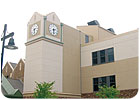
A recently completed California School with stucco.
Engineering Class
A few years ago another benefit of stucco was rediscovered. After the Northridge earthquake in California, structural engineers noticed that framed buildings clad in traditional 3-coat cement stucco fared much better than other buildings similarly framed but with alternate claddings. Engineers ran full-scale seismic tests on two-story homes with and without stucco. The University of British Columbia did similar testing, recreating the Northridge and Kobe earthquakes. They built complete 2,000 square foot, two-story buildings on large shaker tables. The results were astonishing. The team discovered stucco added more shear value than anyone had anticipated. The results led Graham Taylor, P. eng., who headed up the testing in Vancouver, B.C., to urge the Canadian government to “strongly consider using stucco on all public buildings needing to provide services after a major earthquake.”I was fortunate to tour with Mr. Taylor on a series of stucco seminars across Canada. While Mr. Taylor reported on the test data from the universities, I spoke on proper practices for application of stucco. We spent evenings sharing and comparing notes. We learned from each other.
The combination of metal or fabric lath encased in portland cement provides remarkable shear values. Similar to cable reinforced concrete, the lath provides tensile strength and the cement provides the compressive strength. An important and often overlooked feature is the connection of the lath to the framing members. Staples and nails are both allowed by code. Staples typically performed better because a staple engages the lath more completely and thus does not allow the lath wire to slip out, as it would from under the head of the nail. Nails performed well only when two nails were used on both sides of the wire lath. I noted that many older lathers made it a practice to alternate the placement of the nails on the side of the lath when using welded or woven wire to provide better shear resistance. Taylor felt this made good engineering sense.
After the seismic testing and studies were completed on the buildings with a variety of claddings, they were rated as follows:
1. Unsurvivable
2. Survivable with major repairs needed
3. Survivable with moderate repairs
4. Survivable with minor repairs.
The cement stucco cladding, applied per plaster industry recommendations, was the only framed wall to rate a 4. This makes stucco a perfect choice for schools to provide the life/safety requirements current codes demand. Even the stucco wall with no sheathing beneath the stucco performed well. The cement membrane cracked and the continuous encased lath held the wall assembly together with minimal lateral movement. The studies concluded the addition of traditional cement stucco reduced the lateral movement by as much as 300 percent.
All of this data explained why buildings in Southern California typically fared better than in other cities with similar-strength earthquakes.
The recent concerns over moisture intrusion and mold in buildings have led some designers to opt for additional drainage with exterior walls. Faster drainage with a secondary moisture barrier seems to be the new desire by most designers. Manufacturers are answering the call with a variety of drainage mats designed for use behind stucco. These drainage mats are installed over the weather-resistive barrier to create a small drainage cavity to allow water that may find its way behind the cement membrane a clear and easy path to drain to an exit point at the base of the wall. All plaster industry associations and independent testing by Oak Ridge Laboratories have concluded that building paper behind stucco provides adequate moisture protection even in severe weather areas. However, adding a drainage mat (designed for stucco) will not have a negative impact on the system and does increase the drainage rate. The testing facilities also tested a rainscreen (strapped) cavity stucco assembly and found no depreciable reduction in lateral shear support.
The Art Department
While most stucco we see has a sand finish texture, there are options for finishing stucco. Textures can range from smooth to very heavy. The textures possible are only limited by the imagination and creativity of the designer and the plasterer. For examples of the possible plaster textures, visit the Technical Information Services Bureau website www.tsib.org and click on plaster textures. There are 34 standard textures ranging from sand to simulated timber. There are color photographs of each texture with a brief description of the application procedure. Acrylic finishes typically used for EIFS (Exterior Insulated Finish Systems) can be used in lieu of a typical cement finish. The acrylic finish products, while limited in texture possibilities, offer greater range of color selection and deeper tones.Another recent change to stucco is the advent of using EPS (Expanded Polystyrene) shapes over the stucco base coat to create inexpensive decorative shapes, such as plant-ons, quoins and cornices. These foam trim items can be cut into any imaginable shape to add character to even a plain stucco façade. The shapes are adhesively applied over the cement basecoat and then covered with a fiberglass mesh troweled into a polymer-enriched cement basecoat. The finish coat is then applied over the stucco and foam shapes. The type of finish (cement versus acrylic) will dictate the proper type of polymer-enriched basecoat that should be used to cover the foam shape. Foam shapes are not as abuse-resistant as traditional cement stucco and use on schools should be limited to inaccessible areas by students.
Law School
Unlike any other system, stucco is as simple as it is complicated. Properly done, it works anywhere, in any climate and lasts a lifetime; improperly done, it will lead to problems and eventually to court.How many exterior claddings are completely fabricated on-site from basic piles of raw materials? This means the applicator is truly the key to the success of the stucco and not all applicators understand the system and related items they are installing. Unfortunately, there is no shortage of stucco experts. Many proclaimed stucco instructors or experts fail to fully comprehend the system. Some are even featured at seminars. This would include some building envelope experts who may understand vapor drive and other building science related issues, but do not understand the stucco system and the constructability issues that are intricately related to the success of the system. I still encourage all plasterers to attend as many seminars as possible on stucco; keeping an open mind to new ideas, while being skeptical of the speaker’s underlying motives. Some are pushing related products or services for personal gain or business expansion.
Looking for a reprint of this article?
From high-res PDFs to custom plaques, order your copy today!