Trowel Talk: Working Class Hero
According to the U.S. Department of Labor - Bureau of Labor Statistics, there are approximately 6 million citizens or legal residents of the United States between the ages of 18 and 64 who are actively seeking work, but who are unemployed. What happened?
.jpg)
According to the U.S. Department of Labor - Bureau of Labor Statistics, there are approximately 6 million citizens or legal residents of the United States between the ages of 18 and 64 who are actively seeking work, but who are unemployed. We continue to see businesses relocate their manufacturing plants and outsource their high-technology jobs to foreign lands, and undocumented immigrants coming to America to find jobs some say, “no one else wants ...”
As I travel in my day job, I have the opportunity to visit both inner cities and remote rural communities that are plagued with poverty. I am shocked by the conditions that exist in places in America that once flourished with economic vitality. What happened?
A basic principle of physics is, “for every action there is an equal and opposite reaction.”

Most who read this column are probably baby-boomers or the offspring of “boomers.” We were born some time after the hardships of WWII. We know of the Industrial Revolution and the coming together of America to fight Nazism and Fascism only from history books, stories passed down from our parents or grandparents, and documentaries on the History Channel. What we may remember, and certainly benefited from, is the period of prosperity that followed the end of the war. Soldiers returned home to begin raising families; and new families needed new homes. As a result, the largest residential construction boom in American history began.
There was an energy generated from this need to come home and build a normal life. This desire was reflected in our TV shows of the day; Ozzie and Harriett, Father Knows Best, and Leave it to Beaver, among others. An important part of the “dream” included employment; secure employment earned from hard work and responsible behavior. We believed that if we applied ourselves, we would be rewarded with the ability to sustain this “Dream.”
The economic engine that drove the prosperity of the 1950s and ‘60s was in large part fueled by the need to fulfill this promise. Somewhere in the 1970s, along with the first energy crisis, Watergate, Vietnam, and gasoline rationing, the dream began to fade, at least for some.
For over 25 years after the end of WWII, the American construction market had been dominated by collective bargaining between labor unions and management. Their first goal was to establish an industry-wide “scale,” another name for a common wage rate covering a geographic area that most employers agreed to pay, and for which no union member would work for less.
Employers who were the source of such substandard offers were considered to be undercutting the profits of other employers who were playing by the rules. They were often picketed by the union in an effort to let the public know that these employers were “unfairly” undermining area living conditions. Sustaining a good standard of living for the middle class was an effort shared by nearly everyone back then, and a picket line generally garnered great sympathies.
As the financial prosperity of the industry grew, labor and management negotiated new benefit plans to address concerns of retirement and medical care for workers. Trust funds were established and agreements written calling for modest contributions for every hour an employee worked; some plans began with as little as 10 cents per hour in contributions. All in all, the system seemed to work well for most everyone involved. Contractors had a fairly level playing field of competition, and their bids were sharpened based upon their productivity and efficiency. Material and labor costs were uniform and no one really had an unfair advantage over another.
As the ‘70s and ‘80s rolled around, a subtle shift in attitudes began to emerge. Companies that had once been owned and run by men forged from the challenges that made the “Greatest Generation” what it was, and who had built a partnership with labor after the war, were beginning to pass the torch. Some handed their companies off to their children whom they had sent off to college and who were returning with MBAs and lots of new ideas on how to maximize profits.
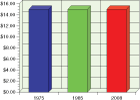
During the late ‘80s and early ‘90s non-union contractors saw record profits as a result of their competitive advantage. Funny thing though, as the price of labor fell, and as the subcontractors’ bids became more competitive, home prices continued to rise. In 1974, when I entered the
work force, a journeymen plasterer in the union was making about $15 per hour, plus some modest benefits. An average three-bedroom home cost well under $50,000, even in southern California. By the end of “trickle-down economics” in the late ‘80s, the average non-union plasterer or drywaller was making about the same $15 per hour and the average home in California now cost about $150,000. I may not be a CPA, but I could see things weren’t adding up for the working class.
As the ‘90s continued and the union vs. non-union market generally settled along the boundary lines of commercial vs. residential work, non-union contractors found they were now in competition against each other and no longer had the advantage of simply lower labor costs-everyone could pay what they wanted and the free market system of supply and demand was in full force and effect. So how could an enterprising employer in an almost totally non-union environment retain a financial advantage over their competition? Where could they find workers who were willing to work for even less than the ones they already had?
“Give me your tired, your poor,
Your huddled masses yearning to breathe free,
The wretched refuse of your teeming shore.
Send these, the homeless, tempest-tost to me,
I lift my lamp beside the golden door!”
The contribution of immigrants to American’s building trades is beyond measure. The hard work and craftsmanship of those who have come from faraway lands has shaped our architecture and our culture. America would not be what it is today without their contribution, and unless you are a native-American, you probably have personally benefited from your ancestor’s immigration to this land. But the exploitation of immigrants is not supposed to be part of the plan.
Many non-union employers found a source for lower-cost workers in the undocumented immigrant. Here was a source of labor that worked hard, asked few questions, and because so many were here “illegally” (estimated at above 12 million) they would avoid contact with pesky union or government officials inquiring about things like wages and conditions. During the 1990s I was one of those union officials, and I can tell stories of abuse and exploitation that would curl your hair.
As a direct result of the almost unlimited supply of undocumented workers willing to cross our border for a job-any job at any wage-conditions in the construction industry have remained stagnant, especially in the residential market. Today, over 30 years since I first joined a union, an undocumented worker performing plaster or drywall work is lucky to be making that same $15 an hour we made so long ago; and the cost of a home today? Well, try an average price of over $300,000.<
It is time to stop the exploitation of undocumented immigrants, and seriously address immigration reform. A career in the building trades should be something worthy of a middle class wage; it should not be compared to picking fruit. It is time to remember the values of the “Greatest Generation” and what was most important to them; our freedom and the American way of life. It is time to revisit the importance of re-establishing the “American Dream” for every one of us who earns a living in the walls and ceiling industry. After all, a “working class hero” should be able to make a good living in America.
According to the U.S. Department of Labor - Bureau of Labor Statistics, there are approximately 6 million citizens or legal residents of the United States between the ages of 18 and 64 who are actively seeking work, but who are unemployed. We continue to see businesses relocate their manufacturing plants and outsource their high-technology jobs to foreign lands, and undocumented immigrants coming to America to find jobs some say, “no one else wants ...”
As I travel in my day job, I have the opportunity to visit both inner cities and remote rural communities that are plagued with poverty. I am shocked by the conditions that exist in places in America that once flourished with economic vitality. What happened?
A basic principle of physics is, “for every action there is an equal and opposite reaction.”
HAVE WE IMPORTED POVERTY?
Have we imported poverty in exchange for our quest for lower prices and higher corporate profits? The next time you go into a hardware store to buy a drill or a pair of pliers, take a look at where it was manufactured before you whip out that credit card. Then keep looking along the shelves until you find something that is labeled with the once proud symbol “Made in USA.” You might be looking for quite a while.Most who read this column are probably baby-boomers or the offspring of “boomers.” We were born some time after the hardships of WWII. We know of the Industrial Revolution and the coming together of America to fight Nazism and Fascism only from history books, stories passed down from our parents or grandparents, and documentaries on the History Channel. What we may remember, and certainly benefited from, is the period of prosperity that followed the end of the war. Soldiers returned home to begin raising families; and new families needed new homes. As a result, the largest residential construction boom in American history began.
There was an energy generated from this need to come home and build a normal life. This desire was reflected in our TV shows of the day; Ozzie and Harriett, Father Knows Best, and Leave it to Beaver, among others. An important part of the “dream” included employment; secure employment earned from hard work and responsible behavior. We believed that if we applied ourselves, we would be rewarded with the ability to sustain this “Dream.”
The economic engine that drove the prosperity of the 1950s and ‘60s was in large part fueled by the need to fulfill this promise. Somewhere in the 1970s, along with the first energy crisis, Watergate, Vietnam, and gasoline rationing, the dream began to fade, at least for some.
For over 25 years after the end of WWII, the American construction market had been dominated by collective bargaining between labor unions and management. Their first goal was to establish an industry-wide “scale,” another name for a common wage rate covering a geographic area that most employers agreed to pay, and for which no union member would work for less.
THE COMPETITIVE EDGE?
Of course, some employers looking for an edge over their competition offered lower wages, and some union members agreed to work for them. When this happened, the union member was said to be “putting his card in his boot” or hiding the fact he was a union member. Such actions were considered to be undermining the area conditions of other union members; and if found out, the member was subject to heavy fines or even expulsion from the union.Employers who were the source of such substandard offers were considered to be undercutting the profits of other employers who were playing by the rules. They were often picketed by the union in an effort to let the public know that these employers were “unfairly” undermining area living conditions. Sustaining a good standard of living for the middle class was an effort shared by nearly everyone back then, and a picket line generally garnered great sympathies.
As the financial prosperity of the industry grew, labor and management negotiated new benefit plans to address concerns of retirement and medical care for workers. Trust funds were established and agreements written calling for modest contributions for every hour an employee worked; some plans began with as little as 10 cents per hour in contributions. All in all, the system seemed to work well for most everyone involved. Contractors had a fairly level playing field of competition, and their bids were sharpened based upon their productivity and efficiency. Material and labor costs were uniform and no one really had an unfair advantage over another.
As the ‘70s and ‘80s rolled around, a subtle shift in attitudes began to emerge. Companies that had once been owned and run by men forged from the challenges that made the “Greatest Generation” what it was, and who had built a partnership with labor after the war, were beginning to pass the torch. Some handed their companies off to their children whom they had sent off to college and who were returning with MBAs and lots of new ideas on how to maximize profits.
THE GREAT DIVIDE
A great migration of construction employers who had once been union-friendly, within a single decade, became anti-union. The wall and ceiling industry in particular became divided between contractors who saw the value of a partnership with the union and those who did not. And for the first time in more than a quarter of a century of prosperity for the working class, it took a second income for a family to pay a mortgage and the term “latch-key kid” was coined.During the late ‘80s and early ‘90s non-union contractors saw record profits as a result of their competitive advantage. Funny thing though, as the price of labor fell, and as the subcontractors’ bids became more competitive, home prices continued to rise. In 1974, when I entered the
work force, a journeymen plasterer in the union was making about $15 per hour, plus some modest benefits. An average three-bedroom home cost well under $50,000, even in southern California. By the end of “trickle-down economics” in the late ‘80s, the average non-union plasterer or drywaller was making about the same $15 per hour and the average home in California now cost about $150,000. I may not be a CPA, but I could see things weren’t adding up for the working class.
As the ‘90s continued and the union vs. non-union market generally settled along the boundary lines of commercial vs. residential work, non-union contractors found they were now in competition against each other and no longer had the advantage of simply lower labor costs-everyone could pay what they wanted and the free market system of supply and demand was in full force and effect. So how could an enterprising employer in an almost totally non-union environment retain a financial advantage over their competition? Where could they find workers who were willing to work for even less than the ones they already had?
THE IMMIGRATION FACTOR
We all remember the words of the Jewish-American poet, Emma Lazarus which are memorialized at the base of the Statue of Liberty:“Give me your tired, your poor,
Your huddled masses yearning to breathe free,
The wretched refuse of your teeming shore.
Send these, the homeless, tempest-tost to me,
I lift my lamp beside the golden door!”
The contribution of immigrants to American’s building trades is beyond measure. The hard work and craftsmanship of those who have come from faraway lands has shaped our architecture and our culture. America would not be what it is today without their contribution, and unless you are a native-American, you probably have personally benefited from your ancestor’s immigration to this land. But the exploitation of immigrants is not supposed to be part of the plan.
Many non-union employers found a source for lower-cost workers in the undocumented immigrant. Here was a source of labor that worked hard, asked few questions, and because so many were here “illegally” (estimated at above 12 million) they would avoid contact with pesky union or government officials inquiring about things like wages and conditions. During the 1990s I was one of those union officials, and I can tell stories of abuse and exploitation that would curl your hair.
As a direct result of the almost unlimited supply of undocumented workers willing to cross our border for a job-any job at any wage-conditions in the construction industry have remained stagnant, especially in the residential market. Today, over 30 years since I first joined a union, an undocumented worker performing plaster or drywall work is lucky to be making that same $15 an hour we made so long ago; and the cost of a home today? Well, try an average price of over $300,000.<
TIME FOR NEW POLICIES
There is no question in anyone’s mind that our nation’s immigration policy is broken, and that immediate steps need to be taken to fix the problem. Enforcement of our border security must also be accompanied by fair and effective enforcement of our existing immigration laws, as well as fair and equal enforcement of federal and state labor and employment laws. Perhaps a mandatory electronic work-eligibility verification system is needed, accompanied by strong and effective procedures designed to protect personal and civil rights.It is time to stop the exploitation of undocumented immigrants, and seriously address immigration reform. A career in the building trades should be something worthy of a middle class wage; it should not be compared to picking fruit. It is time to remember the values of the “Greatest Generation” and what was most important to them; our freedom and the American way of life. It is time to revisit the importance of re-establishing the “American Dream” for every one of us who earns a living in the walls and ceiling industry. After all, a “working class hero” should be able to make a good living in America.
Looking for a reprint of this article?
From high-res PDFs to custom plaques, order your copy today!