High-Performance Building Envelope: LEED-Platinum Pays Dividends
Michigan builder achieves celebrity status with LEED-Platinum home
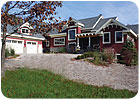
When Bob Burnside set his sights on building the first Platinum LEED-certified home in southeast Michigan near Ann Arbor two years ago, he needed to make only a few changes to his standard method of operations.
“I’ve been building green for 12 years, but we never called it green back then,” explained Burnside during an interview in the 4,000-square-foot home that has turned him into a virtual celebrity in building circles. The home is the only one in the state and the 12th in the United States to be Platinum-certified. “My philosophy has always been that it just makes good sense all the way around to be environmentally aware and cost-conscious.”
Indeed, the previous week Burnside had given a lecture at a Realtors meeting in suburban Detroit and was slated to give another at Eastern Michigan University. For many years, he has been the local expert for the regional Home Builders Associations, routinely speaking at seminars and educational events.
“Green building has really taken off big-time. It’s really snowballing as engineers, professionals and builders become more educated about its benefits,” Burnside said.
Burnside got into the construction business a dozen years ago, after working many years for the Buick division of General Motors Co., for a while as national advertising manager and national customer service manager.
His company, Fireside Home Construction has seven employees, including himself, and he usually spends much time on job sites with his working superintendent and four carpenters. While he modestly says “We’ll build anything the customer wants from a gazebo to a garage to a home,” he tells everyone, “if it’s not green, we won’t build it.” He specializes in high-end custom residential, additions and renovations and has received a multitude of awards, and holds the Certified Green Professional Designation by the National Association of Home Builders.
“We do much of the work ourselves,” Burnside explained. “We do everything up to the mechanicals-heating, cooling, electrical-which we give to trades craftspeople whom we have worked with for years.”
He builds timber-frame construction homes and traditional custom homes as well as renovations, ranging from smaller renovations to million-dollar homes.
He uses insulated concrete forms (ICFs) for the basements and structural insulated panels (SIPs) for the walls and roof. “I’ve been building with ICFs since 1998, and I love them. It’s my first choice. The decision whether to use them is usually budget-driven by the customer. It costs about 35 percent more but is pretty much a wash if you are going to finish the basement anyway.”
Burnside started using SIPs about six years ago. “It’s wonderful technology, and I don’t see any drawbacks to it, at all,” he said. The Insulspan wall SIPs are 6-inches thick, extruded polystyrene foam sandwiched between oriented strand board. The roof panels are 10 inches thick.
A carved wooden plaque bearing the words “Burnside Inn” is attached near the front of his house, giving it an “antique” feel that blends well with the overwhelming visual impression created by the unfinished oak beams and wood floor. The design was based on a New England shingle-style home.
“When I started this house I knew it would be a LEED home. Without doing anything different from what I normally do, it would have been LEED-Gold,” he said. “The requirements to get the Platinum status were very comprehensive,” he said.
LEED points were given in eight categories, including the design process, site selection, water efficiency, energy efficiency, indoor environmental quality, using environmentally preferred materials, minimizing construction waste and landscaping.
Burnside used Sherwin Williams Harmony paint, which has no VOCs and the carpet used, mainly in bedrooms, as most of the house has wood floors, is certified green with a green label.
The house is situated on a four-acre lot that has been left mostly natural, leaving a smaller footprint. The driveway is gravel, a pervious surface for water runoff, and the lawn’s sprinkler system has a water sensor so it does not run when it is raining and uses drip irrigation instead of spray heads.
He installed dual-flow toilets, which use one-half the amount of water that most houses use.
The geothermal heating system is connected to an in-floor radiant heat system in the basement, master bath and garage.
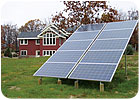
Electricity is supplemented by a 2 kilowatt photovoltaic system, with the solar panels located about 200 feet from the house.
Burnside also tells his audiences that the financial advantage for the builder who builds a reputation for quality green building can be amazing. For several years he has had a backlog of work despite the depressed Michigan economy. In February he hit a milestone he’d never reached before: “In February I had already covered the fixed costs for my company for the rest of the year, and it’s all in the black after that. I feel very confident that this is going to be a very good year for us.”
• Two inches of Styrofoam under the basement floor.
• Foundation and basement walls made of ICFs.
• Exterior walls and roof made of Insulspan structural insulating panels (SIPs). The walls are 6 inches thick and the roof panels are 10-inches thick.
• Photovoltaic cells - 2 kilowatts of panels mounted in the southern yard.
• Integrated planning between designer, builder and energy rater.
• Development of durability checklist for construction.
• Site selection; location, solar orientation, minimal disturbance of nature and soil erosion protection.
• Landscape design, plant selection to minimize water usage, smaller yard, more natural vegetation.
• Gravel driveway to minimize water run-off.
• Irrigation with rain sensor to minimize water usage.
• Careful design of irrigation.
• Drip irrigation for plants to minimize water usage.
• Dual-flush toilets, restricted water volume usage, low-flow showerheads and faucets.
• Highest efficiency Water Furnace geothermal heating and cooling with pre-heat of hot water.
• Geothermal heating for in-floor radiant heating in lower level, garage and master bathroom.
• Maximum air filtration with HEPA air filter.
• Venmar heat recover ventilator for fresh air and moisture control.
• Exceeds all Energy Star Requirements.
• Exhaust fan for garage to eliminate carbon monoxide gases.
• Sealed combustion fireplace.
• Radon venting to outside from sump crock.
• Sealed sump crock.
• Homeowner manual for proper maintenance and usage of systems.
• No dumpsters on site. No waste was trucked to landfill.
• Maximum recycling including drywall scraps worked into soil along with shredded cardboard.
• Selection of materials within 500-miles or less to minimize trucking costs.
• Siding/wood materials 12 inches or more from grade.
• Insulated hot water pipes throughout the house.
• All heating ductwork sealed during construction to prevent dust and debris incursion.
• All windows and insulation far exceed Energy Star requirements.
• Very high efficiency lighting, almost all interior lights are high-efficient fluorescent.
• All appliances are the most efficient units available.
When Bob Burnside set his sights on building the first Platinum LEED-certified home in southeast Michigan near Ann Arbor two years ago, he needed to make only a few changes to his standard method of operations.
“I’ve been building green for 12 years, but we never called it green back then,” explained Burnside during an interview in the 4,000-square-foot home that has turned him into a virtual celebrity in building circles. The home is the only one in the state and the 12th in the United States to be Platinum-certified. “My philosophy has always been that it just makes good sense all the way around to be environmentally aware and cost-conscious.”
‘I'VE ALWAYS BEEN GREEN'
On the snow-covered morning in March when Burnside talked to a visitor about his building philosophy in the home, the basement of which serves as his office, he was repeatedly interrupted by phone calls. One was from a news reporter and another from a University of Michigan School of Architecture official who was arranging a guest lecture about his LEED achievement.Indeed, the previous week Burnside had given a lecture at a Realtors meeting in suburban Detroit and was slated to give another at Eastern Michigan University. For many years, he has been the local expert for the regional Home Builders Associations, routinely speaking at seminars and educational events.
“Green building has really taken off big-time. It’s really snowballing as engineers, professionals and builders become more educated about its benefits,” Burnside said.
Burnside got into the construction business a dozen years ago, after working many years for the Buick division of General Motors Co., for a while as national advertising manager and national customer service manager.
His company, Fireside Home Construction has seven employees, including himself, and he usually spends much time on job sites with his working superintendent and four carpenters. While he modestly says “We’ll build anything the customer wants from a gazebo to a garage to a home,” he tells everyone, “if it’s not green, we won’t build it.” He specializes in high-end custom residential, additions and renovations and has received a multitude of awards, and holds the Certified Green Professional Designation by the National Association of Home Builders.
“We do much of the work ourselves,” Burnside explained. “We do everything up to the mechanicals-heating, cooling, electrical-which we give to trades craftspeople whom we have worked with for years.”
He builds timber-frame construction homes and traditional custom homes as well as renovations, ranging from smaller renovations to million-dollar homes.
He uses insulated concrete forms (ICFs) for the basements and structural insulated panels (SIPs) for the walls and roof. “I’ve been building with ICFs since 1998, and I love them. It’s my first choice. The decision whether to use them is usually budget-driven by the customer. It costs about 35 percent more but is pretty much a wash if you are going to finish the basement anyway.”
Burnside started using SIPs about six years ago. “It’s wonderful technology, and I don’t see any drawbacks to it, at all,” he said. The Insulspan wall SIPs are 6-inches thick, extruded polystyrene foam sandwiched between oriented strand board. The roof panels are 10 inches thick.
THE WOW FACTOR
The timber frame members-including massive 7 by 11-inch oak post and beams that exude what Burnside calls a “wow factor”-are manufactured by Riverbend in Blissfield, Mich., and the SIPs are by Insulspan, also in Blissfield. He uses ICFs manufactured by Advantage.A carved wooden plaque bearing the words “Burnside Inn” is attached near the front of his house, giving it an “antique” feel that blends well with the overwhelming visual impression created by the unfinished oak beams and wood floor. The design was based on a New England shingle-style home.
“When I started this house I knew it would be a LEED home. Without doing anything different from what I normally do, it would have been LEED-Gold,” he said. “The requirements to get the Platinum status were very comprehensive,” he said.
LEED points were given in eight categories, including the design process, site selection, water efficiency, energy efficiency, indoor environmental quality, using environmentally preferred materials, minimizing construction waste and landscaping.
Burnside used Sherwin Williams Harmony paint, which has no VOCs and the carpet used, mainly in bedrooms, as most of the house has wood floors, is certified green with a green label.
The house is situated on a four-acre lot that has been left mostly natural, leaving a smaller footprint. The driveway is gravel, a pervious surface for water runoff, and the lawn’s sprinkler system has a water sensor so it does not run when it is raining and uses drip irrigation instead of spray heads.
He installed dual-flow toilets, which use one-half the amount of water that most houses use.
The geothermal heating system is connected to an in-floor radiant heat system in the basement, master bath and garage.
Electricity is supplemented by a 2 kilowatt photovoltaic system, with the solar panels located about 200 feet from the house.
THE FINANCIAL ADVANTAGE
In his many lectures to area builders about the good sense of “going green,” Burnside invariably mentions the financial advantages both to customers and the builder. “On average it only costs 3 to 5 percent more to build green,” he said, noting that the energy savings are enormous over time. His electric utility bill for November was $140, $80 for normal electric usage and $60 for heating, cooling and hot water after a credit of $25 was applied for solar energy. It has a HEPA air filter and a heat recovery ventilator, manufactured by the Canadian firm, Venmar.Burnside also tells his audiences that the financial advantage for the builder who builds a reputation for quality green building can be amazing. For several years he has had a backlog of work despite the depressed Michigan economy. In February he hit a milestone he’d never reached before: “In February I had already covered the fixed costs for my company for the rest of the year, and it’s all in the black after that. I feel very confident that this is going to be a very good year for us.”
SIDEBAR: What makes it Green?
These are the features of Bob Burnside’s LEED Platinum home he built in Dexter, Michigan, last year that contribute to it being “green.”• Two inches of Styrofoam under the basement floor.
• Foundation and basement walls made of ICFs.
• Exterior walls and roof made of Insulspan structural insulating panels (SIPs). The walls are 6 inches thick and the roof panels are 10-inches thick.
• Photovoltaic cells - 2 kilowatts of panels mounted in the southern yard.
• Integrated planning between designer, builder and energy rater.
• Development of durability checklist for construction.
• Site selection; location, solar orientation, minimal disturbance of nature and soil erosion protection.
• Landscape design, plant selection to minimize water usage, smaller yard, more natural vegetation.
• Gravel driveway to minimize water run-off.
• Irrigation with rain sensor to minimize water usage.
• Careful design of irrigation.
• Drip irrigation for plants to minimize water usage.
• Dual-flush toilets, restricted water volume usage, low-flow showerheads and faucets.
• Highest efficiency Water Furnace geothermal heating and cooling with pre-heat of hot water.
• Geothermal heating for in-floor radiant heating in lower level, garage and master bathroom.
• Maximum air filtration with HEPA air filter.
• Venmar heat recover ventilator for fresh air and moisture control.
• Exceeds all Energy Star Requirements.
• Exhaust fan for garage to eliminate carbon monoxide gases.
• Sealed combustion fireplace.
• Radon venting to outside from sump crock.
• Sealed sump crock.
• Homeowner manual for proper maintenance and usage of systems.
• No dumpsters on site. No waste was trucked to landfill.
• Maximum recycling including drywall scraps worked into soil along with shredded cardboard.
• Selection of materials within 500-miles or less to minimize trucking costs.
• Siding/wood materials 12 inches or more from grade.
• Insulated hot water pipes throughout the house.
• All heating ductwork sealed during construction to prevent dust and debris incursion.
• All windows and insulation far exceed Energy Star requirements.
• Very high efficiency lighting, almost all interior lights are high-efficient fluorescent.
• All appliances are the most efficient units available.
Looking for a reprint of this article?
From high-res PDFs to custom plaques, order your copy today!





