Straight Green: Thermal Performance of Steel Stud Framing: Better Than Wood
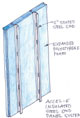
Accel-E Insulated Steel Stud Panel System
Thermal performance of exterior steel stud framed walls has always lagged behind that of wood. This critical difference often overshadows steel’s many benefits such as its dimensional consistency, high recycled content, high recyclability, strength, and mold, rot and termite resistance. Much thinking, technical papers, and tests have been devoted to solving the energy efficiency problem associated with steel stud framing. Steady work on the problem has resulted in some exciting and innovative product offerings that make steel studs equal to and in some cases superior to wood in terms of thermal efficiency.
There are many ways to improve the thermal performance of steel studs. The simplest and least expensive is to reduce the surface area of the flange in contact with the exterior wall sheathing by adding a spacer-plywood, fiberglass and foam are common. Less steel at this location results in less thermal transfer across the wall assembly. Another way to reduce the contact area is to use a proprietary steel stud product like Thermachannel which is made with an indentation at the flange face resulting in a very small contact area. A third method involves removing steel from the web of the stud. One such product on the market is Tri-Chord which promises that “thermal problems associated with metal framing have been eliminated with Tri-Chord’s patented steel stud.” These three options, however, may not offer enough thermal improvement to satisfy ever more stringent energy code requirements. Careful building envelope calculations and energy modeling may be required to prove compliance with energy codes.
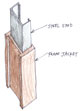
ORNL Stud Snuggler
Proving Thermal Efficiency
Oakridge National Laboratory has been investigating, evaluating and testing the thermal performance of steel stud wall assemblies for many years. In one of its most comprehensive studies, “Improving Energy Performance of Steel Stud Walls,” 40 different steel stud wall assemblies were built and tested in an apparatus called a Guarded Hot Box (in accordance with ASTM C 1363) to determine which combinations of framing, sheathing and insulation was the best for thermal performance. At the end of this undertaking, the authors determined:It is possible to construct steel stud walls which perform as well or even better than wood framed walls.
Traditional insulating sheathing is a simple and effective way of reducing heat losses caused by steel components in steel stud walls.
Reduction of the contact area between steel studs and wall finish layers (wood or steel furring) is only effective if accompanied by the additional insulating sheathing.
Usage of expanded channel steel studs (stud depth area reduced 40 to 65 percent) is one of the most effective ways of improving thermal performance of steel stud walls.
Walls containing combined steel studs (two rows of small steel studs using foam or wood as a connector) can be more effective than similar wood stud walls. However such designs may be very expensive.
Walls with foam-covered steel studs perform as well as wood stud walls. The usage of the foam-covered studs can be the simplest (also cheaper than foam sheathing) way of dramatically improving the thermal performance of steel stud walls.
The last bullet point is a reference to an ORNL-invented product called the Stud Snuggler; a 1-inch thick expanded polystyrene foam jacket that tightly encapsulates the stud on three sides. Tests using this novel product show a dramatic improvement in whole wall, steel stud R values. ORNL is convinced that this product could be a very cost effective solution to the thermal performance problem. Until such a product is commercially available, however, the jury is still out on that prediction. For a recent test of this idea check out the 2009 ORNL paper “Steady-State Thermal Performance Evaluation of Steel-Framed Wall Assembly with Local Foam Insulation.” The paper proves through Guarded Hot Box tests that using this product results in a steady state, whole wall R value for a 2-inch-by-4-inch steel stud wall of R-19.
Although the Stud Snuggler isn’t something one can buy and use, a company called LiteDeck makes products that are very similar. The concept behind LiteDeck is the same as ORNL’s invention; steel studs are enveloped completely with expanded polystyrene and formed into panels that are used in floors, roofing and tilt-up concrete construction. Litedeck products are designed to be used integrally with cast-in-place concrete and not an equivalent replacement for standard steel stud framed wall assemblies.
Continuous Rigid Insulation - The Simple Answer
Perhaps the least sophisticated and most straightforward way to thermally improve a steel stud wall assembly is to add a continuous layer of rigid foam insulation within the assembly-exterior, interior or somewhere in the middle. This method is fast becoming de rigueur in the construction industry due largely to prescriptive energy code requirements.As simple as it seems, adding a layer of rigid foam can present significant challenges to designers. One and a half to 2 inches of continuous foam outboard of the exterior sheathing requires thought and expertise in solving detailing issues at openings, support of the exterior cladding and flashing and weatherproofing. Not all solutions are ideal. In addition to these complexities, labor and material costs can also be significant and sometimes prohibitively so.
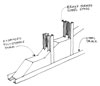
K-tect System
Steel Stud Assemblies of the Future: The Future is Now
What if there were products that combined several of the above methods to improve the thermal efficiency of steel stud assemblies? What if those products were factory fabricated, fully engineered and less costly to produce and install? New products that do just that are available now. K-Tect, Thermasteel, Rigidwall and Accel-e are four manufacturers that produce foam encapsulated metal stud framing assemblies with R values that are equal to, and in many cases exceed, that of wood framed construction. Rigidwall and Accel-e produce panels that expose a portion of the metal stud to the interior to create a small cavity used to run wiring and plumbing. K-Tect and Thermasteel make panels in which the foam is flush with the steel, requiring raceways for conduit and plumbing to be cut into the foam (and then replaced or filled with spray foam insulation).According to K-Tect President Ken Miller, using his company’s panels results in a 50 percent reduction in labor over field “stick built” stud framing assemblies. In one example, his system cost $130,000 less than a wood, stick-framed equivalent in a $2.3 million office building. Thermasteel reports similar savings and gives one example in which a first-time installation crew of “five men installed 234 linear feet of 9-foot insulated wall panels in seven hours.” The prefabricated panels require no special detailing for cladding, openings, flashing or weatherproofing. The panels are engineered to withstand all required live and dead loads and can be load-bearing.
K-tect provides on-site factory personnel to assist and train contractors during erection of the system and K-tect provides hot knives used in cutting raceways in the foam, as well as spray foam insulation to fill holes and joints between the panels and adjacent construction.
R values for the panels range from a minimum of R-11 (5½-inch panel by Accel-e) to as much as R-22 (5½-inch panel by Thermasteel) when tested in accordance with ASTM C 1363.
Conclusion
It has taken a long time to get there, but steel framed assemblies can now take their place alongside wood framing as a thermally efficient equivalent and do so without breaking the budget. Many options are available to designers and contractors, depending on energy code requirements, as viable, cost effective alternatives to traditionally framed steel stud assemblies. Look for these products and systems to become more commonplace as the economy continues to improve and energy codes continue to get tighter.Looking for a reprint of this article?
From high-res PDFs to custom plaques, order your copy today!