Walls & Ceilings logo
search
cart
facebook twitter linkedin youtube youtube Spotify Podcasts Apple Podcasts Spotify Podcasts Apple Podcasts
  • Sign In
  • Create Account
  • Sign Out
  • My Account
Walls & Ceilings logo
  • NEWS
  • TOPICS
    • Drywall
    • Stucco/EIFS
    • Ceilings
    • Steel Framing
    • Fireproofing
    • Interior Plaster
    • Building Envelope
    • Insulation
    • Technology
    • Interior
    • Exterior
    • Women In Construction
  • COLUMNS
    • Up Front
    • All Things Gypsum
    • Art & Craft of Plastering
    • Stucco Stop
    • Steel Deal
    • Industry Voices
  • PRODUCTS
    • Buzz Guide
  • EVENTS
    • Industry Events
    • Webinars
    • BUILD Expo
  • MEDIA
    • Videos
    • Podcasts
    • Photo Galleries
    • BUILD26 Videos
    • Take our Quiz!
    • Infographics
  • EXCLUSIVE
    • Newsletters
    • Top 50 Contractors
    • Contractor of the Year
    • State of the Industry
    • W&C Store
    • Market Research
    • CEUs
    • Sponsor Insights
    • Custom Content & Marketing Services
  • DIRECTORY
  • EMAGAZINE
    • eMagazine
    • Advertise
    • Archive Issues
  • SIGN UP!
ColumnsTechnology

Centered on Solutions

Digital vs. Manual Estimating

By Cecilia Padilla
October 1, 2014

As a second-generation contractor, my journey started more than 30 years ago as an estimator and project manager in the wall and ceiling industry. Not long ago, our trade dealt with light and heavy gauge framing, rated and non-rated drywall, and simple ceiling systems. Today, it includes installation of extremely complex systems, both built on-site and prefabricated in special facilities. It’s an extremely competitive trade, but armed with the right automation tool companies can maintain a competitive edge over others in the trade.

Quick Review of Part 1

In case you missed Part 1 of this series, I would like to take a brief moment to bring you up to speed on the topics discussed. To enhance productivity, reduce waste and increase profits, wall and ceiling contractors have always invested in technology and equipment, both in the office and on the jobsite. Prior to digital technologies, the tools used for takeoff and estimating consisted of a scale, colored pencils, highlighters, ledger pads and a calculator.

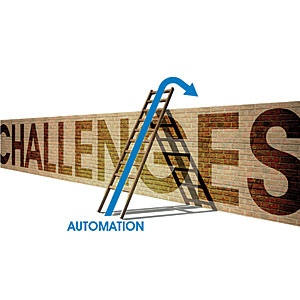
However, the industry realized that manual processes are both time and labor intensive. Many companies are turning towards automation to solve business problems, reduce inefficiencies and increase productivity to remain competitive. Let’s continue our discussion to see how initial investment in technology can benefit your company in the long run.

Reduce Redundancy & Increase Efficiencies

Digital takeoff and estimating applications quickly pay for themselves in several ways—first by increasing the number of jobs a company bids to win more work; second by eliminating the need to print, handle and store bulky paper plans and other documents; and third by improving the estimator’s ability to analyze the project and organization of their takeoff and estimate.

Digital plans and designs imported into the applications allow an estimator to takeoff all aspects of the project including window, door and MEP cutouts and ceiling track layouts. Because the estimator specifies and views individual conditions directly on the computer screen, it’s easy to work up precise drywall and ceiling counts, types and quantities to develop accurate estimates that meet the design requirements.

Estimators can maintain and manage a library of common assemblies and ceiling and wall designs. These assemblies are generally combinations of material quantities and costs as well as labor and equipment. These common assemblies can be instantly recalled and reused among projects to save time. Built-in cost databases that are specific to ceilings and drywall are another time-saver designed to reduce errors and develop a more accurate bid. A good estimating software package allows an estimator to manage extensive catalogs and pricelists from multiple sources including vendors and subcontractors.
Digital estimates

With integrated takeoff and estimating solutions, estimators avoid spending significant time as designs change by simply overlaying any new plans over the original plans to identify and highlight the differences, identify potential conflicts, and perform a new takeoff. The system simply applies the changes to the estimate, all with a few clicks of a mouse.

A knowledgeable estimator uses the digital takeoff and estimating tools to specify what assemblies and labor are required to perform a specific portion of a project, as well as how many assemblies are required based on the measures identified during the takeoff process. Once the materials and labor are determined, prices and rates are applied, a markup is calculated, and the detailed estimate is published for the bid.

Better Ways to Manage Costs

Estimating programs generate reports that help the business owner manage labor and material costs. There are reports to manage material inventories and purchases and to plan man-hours and costs for a variety of labor categories and tasks. Depending on the reporting capabilities, labor is broken down into sub-categories for site labor, installation labor and separate values for labor which can include tasks like handling, finishing, taping, caulking, insulating, etc. Furthermore, material requirements are reported by what is needed, and when, in order to facilitate just-in-time purchasing. These programs also export costing information to accounting systems—another way to save time and reduce input errors.

The Bottom Line: A Better Way to Conduct Business

Wall and ceiling contractors that have already adopted digital takeoff and estimating applications can’t imagine doing business without these tools. These programs help the business owners:

  • Save time and money—Reduce the cost of shipping and printing plans. Spend far less time doing takeoffs and estimating costs for each bid. Submit more bids to win more projects.
  • Reduce costly mistakes—Eliminate manual entry errors and see visually on the screen that everything is accounted for, and decrease the likelihood of misinterpreting designs and the related inspection problems such as rework and penalties.
  • Improve collaboration—Get everyone in the shop on the same page for how to bid and work a job.
  • Differentiate from competition—Submit bids, respond to change requests and offer alternatives quickly and with confidence.

A wall and ceiling contractor’s success begins with expertise, attention to detail, and hard work, and continues with the ability to takeoff, estimate and bid projects in a timely and accurate manner. Taking too long to generate a bid or bidding too high because of inaccurate input costs will cause companies to lose jobs. Conversely, if a company bids too low due to inaccurate information, it will lose money on its work. The objective is to get it right the first time, every time. Digital takeoff and estimating software programs make the difference between keeping a company busy and profitable, and just keeping the doors open. 

KEYWORDS: estimating tools

Share This Story

Looking for a reprint of this article?
From high-res PDFs to custom plaques, order your copy today!

Cecilia Padilla, president of On Center Software Inc. is an internationally known expert in the construction industry. Padilla’s expertise spans 25 years in drywall, light- and heavy-gauge framing, lath and plaster, EIFS, fireproofing-themed facades, and acoustical ceilings. Prior to joining On Center, she worked for Marek Brothers Systems in Houston and for Raymond Interior Systems in Las Vegas and Orange County, Calif.

Recommended Content

JOIN TODAY
To unlock your recommendations.

Already have an account? Sign In

  • Abercrombie & Fitch

    EIFS in 2026: How Specialty Finishes Are Redefining Exterior Wall Systems

    As building codes, owner expectations, and design demands...
    Stucco/EIFS
    By: Regi Mendoza
  • proper air and vapor control

    From Energy Efficiency to Moisture Management: Why Air and Vapor Control Matter

    How proper air and vapor control within building...
    Building Envelope
    By: Benjamin Meyer AIA, LEED AP
  • Linear Metal Ceiling Beam Baffles

    Top 25 Ceiling Contractors of 2026

    Suspended ceilings demand precision, code compliance and...
    Ceilings
    By: John Wyatt and Tanja Kern
You must login or register in order to post a comment.

Report Abusive Comment

Manage My Account
  • eMagazine Subscription
  • Newsletters
  • Online Registration
  • Manage My Preferences
  • Subscription Customer Service

More Videos

Sponsored Content

Sponsored Content is a special paid section where industry companies provide high quality, objective, non-commercial content around topics of interest to the Walls & Ceilings audience. All Sponsored Content is supplied by the advertising company and any opinions expressed in this article are those of the author and not necessarily reflect the views of Walls & Ceilings or its parent company, BNP Media. Interested in participating in our Sponsored Content section? Contact your local rep!

close
  • medical professionals moving a patient on a stretcher through the halls of a medical building
    Sponsored byNational Gypsum Company

    What Does High Performance Mean When It Comes To Gypsum Boards?

Popular Stories

Linear Metal Ceiling Beam Baffles

Top 25 Ceiling Contractors of 2026

Wichita Biomedical Campus

Wichita Drywall Worker Dies After Scaffolding Fall

QXO Just Changed the Game-Here's What Contractors Are Asking

QXO Just Changed the Game-Here's What Contractors Are Asking

An interior drywalling work in progress

Boost Profits with AI Scheduling

Events

June 24, 2026

The Bright Side & Benefits of Designing with Integrated Lighting

Credits 1 AIA LU/HSW; 0.1 ICC CEU

This course will explore the pivotal role architects and lighting design play in creating safer, more sustainable spaces. Learn how to avoid common lighting mistakes and make informed decisions that create the best visual environment for occupants. 

January 1, 2030

Webinar Sponsorship Information

For webinar sponsorship information, visit www.bnpevents.com/webinars or email webinars@bnpmedia.com.

See our full library of webinars

View All Submit An Event

Products

2026 National Painting Cost Estimator

2026 National Painting Cost Estimator

See More Products

Related Articles

  • Digital vs. Manual Estimating

    See More
  • Centered on Solutions: Myths and Mistakes of the Bidding Process

    See More
  • How to be a Greater Asset for General Contractors

    See More

Related Products

See More Products
  • plaster and drywall

    Plaster and Drywall Assemblies Manual

  • manual

    2026 National Building Cost Manual

See More Products

Related Directories

  • Estimating Edge

    Built by trade experts, The EDGE Estimator is a professional-grade all-in-one takeoff and estimating software solution. It’s robust and detailed enough for bids of any size and is intuitively designed to help both new and seasoned estimating professionals work smarter, bid sharper, and build better.
×

Connect with the industry’s leading resource for unparalleled insights and education.

Join thousands of industry professionals today. Shouldn’t you know what they know?

JOIN NOW
  • RESOURCES
    • Advertise
    • Contact Us
    • Directories
    • Store
    • Want More
  • SIGN UP TODAY
    • Create Account
    • eMagazine
    • Newsletters
    • Customer Service
    • Manage Preferences
  • SERVICES
    • Marketing Services
    • Reprints
    • Market Research
    • List Rental
    • Survey/Respondent Access
  • STAY CONNECTED
    • LinkedIn
    • Facebook
    • Instagram
    • YouTube
    • X
  • PRIVACY
    • PRIVACY POLICY
    • TERMS & CONDITIONS
    • DO NOT SELL MY PERSONAL INFORMATION
    • PRIVACY REQUEST
    • ACCESSIBILITY

Copyright ©2026. All Rights Reserved BNP Media, Inc. and BNP Media II, LLC.

Design, CMS, Hosting & Web Development :: ePublishing