CENTERED ON SOLUTIONS
Digital vs. Manual Estimating
In this two-part series, I will be discussing some of the challenges faced by wall and ceiling contractors. As a second-generation contractor, my journey started more than 30 years ago as an estimator and project manager in the wall and ceiling industry. It’s an extremely competitive trade. Any and all efficiencies that can be gained—from the takeoff process through build-out—are crucial to a company’s bottom line. The success of a project is often determined even before a company is awarded the work. It all starts with a high quality bid built on the accuracy and timeliness of a company’s takeoff and estimation processes.
A Sophisticated Trade Marked by Details & Change
Wall and ceiling contractors operate businesses off details, where every aspect of a job is unique. Not long ago, our trade dealt with light and heavy gage framing, rated and non-rated drywall, and simple ceiling systems. Today, it includes installation of extremely complex systems, both built on-site and prefabricated in special facilities. What was once considered a specialty is now considered common. In short, our trade has become more sophisticated and precise. To enhance productivity, reduce waste and increase profits, wall and ceiling contractors have always invested in technology and equipment, both in the office and on the job site. For an estimator, the success of a job is often determined when they are performing their takeoff and completing their bid. For a project manager it’s when they are analyzing the most efficient way to build the job, then organizing that information into a labor budget and a material stocking list. Time invested up front is the best way to avoid unnecessary problems down the road, the wrong material on the wrong floor, at the wrong time can eliminate most of your profits.
Insufficient & Costly Manual Processes
Prior to digital technologies, the tools used for takeoff and estimating consisted of the rolling linear scale, colored pencils, highlighters, ledger pads and a calculator. As personal computers became common in business, estimators replaced their calculators and ledgers with electronic spreadsheets and complex formulas. Many estimators still use these tools today to manually perform material takeoffs and to generate educated cost “guesstimates” that slowly make their way into formal bids.
Manual processes are both time and labor intensive. Estimators spend too many hours carefully combing through numerous printed plans to tabulate material quantities, such as the lineal feet of stud and track, the number of sheets of drywall in various sizes, bags of insulation, the number of drywall screws, the amount of tape and mud, and the amount of estimated waste. It takes significant time and skill to calculate the material values due to all of the unique conditions and odd shapes on some of today’s complex projects.
Further complicating the process is the prospect managing all of the change orders, alternates, and the inevitable deviations from the original architectural “design intent.” Many times the original plans show a ceiling layout with 2x4 light fixtures only then to discover another set of plans that have recessed can lights, and a third set of plans that have large ductwork in the plenum that interferes with both.
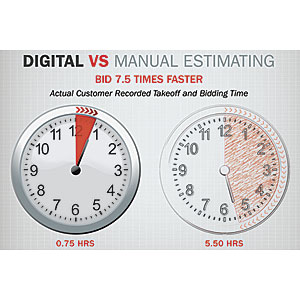
Detecting and managing these changes is complicated and time consuming. With manual processes, the estimator must sift through marked-up plans and prior estimates to work up a change order and incorporate it into the overall project budget and bid. Even small changes add to the cost of bidding on projects—and takes away from the profit margin. Many contractors invest considerable time in their takeoff and estimating processes in the hope of winning work, while others invest in technology to increase their output and reduce their overhead. Those that choose to invest in technology will easily double their estimating and project management productivity over manual methods. Contractors submit more bids in less time with greater confidence when they use digital takeoff and estimating applications. And of course, more and better bids mean work volume that is profitable not burdensome.
Digital Takeoff & Estimating Improve Productivity
Digital takeoff applications allow a knowledgeable wall and ceiling estimator to measure areas, lengths and volumes, count quantities, and select system components from digital plans viewed on a computer screen. As counts and measurements are taken with the click of a mouse, the on-screen plan is highlighted to show exactly what has been processed. The estimator applies conditions such as wall type, height, length, window/door cutouts, ceiling grid and finish type. Rather than tabulating the takeoffs on a ledger or spreadsheet, the estimator lets the application track and tally all the material needs. Digital estimating applications apply current material, labor, mark-up and other costs to the takeoff data to estimate project costs. An important element of creating an accurate estimate is being able to break a project down into smaller pieces and roll them up again into an overall bid; for example, creating estimates by floors or rooms. From start to finish, an estimator who is proficient with these automated tools develops a more precise, detailed bid, in much less time compared to manual methods. An automated approach to takeoff and estimation also enables quick historical recall from prior bids and change order processing. It also increases the ability to visually detect conflicts and to sort and organize in multiple ways for more efficient scheduling of materials and crews.
Today’s digital takeoff and estimating solutions from a single vendor’s portfolio have a high degree of integration so that takeoff data flows right into cost estimates. The best value is found in full-featured takeoff and estimating solutions that do more to simplify and accelerate the bid development process
Part 2: Sneak Preview
I look forward to continuing our discussion in the second part of this series, where we will look into reducing redundancy and increasing efficiency.
Looking for a reprint of this article?
From high-res PDFs to custom plaques, order your copy today!