How Texas Does Net Zero
Green schools that include renewable forms of energy generation are much in vogue these days as communities and school districts around the country seek to capitalize on providing comfortable, healthy indoor environments for students and faculty while saving energy and reducing energy costs. Examples and studies of green schools, including LEED-certified and even net-zero schools, are finding their way into school publications and being presented at school design-build workshops and conferences.
There’s a lot of buzz right now about design and construction challenges, feasibility issues, and payback associated with the laudable objective of creating a green school building. There is also evidence that green schools promote student performance and reduce absenteeism.
While there is growing awareness and interest in the educational community about sustainable school facilities, school officials who engage architects and MEP engineers about building a green school in their district inevitably discover that while there are clear benefits to be had, especially in return on investment, there are cost, design and construction hurdles that must be faced upfront.
From the architect’s and engineer’s perspectives, educating school clients about what’s involved in incorporating alternative energy sources to achieve a green school and securing their buy-in can also be challenging, as can the actual design and engineering tasks that follow.
With these considerations in mind, this article will focus on the more common—plus some unique—challenges and issues that arise in working with school officials on green school projects featuring alternative energy sources such as wind, solar and geothermal. Representing firms that each specialize in the school build market as a core specialty, we have worked on many green schools to date, mostly in our home state of Texas but in other parts of the country as well.
Texas affords a great opportunity for green school projects due to the state’s strong population growth that is driving districts to increase their facilities serving K-12, combined with a heightened awareness and practice in clean renewables. Texans routinely see wind and solar farms operating across the state as well as the drilling that goes on in the state’s oil fields
Lady Bird Johnson Middle School
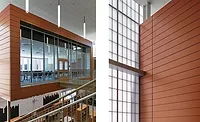
We have also collaborated on what is to date the nation’s greenest K-12 school, the Lady Bird Johnson Middle School in Irving, Texas, just north of Dallas. Lady Bird MS, which opened for the 2011 school year, is a unique green school not only because of its incorporation of wind-solar-geothermal but also because of how those operational renewables are incorporated as teaching elements for the school’s students.
At Lady Bird MS, because of the renewable energy sources at work, energy conservation and sustainability were designed into the school’s curriculum from the very start. Students at the school study each renewable in class and engage in energy- and water-use monitoring as well as recycling. Lady Bird thrusts the next generation into these concepts and best practices that are going to be paramount to future generations.
Lady Bird MS was the first net-zero school in Texas, and as of this writing remains both the only net-zero middle school and the largest (at 152,000 square feet) in the U.S. Because the objectives for Lady Bird MS pushed the green school envelope to such an unprecedented degree, the school serves as a model for what can be achieved and also as a blueprint for successful employment of renewable technologies in other schools.
In fact, the history of Lady Bird MS illustrates many of the issues and challenges the project design team faces in working with a school client seeking a green school. The Irving Independent School District (ISD) purchased the land for what became Lady Bird Johnson MS years before the school’s construction. As the district’s population grew to the point that a school was needed on the purchased property, a bond referendum was placed before voters to finance a new middle school, which was approved. But rather than build a conventional central plant HVAC system, as has been common practice in Texas, the district unveiled plans to build a net-zero school with an integrated curriculum. To do this, the district added $4 million from a reserve account to finance the renewables portion to achieve net-zero.
Weighing First Costs Against Payback
This brings us to the first issue to consider: the cost of employing renewable energy sources. The ISD had a very special objective in mind for Lady Bird MS and had the money to pay for it. Plus, the district understood what the payback could be. But most schools considering going green don’t hold such an objective, and, from our collective experience, they are always very cost-conscious about the upfront costs of adding solar or geothermal. (Wind energy in the Lady Bird MS project was included mostly for demonstration/educational purposes, as the school’s 12 turbines contribute only minimally to the energy generation mix.) Using renewables, especially geothermal with its miles of underground geothermal wells, is always costly upfront, even though drill costs are generally lower in Texas simply because more companies are in the drilling business to begin with.
With Lady Bird MS the sustainable systems cost about $25 per square foot more for a building of its size, taking into account the systems themselves, energy modeling and monitoring, LEED commissioning costs, and other associated costs—that’s about 13 percent in total costs above a conventional chiller plant cost. (LEED costs are purely discretionary and made sense in Lady Bird MS’s case because of the special nature of the school.)
School officials interested in employing renewables can easily become sticker-shocked. To ease their concerns over the first costs, the architect and engineer team must convincingly show them the payback for such upfront investments will be. Fortunately, we now have Lady Bird MS to help make the case for going with renewables. Lady Bird’s annual energy costs are approximately 70 percent lower than a conventional HVAC system and have taken energy costs down from $200,000 a year to $60,000. Lady Bird MS has reduced energy use to 17 kBTU per square foot compared with an average of 54 kBTU per square foot for a Texas middle school. These savings are in line with what the district was anticipating and can be used as a yardstick for other projects that include geothermal and solar.
Such savings were accomplished by bundling the geothermal system with solar. Through a primary reliance on the geothermal system, which features Bosch FHP water-source heat pumps, the solar PV cost for 3,000 PV solar panels was minimized.
Further hard confirmation of the potential energy savings from renewables comes from another Texas school district, one that is investing heavily in geothermal both for new school construction and retrofits to existing schools. The Frisco ISD serves a fast-growing Dallas bedroom community comprising two counties and portions of three others. It has experienced a more than 500 percent student increase since 2000, warranting a rapid construction program for its school system.
Frisco ISD is committed to geothermal for energy savings. With a total of 56 existing K-12 schools—45 of which are geothermal—plus an additional 20 planned and/or currently in construction, Frisco ISD is saving, on average, 34 percent on energy costs for its geothermal-equipped elementary schools and 46 percent on its geothermal-equipped middle schools versus its existing schools equipped with a central plant. During the past two years, kBTU use per square foot for three middle schools with central plants averaged 56.78; for nine schools with geothermal systems the kBTU average per square foot is 30.65. With savings like these, school officials can estimate their payback against the added first costs in less than a decade.
In Lady Bird MS’s case, payback on the geothermal system compared with the ISD’s standard four-pipe systems was less than a year. Payback on the bundled renewables was projected at 11 to 12 years; however, existing rebates and incentives reduced the payback to eight to nine years.
Space Considerations
Schools interested in geothermal have to gauge the amount of land they have available for the bore fields against the number of square feet needed. A general rule of thumb is that the geothermal space needs will be about equal to the total square footage of the building it will support. Wells are usually drilled and the heat exchanger loops installed under parking lots and especially outdoor athletic fields, as they were for Lady Bird MS. If space is adequate, doing so usually poses minimal problems for the geothermal engineer with new construction.
For retrofit-conversion projects, however, finding adequate space for geothermal can be a real challenge for the engineer depending on the school’s location. Sometimes adjacent land, if available, has to be purchased, or parking lots and even city streets have to be excavated for the bore fields. When available space is restricted, the depth of the bore holes can also be adjusted by drilling deeper.
School construction planners can also opt to provide geothermal for parts of a school’s interior spaces and not for others. This compromise preserves the geothermal aspect while keeping cost in line with budgets. Limited-use spaces like auditoriums and gyms can be serviced by conventional HVAC and not the geothermal system, as can school cafeterias because kitchen work and meal servings conclude by a set time each day.
For solar PV arrays, which work very efficiently with geothermal, school rooftop space must be adequate to locate an array density with sufficient output to attain energy savings. When solar is paired with geothermal, the roof space is relatively free for use because there are no rooftop packaged units to share space with.
Building Alignment
Aligning school buildings to capture natural light through a northern orientation is also a good rule of thumb. Building orientation can be a big cost factor, especially if the orientation is less than ideal. Windows do add cost. Sometimes, however, the optimal building alignment is not possible simply because of footprint limitations, and thus requires the architect to consider other ways to harvest light. This was the case with Lady Bird MS, which has an east-west orientation to the sun, probably the worst orientation possible. To compensate, highly efficient window glazing and solar shading provide a solution. Glazed windows also reduce the need for corridor lighting, saving money on artificial lighting.
Less Maintenance with Renewables
School officials also need to understand that maintenance costs are much lower with renewables than with a conventional HVAC system. It costs about 80 cents per square foot to maintain a four-pipe system. In the case of a geothermal system the cost is about 22 cents per square foot. That’s because much of the geothermal system is underground and requires little or no maintenance. Geothermal systems can last up to 50 years; solar panels have an operational life of 25 years. The heat pump portion of the geothermal system also has a long operational life and low maintenance needs, requiring little more than filter replacements. However, no system is entirely maintenance-free, and unanticipated developments can occur. As an example, the original solar array field on the roof of Lady Bird MS had to be replaced because of damage caused by hail storms.
Involving the Engineer Upfront
When considering going with renewables, it’s good practice to involve the engineer as early in the process as possible. There are a number of sound reasons for this. Integrating renewables and providing an energy model for the building are critical tasks best performed in the earliest stages of a project.
The engineer must work closely with the architect to make sure that the building’s design is optimized for the use of renewables and to identify any shortfall challenges in the building envelope that can be solved by creative, collaborative problem solving. Bringing in the engineer in the latter stages of the design process can create unnecessary work and add to costs.
Convincing the Client to Go Green
Most school clients who are interested in employing renewables require education and a degree of hand-holding through the design-build process. Here are some proven techniques to follow if you are dealing with school district officials wrestling with making the best decisions they can to go green for all the right reasons while saving energy dollars:
- Use historical or industry-supported data in making your case: AHRAE-, AEE-, DOE- and EPA-supplied documentation/verification.
- Use simulation models that have been tested and tweaked against actual experience data regarding energy costs, installation costs, etc.
- Keep your calculations simple; limit evaluation to main cost items such as energy usage, installation and maintenance.
- Evaluate your client’s understanding of renewables and the costs and benefits. Your working approach with the client regarding the level of detail and complexity required will depend on the client’s experience and knowledge.
Conclusion
The green school movement is growing, and while there are various ways to achieve a more energy-efficient school, use of geothermal and solar provide a very strong, short-term payback calculus that school officials will warm to when presented with the facts. Opting to use renewables does increase upfront costs that would increase bond request amounts—not every school district can provide the difference out of a reserve fund, as was the case with Lady Bird Johnson MS. In addition to quick payback, renewable systems have long operational lives and require less maintenance than conventional HVAC systems. When consulting on use of renewables, a close architect-engineer working relationship at the table provides the owner with the confidence and sometimes even the courage to build a school of the future.
Lady Bird Johnson Middle School Project Team
-
Client/Owner: Irving Independent School District
-
Architect: Corgan Associates Inc.
-
Interior designer: Corgan Associates Inc.
-
Mechanical engineer: Image Engineering Group
-
Structural engineer: L.A. Fuess Partners
-
Electrical engineer: Image Engineering Group
-
Civil engineer: Glenn Engineering
-
Geotechnical engineer: Terracon Consultants Inc.
-
Construction manager: Charter Builders
-
General contractor: Charter Builders
-
Landscape architect: Ramsey Landscape Architects LLC
Project Data
-
Building gross floor area: 152,000 sq. ft.
- Number of permanent occupants (+ visitors): 1,080 (950 students, 110 staff, 20 visitors)
-
Percent of the building that is daylit: 80 percent
-
Percent of the building that can be ventilated or cooled with operable windows: 0 percent
-
Total water used (gallons per year): 872.84 kGAL
- Calculated annual potable water use (gallons per square foot per year): 5.81 gal./sq. ft.
- Total energy used (kBtu per square foot): 36.5 kBtu/ sq. ft./yr
- Percent total energy savings: 100% over a 12 month period
-
LEED rating: Gold
- Total project cost: $30 million
Materials and Sources
-
Adhesives, coatings and sealants: Tremflex
-
Appliances: GE
-
Building management systems and services: Legrand Convia, Siemens energy management system
-
Carpet: Tandus
-
Ceilings: USG Ceilings
-
Curtain walls: Kawneer
-
Electrical: Eaton
-
Fabrics: Maharam
-
Flooring: Mondo rubber flooring, Gerflor gym floor
-
Furniture: Vanerum Stelter, Hertz Furniture, Global office systems, HON, Turnstone by Steelcase
-
Glass: Oldcastle BE
-
HVAC: Mammoth WSHP, Performance Pipe
-
Insulation: Owens Corning
-
Interior walls: Dietrich metal framing, Temple-Inland
-
Lighting control systems: Legrand Convia
- Lighting: Lithonia, Cooper Lighting, Musco, Ledalite, Mark, Pinnacle
-
Masonry, concrete and stone: Blackson Brick
-
Mechanical: Bosch FHP Water Source Heat Pumps
-
Venmar ERVs Metal: Fabral
-
Millwork: JC Millwork Inc.
-
Paints and finishes: Sherwin Williams
-
Photovoltaics: Solyndra
-
Plumbing and water systems: Bradley, Zurn
-
Renewable energy systems (excluding photovolatics): Southwest windpower
-
Roofing: Firestone
-
Seating: Southern Bleacher Company
-
Signage: Benchmark Signs
-
Site and landscape products: AAA State of Play
-
Wind Turbines: Skystream
-
Windows and doors: Kawneer, ACE Door & Repair
Looking for a reprint of this article?
From high-res PDFs to custom plaques, order your copy today!