Soundproofing the Multi-Unit Structure
Whether you are working on a 20-story hotel, hospital, apartment building, classroom or your personal bedroom, odds are you have had conversations about soundproofing. The game isn’t new. The Department of Housing and Urban Development (HUD) first began publishing literature in regard to the importance of soundproofing in multi-unit structures in 1967. In the past decade, the demand for crews competent in acoustic-sensitive methods of installations has grown exponentially in the drywall industry. While the assumption is that a private, quiet environment equates to a high-priced bid, I disagree.
Sound Waves 101
Sound is a type of energy that travels in the form of waves. Once a sound wave comes in contact with an obstacle, like a wallboard, it’s transferred through the obstacle via vibrations. Vibrations then carry the sound through the barrier to your clients’ ears. As a soundproofing expert, your job is blocking as many of these vibrations from reaching the other side of your barrier as possible to raise your STC or IIC rating.
IIC, Impact Insulation Class and STC, Sound Transmission Class, are number-based rating systems. STC scores reflect how well building barriers attenuate airborne sounds within a typical person’s hearing range- 20-20,000 hertz. IIC ratings measure your floor and ceiling’s resistance to structure and impact induced noises. Required STC and IIC ratings are inspected based on the current IBC 2012 codes, but some states and projects are spec’d to higher standards. Despite site and state specific deviations, here’s a rough display of current standards:
Options
When soundproofing, proper execution revolves around utilizing a combination of four fundamental elements: absorption, damping, decoupling and mass.
Absorption can be achieved by installing fiberglass of R-11 in 2 by 4 walls and R-19 in 2 by 6 walls and ceilings. Fiberglass insulation typically only adds 3-4 points, so although it isn’t the major player, it is still a price-conscious, concurrent step that should be taken in any serious soundproofing project.
Damping involves turning the “obstacles” mentioned earlier into panels that do not vibrate, thus preventing sound transference. Damping is achieved by installing non-typical drywall sheets laced with sound proofing compounds (i.e. soundboard). This type of drywall is very effective, adds zero time to your installation, and bumps up your STC points. However, it’s definitely a more expensive route. A ½-inch by 4-foot by 8-foot panel costs you about six or seven times the price of ordinary gypsum board.
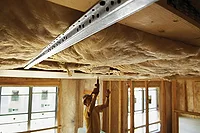
Decoupling is a method used with the intent of separating the attachment of walls from your studs, thus breaking the direct path of the sound waves. Including resilient channel or resilient sound clip mounts to your studs can give your decoupling a boost, thwarting sound wave movement and improving performance.
Resilient clips yield impressive results, but their installation is cumbersome and expensive compared to other options. Clips require initial mounting and then subsequent hat channel installation. The result adds hours to the job and significant cost to the overall project.
By comparison, resilient channel (RC) is wallet-friendly and has been around for more than 50 years. In addition, this solution provides a serious reduction in any ceiling ridging and cracking. Researching your options to choose one of the properly tested RC lines is a must to ensure you receive a quality product. Most importantly, the installation is easy.
Mass simply means constructing a heavier, denser wall by using another layer of drywall or thicker materials.
After considering the four options above, consult the following table for a 10,000-foot overview on soundproofing options (excluding insulation and mass):
Comparing the information listed in Figure 2, picking properly tested RC for your job is a safe bet for your ROI. By utilizing RC, you can save money, receive a legitimate STC rating, and finish on time with an easy installation. Don’t forget the bonus: less ridging and cracking in your walls and ceilings.
Installation
Often architects wish to specify RCs in their designs, but choose otherwise due to concerns of incorrect installation. If spec’d for RC, or bidding on behalf of RC as your solution, you need to know the material. For optimal performance, education on proper installation is a necessity.
First, always choose a RC that has been STC and IIC tested to ensure your investment in a quality product. Once construction begins, here are the common missteps that should be monitored:
Mounting
RC must be mounted perpendicular to the stud. Appropriate center-to-center placement is key in minimizing the connection of gypsum board to your stud or joist.
- Walls—Spacing Max is 24 inches
- Ceilings Joists of 24 inches—RC must be 16 inches
- Ceiling Joists of 16 inches—RC can be 24 inches
- Gypsum with Insulation Support—RC must be 12 inches
It is also crucial for the attachment flanges to always remain face down, ensuring the open side of the RC is face up towards the top of the wall. Appropriate placement allows the weight of the gypsum board to point the RC away from the framing. No direct contact with the impending sound enables the RC to act as a shock absorber. If you incorrectly install the open side of the RC downward, the RC will press into the framing. This error cancels out the intended effect, instead helping sound vibrations in their resonance through to the stud.
Some manufacturers require RC to be specifically aligned to framing members based on their uniquely designed hole patterns. This forces you to scrap the overlapping metal after mounting. There are other manufacturers that offer quality, STC rated products without this requirement—saving you costs associated with unused metal and extra labor.
Screws
Screws that attach your gypsum board to the RC have to be correct length (gypsum board’s depth plus 3/8-inch), and must be located between framing members. Using a screw that is too long and then installing them directly into framing members creates a sound vibration conduit, providing an additional opportunity for a metal-to-metal environment. This error is known as “short circuiting,” which negates some of the acoustical perks associated with RC and is always reflected in reduced STC scores.
Sandwiches, Sealing and Seams
An additional error to note is the installation of RC onto a solid surface like plywood panels, etc. (making the RC the “meat” between panel and gypsum board bread slices) is an acoustical catastrophe—short circuiting your channels once again.
When a job asks for two layers of board, you should always offset your seams for every layer. This ensures sound transmissions is blocked throughout the wall assembly.
You must also remember to thoroughly seal any outlets, switch boxes, etc. to avoid flanking. Flanking basically translates to the occurrence of sound due to gaps within the wall’s corners and perimeters.
The Gist
There are numerous acoustically-oriented wallboard and insulation products that have entered the market in response to the soundproofing trend. All of these products promise better STC ratings, but at a higher price than the traditional, trusted wall assemblies.
In a time that requires a low price tag, properly constructed, short-circuit free RC barriers coupled with insulation and sealant is an old-school approach with new-age results.
References
1. Jerry Lilly, “Update on the use of steel resilient channels for constructing sound rated walls,” Sound and Vibration 36, 8-9 (2002)
2. Quantitative comparisons of resilient channel designs and installation methods. (2009, August 23). 2009 Veneklases Associates
Looking for a reprint of this article?
From high-res PDFs to custom plaques, order your copy today!