Get the Acoustics Right for Every Office Type
Is your office type a "Jewel" for your company?

“Form ever follows function.” - Louis Sullivan’s Jewel Box has a lot to teach about good office acoustics design.
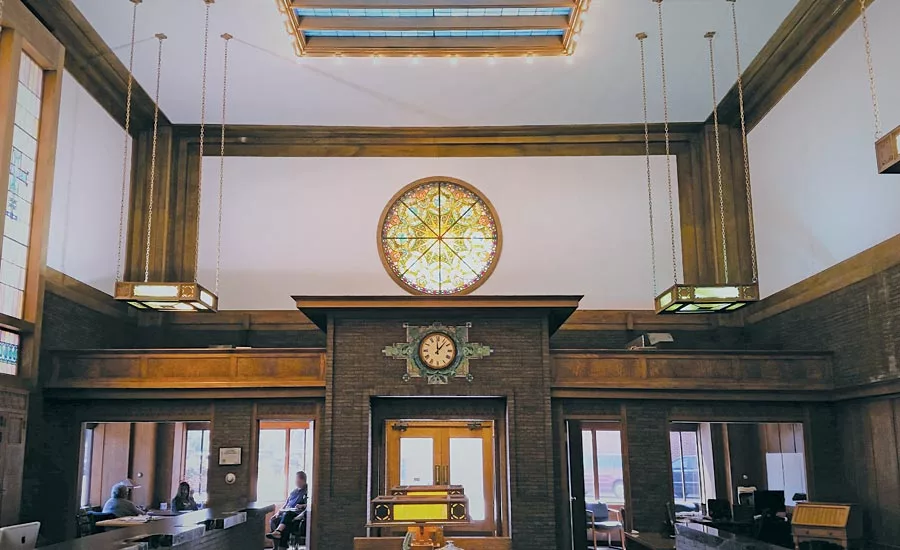
Pictured are five office space types within one shot. Low ceiling conference room (1) and private office (2) on either side of entrance. High ceiling open office with fixed (3) (left) and transient stand-up (4) (center) workstations. Low overhang ceiling team meeting area (5) on the right. Stained glass on the ceiling and walls is the original mass loaded sound damping material.
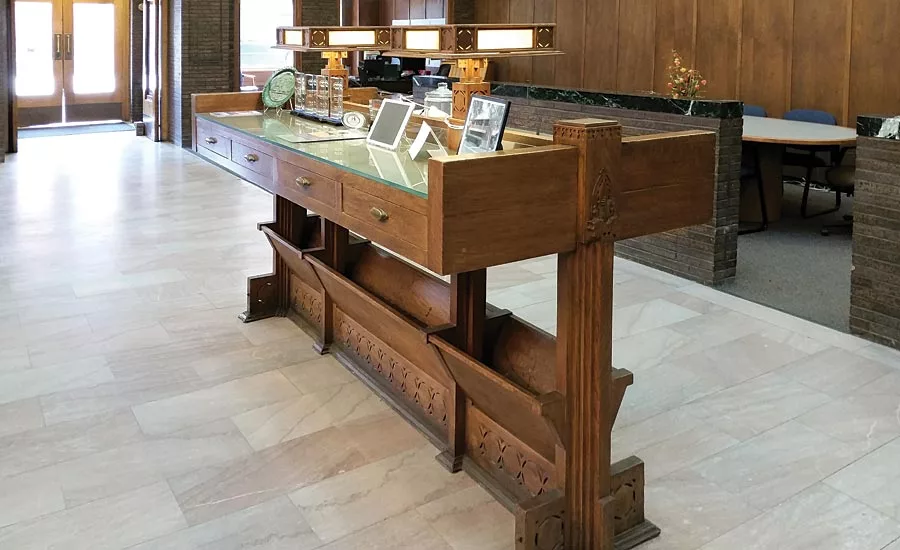
The 1914 version of the stand-up workstation is inviting, utilitarian and prevents standing waves from forming between the hard marble floor and stained glass ceiling. The brick modesty wall, carpeted floor, wood paneling and low ceiling overhang tame the acoustics of the team area shown to the right.
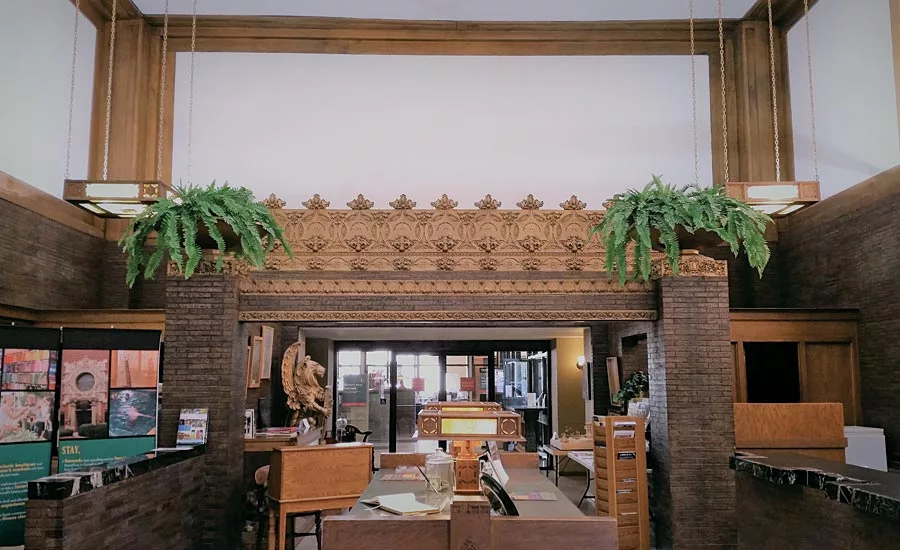
Brick and plaster trelliswork continues Sullivan’s architectural theme while helping to diffuse sound within the high ceiling, open plan office area. Finish carpentry work frames the room while keeping corner reflections in check. Note the glass sliding doors leading to a modern addition, which are not part of the original design.
There seems to be a lot of research activity recently in trying to figure out the best office design for the “new way of working.” At two extremes, should everyone be given a private office with a door they can close to minimize distractions or, should everyone be seated in open-plan spaces to encourage collaboration among team members?
Between these two extremes are variations and combinations of office space designs that have the goal of matching environment to work task. Since work and the studies of it will continue to evolve, our best preparation is to know how to get the acoustics right for every office type.
When things seem a bit a confused, I like to look back to see how the original masters of the art handled the same issues. This summer, I treated myself to a visit to the Merchant National Bank (nicknamed “The Jewel Box”) in Grinnell, Iowa. Designed by “The Master” Louis Sullivan late in his career, the Jewel Box has a lot to say about the acoustics for various types of office spaces. It was amazing considering the Jewel Box’s small size.
Private (Cellular) Office
Research studies aside, I think it’s safe to say that everyone aspires to have a private office—I’ve yet to see an open-plan executive suite. In most business cultures in the United States, private offices must be reserved and “awarded” only to upper management—even though this results in low occupancy rates of the available private offices. In Europe, where employees have a legal say in workplace design, private offices are prevalent.
Good acoustics design for a private office begins with isolation from external noise. To accomplish this, demising walls, ceilings and floor construction should copy one of the catalogued STC55/IIC55 or better sound rated assemblies. Walls can’t stop at a suspended ceiling, they need to extend and be sealed watertight from floor to structural deck. Any and all penetrations (including ductwork) must be specially designed to maintain the sound isolation rating of the room. A 1½-inch thick solid wood door with weather strip and threshold gasketing completes the necessary isolation.
Since the private office space is relatively small, obtaining good room acoustics is not particularly difficult. Typically, a ceiling finish having an acoustic rating of NRC 0.5 will be all that is needed. Ceilings should be low to keep first reflections tight and “normal sounding.” If the office is larger than normal, or if it is used extensively for teleconferencing or recording, then you can expect to also add thin carpet to the floor to prevent scuffling noises, and sound absorbing panels to approximately 10 percent of the wall surfaces to intercept discrete reflections.
Open Plan Office
Driven primarily by its potential for low construction costs, low energy usage and the ability to quickly change office layouts as needed, the open plan is by far the most used office design. Open plan offices typically have high ceilings, which simplify and reduce the costs to distribute light, heat and ventilation throughout the space. Unfortunately, noise is distributed efficiently throughout the space as well.
Good acoustic design of an open plan office includes high NRC ceilings, sound panels on 20 percent or more of the wall surfaces, tall partitions separating workstations, appropriate sound masking and cooperative workers.
Although they are often touted as the ideal office environment to encourage collaboration among employees, Collaboration Expert Jason Fried of Basecamp.com observed that, the necessary environment for achieving productive work is very similar to that needed for achieving productive sleep; namely give employees the opportunity for long stretches of time with no interruptions. Neither good creative work nor good restful sleep happens with interruptions occurring every 10 minutes.
Consultant Steve Orfield of Orfield Labs remarks, “Whatever space is available for the office design, the typical problems are 1) there is never enough space and 2) there is no or little attention paid to acoustic control.”
Efforts to reduce costs drive the selection of inferior performing ceilings, which then increases reverberation throughout the office space.
Industry standards define “private” as meeting a speech privacy index of 0.2, where only 20 percent can be understood. Spaces meeting an SPI of 0.05 are considered “confidential” spaces.
With good acoustic design and the use of sound masking in an open plan office, you can expect to have speech privacy at a distance of 12 feet. With good acoustic design but no masking, the distance would grow to 20 feet.
Without proper acoustic design, we’ve experienced open plan offices having no speech privacy; in which conversations could be clearly understood at a distance of 70 feet.
Combination Office
The combination office recognizes the need for private and open spaces and is simply an arrangement of private offices surrounding an open plan office space. Originally used to separate workers from their noisy office machines of the 1960s, this type of office is now used primarily for call centers, with the operators (wearing headphones) seated rank and file in the open plan area and their supervisors taking refuge from the resulting babble in the surrounding private offices.
Team Office
Where the private office is intended for the individual and the open plan office is intended for groups of 30 or more employees, the team office can be looked at as a downsized open office plan or a supersized private office for a team of approximately six people.
Built like a private office, the team office allows collaboration between team members while the demising walls isolate them from extraneous conversations from other teams.
Alternatively, the team office may be more of a team area within a larger open office plan. In this case, good acoustic design should include a low ceiling height over the team area to help provide visual and acoustic separation.
Programmed Office
The newest office type is the programmed office. Instead of designing the workspace to fit each employee, varieties of workspace types are provided and the employees are free to wander and work where they want. Programmed areas may include a cafe, a series of break out rooms, a library, a courtyard, an exercise room and more. Early studies at both British Petroleum and Sun Microsystems compared the programmed work environment with the open plan and private office. The studies showed significant improvement in productivity. At BP, approximately 13 percent greater performance, 15 percent greater communication, 18 percent greater collaboration, and 10 percent increased creativity. At Sun, a perceived 10 percent gain in individual productivity and 7 percent in team productivity.
Since the programmed office is simply an assembly of various types of work environments, the primary rule of good acoustics is to keep the noisy things away from the quiet spaces. Quiet spaces should be off the main travel routes, ideally in cul-de-sacs. Game rooms should be located off common spaces, not adjacent to office space.
Once the spaces are acoustically separated, the acoustic treatment of each follows its form and function.
Lessons from the Jewel Box
Since modern acoustics was still in its infancy when Louis Sullivan designed the Merchants National Bank, I was expecting its acoustics to be harsh and full of echoes. I was pleasantly surprised. Not only does the design have a look and feel that puts a smile and an obvious sense of pride on the faces of the people that work there, the acoustics are also perfect.
One private office has a low ceiling, an appropriate amount of sound absorption and a door that shuts. The small conference room counter to the office has the same simple features - perfect for private meetings.
The acoustics of the open office area is a bit more complicated than it appears, but again works perfectly. Whether by design, experience or accident, low frequency sound absorption is provided by stained glass (the original mass loaded sound damping material) on the ceiling and walls. Raised wood panels provide mid-frequency absorption.
The 1914 version of the stand-up workstation is inviting, utilitarian and prevents standing waves from forming between the hard marble floor and stained glass ceiling. A brick modesty wall, carpeted floor, wood paneling and the low ceiling overhanging the team table tames the acoustics of the team area within the open plan space.
Brick and plaster trelliswork continues Sullivan’s architectural theme while helping to diffuse sound within the high ceiling, open plan office area. Finish carpentry work frames the room while keeping corner reflections in check.
As employers and architects attempt to create the latest ideal workplace, intending to engage employees and provide them with a connection for more meaning and purpose, our best preparation is to know how to get the acoustics right for every office type. To do that, I listen to the original masters of the art.
Looking for a reprint of this article?
From high-res PDFs to custom plaques, order your copy today!