Walls & Ceilings logo
search
cart
facebook twitter linkedin youtube youtube Spotify Podcasts Apple Podcasts Spotify Podcasts Apple Podcasts
  • Sign In
  • Create Account
  • Sign Out
  • My Account
Walls & Ceilings logo
  • NEWS
  • TOPICS
    • Drywall
    • Stucco/EIFS
    • Ceilings
    • Steel Framing
    • Fireproofing
    • Interior Plaster
    • Building Envelope
    • Insulation
    • Technology
    • Interior
    • Exterior
    • Women In Construction
  • COLUMNS
    • Up Front
    • All Things Gypsum
    • Art & Craft of Plastering
    • Stucco Stop
    • Steel Deal
    • Industry Voices
  • PRODUCTS
    • Buzz Guide
  • EVENTS
    • Industry Events
    • Webinars
    • BUILD Expo
  • MEDIA
    • Videos
    • Podcasts
    • Photo Galleries
    • BUILD26 Videos
    • Take our Quiz!
    • Infographics
  • EXCLUSIVE
    • Newsletters
    • Top 50 Contractors
    • Contractor of the Year
    • State of the Industry
    • W&C Store
    • Market Research
    • CEUs
    • Sponsor Insights
    • Custom Content & Marketing Services
  • DIRECTORY
  • EMAGAZINE
    • eMagazine
    • Advertise
    • Archive Issues
  • SIGN UP!
ColumnsStucco/EIFSStucco Stop

The Benefits of Using Stucco

The Stucco Status Quo
By Albert Carrillo, Senior Advisor
stucco

In my storied career, I have seen building cladding fads come and go: glass, metal, wood, brick, all gaining momentum but eventually, the tide turned back to stucco and EIFS.

April 3, 2018

Back in the early ’80s, I was cutting my teeth in the stucco industry. It was in Tucson, Ariz., where stucco was king; EIFS, the relative newcomer, a close second. Back then, it was the cladding du jour, the go-to for all the buildings. A building could be made “distinct” by adding pop-outs, lots of pop-outs. It was no “walk in the park” working the walls, but in retrospect it was a very profitable and rewarding career. It was because of my choice to be a plasterer that I am where I am today. 

In my storied career, I have seen building cladding fads come and go: glass, metal, wood, brick, all gaining momentum but eventually, the tide turned back to stucco and EIFS. Today, we are seeing an increase in the selection of engineered metal and glass facades and a more aggressive decline in the selection of stucco. I still believe stucco remains one of the most affordable and versatile claddings for all types of construction. After all, with its versatility and affordable cost (compared to other engineered claddings) and our current construction uptick, one would think the plastering trade would be prospering, growing and attracting the multitudes. It is my opinion that this is not the case and in reality, stucco is just maintaining a status quo. So, it begs the question why? 

Is Weather the Culprit?

Now, I must admit that in the southwest, for six to eight months, the hotbox summertime takes a toll on the body and minds of our plasterers. It is just plain difficult to apply stucco in extremely hot temperatures. One must have experience dancing in the devil’s heat to ensure a good stucco cladding application. In fact, all through the Sunbelt states—where stucco is very popular—this hot-boxing effect exists. (Same dance with some humidity variations; taxing the bodies of the applicators; challenging their abilities to apply stucco.) But, I don’t think excessive heat is the reason for stucco just maintaining a status quo.

And what about the other side of the thermal coin, such as the states north of the Mason-Dixon line, where temperatures are mostly shivering cold?  Back in the ’80s and ’90s, I was surprised to see stucco gaining popularity in these areas. Skilled craftsmen and women rallied behind the cladding and helped to grow the stucco market albeit for very short application seasons. I suppose that just like anywhere else, it was aesthetically popular and versatile, ergo desired. But similar to the Sunbelt states, stucco is not taking the leaps in preference it once did. No, I don’t believe the cold is the reason for stucco just maintaining the status quo.

From Northern California to the Canadian border, stucco has been a very popular cladding choice. It was successfully installed for years in this rainy, mostly always-moist, environment.  Here, the art of tenting a building was perfected so stucco could be installed during the rains. Some really hot wet weather and cold wet weather added challenges to the wroughting of the cement cladding. Nevertheless, not the reason for stucco just maintaining a status quo.

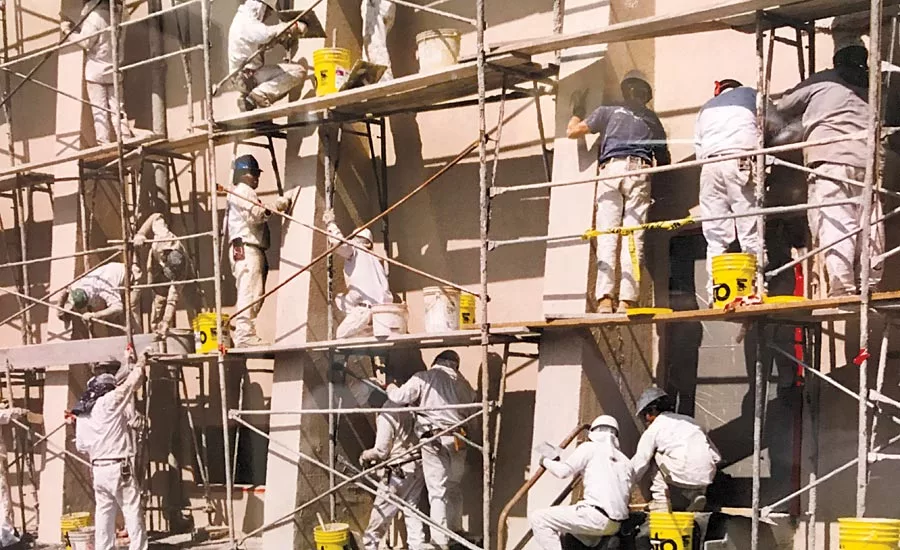
Wet cement is a very burdensome product to manipulate. It contains heavy elements like sand, cement, and water that when combined, place a heavy load on the applicators. Despite this heavy load, a skilled plasterer makes application look as easy as putting on a pair of pants. They have mastered the ability to move this heavy, wet, plastic mix that would rather splash to the ground from a mixer to a relatively flat surface, than the exterior walls. I have many (old) friends suffering from joint pain and overall body aches from slinging the mud. It is just plain old hard work being a plasterer. Still, even this is not the reason for stucco just maintaining a status quo. 

Stick to the Stuff You Know

If I were to focus on a “best reason why” our plastering trade is just maintaining a status quo, I would place the spotlight on the constant downward pressure developers, and builders, are placing on the trade. The price to apply a square yard of plaster has not increased comparatively, in relation to the current economies of construction. In the stucco heyday, the builders reviewed bids to select the most competent, not just take the lowest bid. 

Today, the “lowest-bid-gets-the-job” selection process places undeserving stress on contractors to just come out of the gate cheap. Interestingly enough, the buildings aren’t getting cheaper to build and surely don’t have a cheaper sales price reflecting the cheaper application price spiral. Following in the downward whirlpool are the wages a man or woman earns to sling mud. And shoveled into the mix is the willingness for survival (I’m sure) of the manufacturers and material suppliers to keep lowering their prices. For the labor burden put on an applicator, cheaper is not better. So, the inquiring minds, the thinkers, the best-of-the-best wander to greener pastures or retirement. Their knowledge is passed on by those left, not through a formal training but rather by word of mouth. Remember the Gorilla story?  

I believe in our current environment there are increasingly unfounded perceptions that stucco is a troublesome cladding. It is not the applicators, because heck, anyone can apply stucco, moreover the perception is directed at the actual stucco cladding. Therein lies a real danger. More and more we are seeing enhanced stucco assemblies, engineered with double-sheathed foam sandwiches over vapor impermeable building wraps with high-performance drainage cavity components and product additives to supposedly eliminate labor steps. Yeesh, can we just stop the madness? 

Just like a soupy stucco mix, a watered-down version of skilled craftsmen and the knowledge they carry, lends to weak stucco. This is the chink in the armor that allows stucco “issues” to become more prevalent. I saw a great T-shirt that had printed on the back: “Skilled Labor isn’t Cheap and Cheap Labor isn’t Skilled.” What a very simple premise, an understanding of the very basics of quality construction. Unlike products like computers, automobiles and high-tech gadgets, plaster application cannot be improved solely by advanced product technology. 

Quality stucco claddings still rely on a blend of the toils of the body and application knowledge. I believe if we can reestablish a truly trained and knowledgeable workforce, we have the courage to provide service at a fair price, we provide plasterers a living wage and if the crick doesn’t rise, then, we can grow our plaster trade.

KEYWORDS: cement cladding EIFS stucco

Share This Story

Looking for a reprint of this article?
From high-res PDFs to custom plaques, order your copy today!

Wc0420 clmn stucco stop p3 author albert carrillo

Albert Carrillo is senior advisor for the Western Wall & Ceiling Contractors Association. He can be reached at albert@wwcca.org.

Recommended Content

JOIN TODAY
To unlock your recommendations.

Already have an account? Sign In

  • Abercrombie & Fitch

    EIFS in 2026: How Specialty Finishes Are Redefining Exterior Wall Systems

    As building codes, owner expectations, and design demands...
    Stucco/EIFS
    By: Regi Mendoza
  • proper air and vapor control

    From Energy Efficiency to Moisture Management: Why Air and Vapor Control Matter

    How proper air and vapor control within building...
    Building Envelope
    By: Benjamin Meyer AIA, LEED AP
  • Linear Metal Ceiling Beam Baffles

    Top 25 Ceiling Contractors of 2026

    Suspended ceilings demand precision, code compliance and...
    Ceilings
    By: John Wyatt and Tanja Kern
You must login or register in order to post a comment.

Report Abusive Comment

Manage My Account
  • eMagazine Subscription
  • Newsletters
  • Online Registration
  • Manage My Preferences
  • Subscription Customer Service

More Videos

Sponsored Content

Sponsored Content is a special paid section where industry companies provide high quality, objective, non-commercial content around topics of interest to the Walls & Ceilings audience. All Sponsored Content is supplied by the advertising company and any opinions expressed in this article are those of the author and not necessarily reflect the views of Walls & Ceilings or its parent company, BNP Media. Interested in participating in our Sponsored Content section? Contact your local rep!

close
  • medical professionals moving a patient on a stretcher through the halls of a medical building
    Sponsored byNational Gypsum Company

    What Does High Performance Mean When It Comes To Gypsum Boards?

Popular Stories

Wichita Biomedical Campus

Wichita Drywall Worker Dies After Scaffolding Fall

Okan Tower in Miami, Florida

OSHA Opens Investigation Into Fatal Okan Tower Column Collapse

Construction workers in safety vests install drywall

Gypsum Sales Hold Amid Market Shifts in the U.S.

Polycon CEO Discusses Spray Foam

Doug Kramer: PolyCon Expands Roofing Foam Solutions

Events

June 24, 2026

The Bright Side & Benefits of Designing with Integrated Lighting

Credits 1 AIA LU/HSW; 0.1 ICC CEU

This course will explore the pivotal role architects and lighting design play in creating safer, more sustainable spaces. Learn how to avoid common lighting mistakes and make informed decisions that create the best visual environment for occupants. 

January 1, 2030

Webinar Sponsorship Information

For webinar sponsorship information, visit www.bnpevents.com/webinars or email webinars@bnpmedia.com.

See our full library of webinars

View All Submit An Event

Products

2026 National Painting Cost Estimator

2026 National Painting Cost Estimator

See More Products

Related Articles

  • The Benefits of Using EIFS

    See More
  • A large forklift and a concrete silo

    Top Three Benefits of Using Pre-Blended Stucco and Mortar

    See More
  • Sto releases study on saving benefits of using EIFS vs. brick on metal stud framing

    See More

Related Products

See More Products
  • Builder's Guide to Stucco, Lath & Plaster

  • barrys.jpg

    Barry's Advanced Construction of Buildings, 4th Edition

See More Products

Events

View AllSubmit An Event
  • June 24, 2026

    The Bright Side & Benefits of Designing with Integrated Lighting

    Credits 1 AIA LU/HSW; 0.1 ICC CEU This course will explore the pivotal role architects and lighting design play in creating safer, more sustainable spaces. Learn how to avoid common lighting mistakes and make informed decisions that create the best visual environment for occupants. 
View AllSubmit An Event

Related Directories

  • Stucco Manufacturers Assn.

    The Stucco Manufacturers Association (SMA) is a national association dedicated to the promotion, education and training of the lath and plaster industry. The SMA offers Contractor Certification for those installers who can complete on-line training classes and references verified. The SMA believes the LOW bid is not the best indicator of the better contractor.
  • Association of the Wall and Ceiling Industry (AWCI)

    AWCI represents nearly 2,400 companies and organizations in the acoustics systems, ceiling systems, drywall systems, exterior insulation and finish systems, fireproofing, insulation, prefabrication/panelization and stucco industries. Our members are contractors, suppliers and manufacturers and those in allied trades. Our mission is connecting people in the wall and ceiling industry to innovate, grow and succeed.
×

Connect with the industry’s leading resource for unparalleled insights and education.

Join thousands of industry professionals today. Shouldn’t you know what they know?

JOIN NOW
  • RESOURCES
    • Advertise
    • Contact Us
    • Directories
    • Store
    • Want More
  • SIGN UP TODAY
    • Create Account
    • eMagazine
    • Newsletters
    • Customer Service
    • Manage Preferences
  • SERVICES
    • Marketing Services
    • Reprints
    • Market Research
    • List Rental
    • Survey/Respondent Access
  • STAY CONNECTED
    • LinkedIn
    • Facebook
    • Instagram
    • YouTube
    • X
  • PRIVACY
    • PRIVACY POLICY
    • TERMS & CONDITIONS
    • DO NOT SELL MY PERSONAL INFORMATION
    • PRIVACY REQUEST
    • ACCESSIBILITY

Copyright ©2026. All Rights Reserved BNP Media, Inc. and BNP Media II, LLC.

Design, CMS, Hosting & Web Development :: ePublishing
