ICFs Massive Energy Savings
Why High-mass Walls Offer a Massive Advantage
In the North American building codes, there’s an acknowledgement of the benefits of high-mass walls, but there’s still no official test standard for determining the effect of thermal mass in a wall. The testing done to meet U.S. and Canadian codes concentrates solely on the thermal resistance (R-value) of a wall based on steady-state evaluations of materials and assemblies.
To get a more complete picture of thermal mass performance, the Insulating Concrete Forms Manufacturers Association recently commissioned a study by CLEB Laboratories (now known as UL-CLEB) in accordance with test procedure ASTM C1363-11. The study revealed that insulating concrete form walls can achieve up to 60 percent greater annual energy savings and 58 percent higher R-Value/RSI than can be attained by standard batt insulated 2x6 wood-framed walls.
The study goes even further than what researcher Dr. Pieter VanderWerf learned in the 1990s by comparing ICF and wood-framed walls in 15 different North American locations. His study concluded that ICF walls reduced heating costs by an average of 44 percent and cooling costs by 32 percent compared to traditional wood-framed walls.
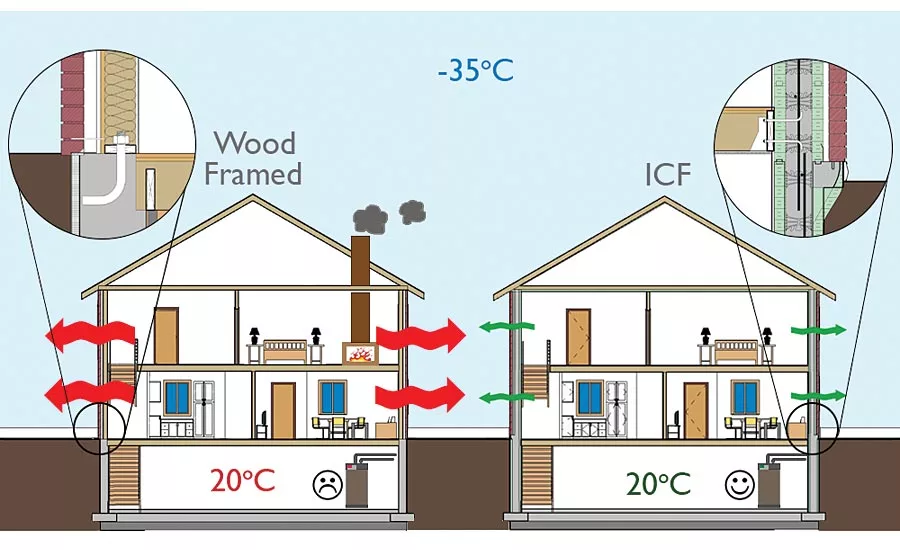
Many builders intuitively know that ICFs have an advantage over wood-framed walls. For years, they’ve seen infrared images of wood walls in the winter, where the studs can clearly be seen to be thermal transfer points that show up orange compared to the blue or purple color of the insulation.
Yet the residential construction field, like many others, often has a mindset of, “This is how we’ve always done walls.” So let’s make a clear distinction between thermal mass and thermal resistance.
Thermal Properties 101
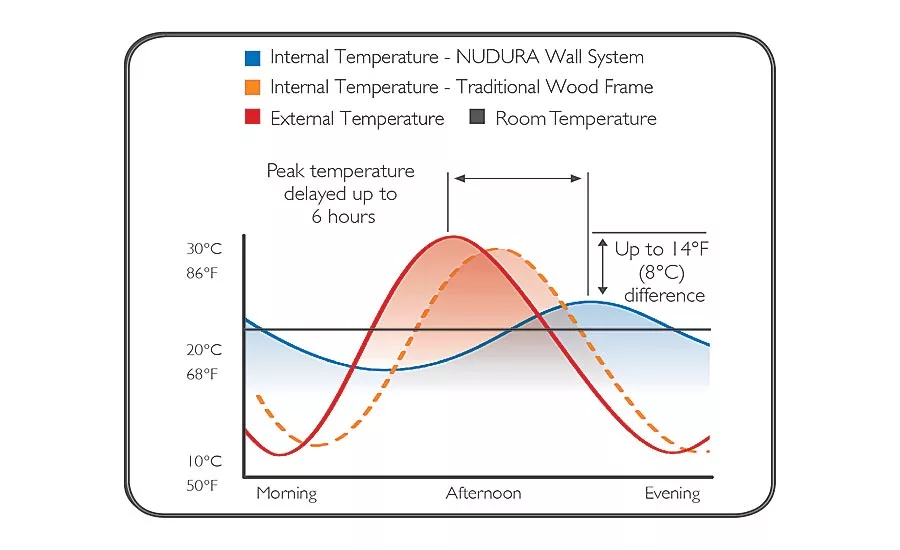
Thermal mass is the wall’s capacity to store energy. An ICF wall has the ability to store and hold heat for a long time. Only after very long exposure to outside conditions does it begin to react. It calls for heating or cooling more slowly—and less often—than a wood framed wall.
In the autumn months leading into winter conditions an ICF wall is very slow to call for heat because there’s still a good deal of heat stored in the concrete core from solar heat gain. But a wood wall will react quickly and call for heat. The same is true for the late spring season leading into summer. The temperature of the concrete contained within the ICF wall still maintains an ambient temperature that is closer to the internal temperature of the room, than to the hotter temperatures outside, meaning it will take longer for a call for air conditioning from the living space. A standard wood wall will typically react quickly and call for cooling almost immediately as the temperatures outside move above 75 degrees Fahrenheit.
Thermal resistance is the difference in temperature between the inside and outside of the wall divided by the amount of heat transmitting through a per unit of time per unit area of the wall.
Bring it to Life
Let’s say that the outdoor temperature is -11 degrees Fahrenheit and the indoor temperature is 70 degrees Fahrenheit. The difference between those two numbers is 81 degrees Fahrenheit. Using a variable heater to condition the interior side of an 8x8 (64 square feet) insulated wall subjected to this temperature difference, we can measure in BTUs per hour the exact amount of heat required to maintain the wall temperature at precisely 70 degrees Fahrenheit.
To complete the example, let’s say that the investigation above finds that this wall is recording a flow of heat through it of 216 BTUs/hour. This means that for every square foot of area of this wall, the wall is transmitting 216/64= 3.375 BTU/hour/square feet.
Using the equation given above, we can calculate the approximate assigned “steady state” thermal resistance of the wall by dividing the total temperature difference (81 degrees Fahrenheit) by 3.375 BTU/hour/square feet, which equals R-24.
Don’t Focus Only on R-value
The key point is as temperatures fluctuate day to night, or seasonally winter to summer, the rate of heat flow through a wall is really never at steady state. This fact is even more emphatically true for an ICF wall due to its ability to delay response to changes in outside ambient air temperature. That’s a direct result of the thermal mass properties of the ICF wall.
As a result, it can be misleading to focus solely on a material’s R-value. In fact, the 2015 and 2018 International Residential Codes already recognize that the fiberglass batts insulation installed in a wood wall in Indiana might have a published requirement of R-20, while a high-mass wall like an ICF could have a published performance of R-15 for the same region, yet it would still be capable of delivering the same energy performance as the R-20 frame wall. That’s because the insulating properties are partially attributed to an ICF’s thermal mass and the fact that the ICF wall also has two continuous layers of EPS foam insulation that are not interrupted by studs, as is common in a wood framed wall. As a result of both properties, a lower R-value ICF wall can still perform at equal to or greater energy savings than the higher insulated wood frame wall.
Test Results Verify the Importance of Thermal Mass
What makes the CLEB testing unique is that it focuses on thermal mass performance. In the test, the wall core of both the ICF and wood wall began at room temperature, and researchers then applied an outside temperature of -35 degrees C. It took the wood wall about 60 hours to reach steady state, while the ICF took almost 13 days (324 hours) to attain steady state. Even though both walls were exposed to the same external temperature, the ICF wall didn’t begin to call for heat for more than two days after the wood wall had reached steady state.
The bottom line is that whether you’re in Fairbanks, Alaska or Miami, an ICF wall will require less insulation yet provide greater energy savings. Because an ICF reacts so slowly to temperature fluctuations outside, it’s able to slow down the flow of heat through the wall—whether it’s coming in during the summer or going out during the winter.
In addition, high-mass walls let homebuilders install less expensive heating and cooling equipment. HVAC tonnage can usually be reduced by 30 to 40 percent when builders choose ICFs instead of wood-framed walls.
ICFs are valuable because of their thermal inertia, but builders need to overcome the inertia of using wood framing simply because it’s been common for decades. Research is showing us that it’s time to take a fresh look at the many advantages of high-mass walls.
Looking for a reprint of this article?
From high-res PDFs to custom plaques, order your copy today!