Walls & Ceilings logo
search
cart
facebook twitter linkedin youtube youtube Spotify Podcasts Apple Podcasts Spotify Podcasts Apple Podcasts
  • Sign In
  • Create Account
  • Sign Out
  • My Account
Walls & Ceilings logo
  • NEWS
  • TOPICS
    • Drywall
    • Stucco/EIFS
    • Ceilings
    • Steel Framing
    • Fireproofing
    • Interior Plaster
    • Building Envelope
    • Insulation
    • Technology
    • Interior
    • Exterior
    • Women In Construction
  • COLUMNS
    • Up Front
    • All Things Gypsum
    • Art & Craft of Plastering
    • Stucco Stop
    • Steel Deal
    • Industry Voices
  • PRODUCTS
    • Buzz Guide
  • EVENTS
    • Industry Events
    • Webinars
    • BUILD Expo
  • MEDIA
    • Videos
    • Podcasts
    • Photo Galleries
    • BUILD26 Videos
    • Take our Quiz!
    • Infographics
  • EXCLUSIVE
    • Newsletters
    • Top 50 Contractors
    • Contractor of the Year
    • State of the Industry
    • W&C Store
    • Market Research
    • CEUs
    • Sponsor Insights
    • Custom Content & Marketing Services
  • DIRECTORY
  • EMAGAZINE
    • eMagazine
    • Advertise
    • Archive Issues
  • SIGN UP!
Building EnvelopeExterior

An Ambitious Restoration 120 Years in the Making

Saving the Bradford County Courthouse

Tom Felton
Copper was an appropriate choice for the courthouse’s architectural era and was well-received with the State Historic Preservation Office. Photo courtesy of Tom Felton.
Tom Felton
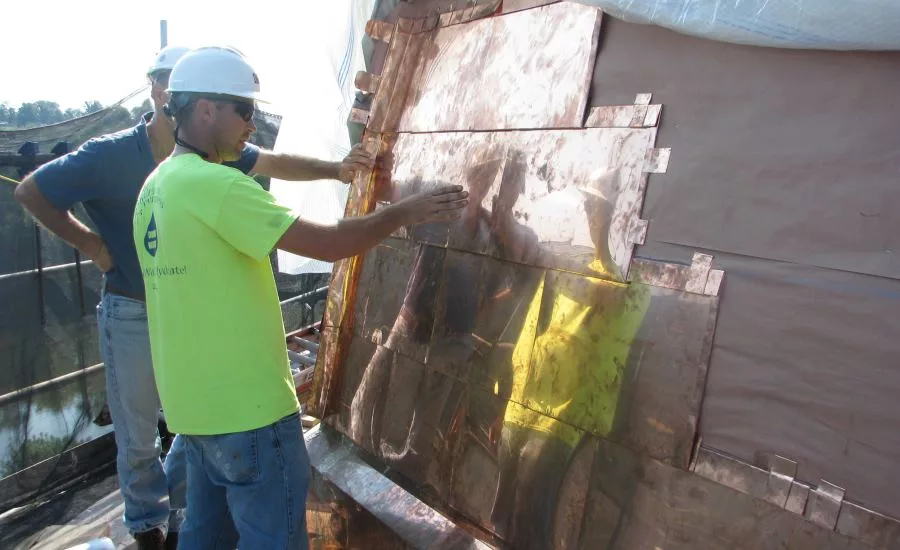
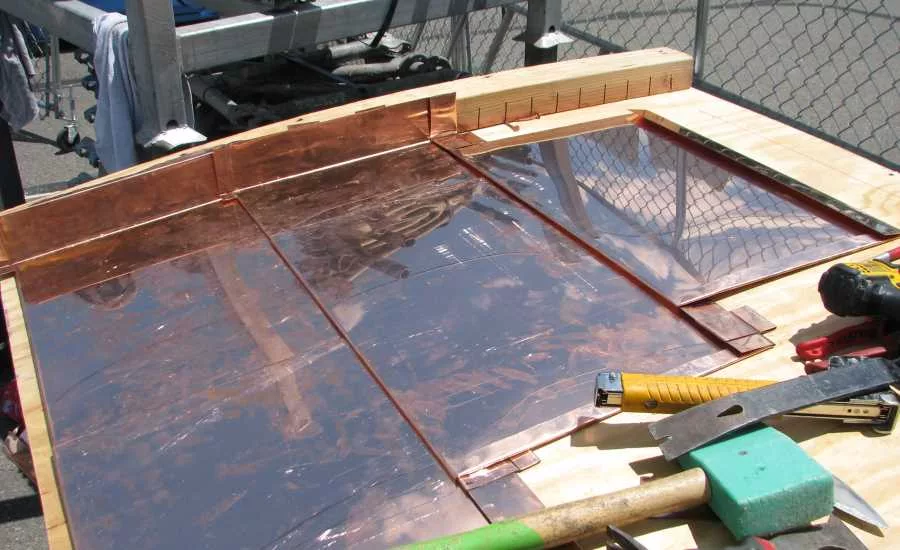
Crews working on the dome encountered many of the issues the original architects and contractors likely faced. The dome’s angle made installing hip battens time consuming and intricate. Photo courtesy of Levine & Company, Inc.
Bradford County Courthouse
The design team quickly realized they needed a durable, long-lasting material to withstand Pennsylvania’s harsh winters and to accommodate the relatively low-slope of the main roof. Copper proved to be the answer. Photo courtesy of Levine & Company, Inc.
Bradford County Courthouse
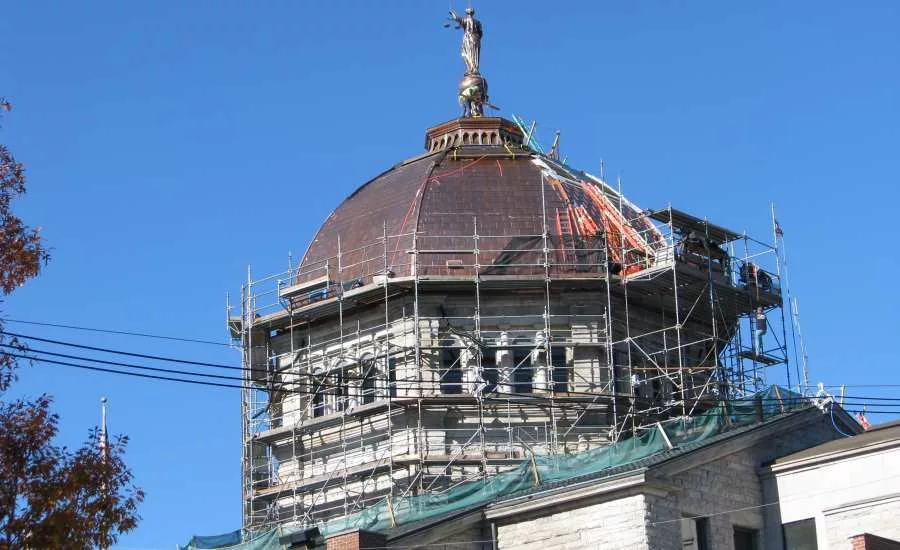
The crews had to specially design and place the scaffoldings to prevent accidental damage to the inside of the old dome. Photo courtesy of Levine & Company, Inc.
Bradford County Courthouse
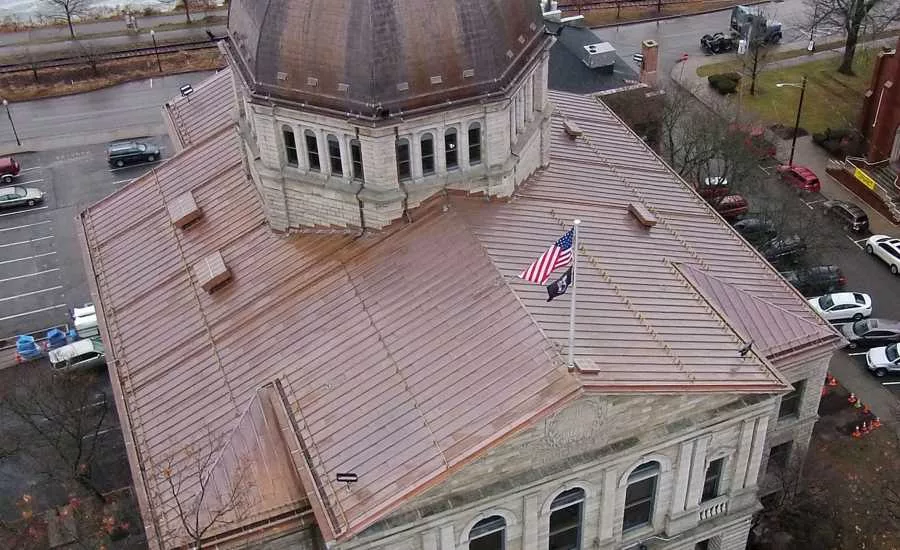
In total, over 15,000 square feet of 20-ounce copper panels were needed for both the main roof and dome. Photo courtesy of Charles F. Evans Company, Inc.
Tom Felton
Tom Felton
Bradford County Courthouse
January 7, 2019

Architects have a lot to consider when beginning a new project. Beyond all of the designing, testing and product selection, they must also fully understand all of the potential problems associated with the project. This is especially true for restoration jobs, where challenges borne from mistakes that might have been made 100 years ago can be lurking in shadows.

The Bradford County Courthouse in Towanda, Pa., is the epitome of a challenging historic restoration, and how tricky is can be to find the right building material. The courthouse’s restoration was anything but simple due to its lengthy list of problems: persistent leaking, substrate vulnerabilities including a weak deck, poorly secured tiles and frame, serious blow-off and pull-out risks, and more.

With so many issues readily known and even more potentially lurking, Levine & Company, Inc.; Charles F. Evans Company, Inc.; and Hunt Engineers, Architects & Land Surveyors, DPC faced a daunting architectural challenge.

A 120-Year-Old Web of Problems
The courthouse’s problems began in 1896 when it was built with a different material than what was originally specified. Just before the roof was installed, the material was changed from black slate shingles to green-glazed, French-style terra cotta tiles.

“When we dug up the building’s past, we found it was actually quite the scandal in the local paper when the material was changed to terra cotta,” said Jeff Levine, former president of Levine & Company and a key consultant for the Bradford project. “Regardless, issues were likely brewing because the main roof’s slope has always simply been too low for tile or slate to provide effective weatherproofing.”

Around 30 years later, leaking was frequent and extensive repairs were needed. 16-ounce, Spanish-style copper shingles were used to replace the terra cotta tiles. Also, a new steel deck was added with two layers of 1/2-inch wood fiberboard coated with in asphalt.

The copper shingles provided a solution for nearly a century. But by 2016, the fiberboard—which is not considered a sufficiently dense material to begin with—was severely deteriorated, which caused leaking and posed a serious pull-out and blow-off risk.

“We quickly realized that we were dealing with more than old-age and weathering,” noted Levine. “The [building] was suffering from decades of mistakes, which meant before we could fixed anything, we had to untangle it from the larger web of problems.”

Additionally, since it was listed on the National Register of Historic Places in 1987, all updates had to be vetted by the State Historic Preservation Office due to the courthouse’s historical significance.

Cupric Qualifications
The team looked into following the original design with modern tile and slate. But quickly realized they needed a more durable, long-lasting material to withstand Pennsylvania’s harsh winters and to accommodate the relatively low-slope.

“After evaluating all of our options, we chose copper,” said Levine. “It’s a reliable, low-maintenance material, and it was appropriate for courthouse’s architectural era.”

Architectural copper can easily last 100 years due to its natural oxidation process. When it is exposed to the elements, a chemical reaction takes place, forming a tough oxide/sulfate coating, or patina. This layer allows copper to resist corrosion almost indefinitely, while also gently changing the color over time, creating an “evolving beauty” that other metals struggle to match.

It’s also a modern sustainability solution. After the metal is taken off a building at the end of its service life and melted down, it’s virtually “as good as new.” When only counting the portions of the copper industry essential for architecture, 72 percent of all the copper comes from recycling sources and is known to maintain 95 percent of its original monetary value.

Preserving Justice
With the material selected, the installation began. Due to its size and daunting complexity, the project was split into two phases.

The first phase ran from April 2016 to April 2017 and involved the removal of the remaining terra cotta tiles from the dome and installing 3,300 square-feet of new flat-seam, 20-ounce cold rolled copper pans.

“While working on the dome, we encountered many of the issues the original architects and contractors likely faced,” said Bill Burge, construction manager for Charles F. Evans Company. “The dome’s angle made installing hip battens time consuming and intricate, but we knew using copper meant this wouldn’t need to be done again for another century.”

Flat seam systems are typically used on roofs that are flat or have a low pitch or alternatively on very steep slopes. They are also used on curved surfaces such as domes and barrel vaults. Additional installation details and recommendations can be found within the Copper Development Association’s (CDA) Copper in Architecture—Design Handbook on www.copper.org.

The second phase, which ran from April 2017 to January 2018, included replacement of the 100-year-old Spanish copper shingles with 12,000 square-feet of 20-ounce, cold-rolled batten seam copper panels. For the flashings, gutters and downspouts, 24-ounce copper was used.

Batten seam consists of copper pans running parallel to the roof slope, separated by wood battens. The battens are covered with copper caps that are loose locked into adjacent pans. The width of these preformed or field formed pans may vary. The recommended maximum depends on the weight of the copper being used, which can be found on www.copper.org.

The project also included restoration of the capitol’s statue atop the dome, Lady Justice, which kept a watchful eye over the Susquehanna River. After removing the paint from the statue, the team found that overall, the statue’s copper was in great condition. However, the head was destroyed from a supporting pole that had snapped.

“Fixing Lady Justice was memorable for us during this project,” said Burge. “It was uplifting to see the symbol of impartiality and fair-mindedness towering above the once long list of challenges.”

Earning Their Spot
For their incredible work on the Bradford County Courthouse, all three firms were honored with a 2018 North American Copper in Architecture (NACIA) Award, which recognizes and promotes North American building projects for their outstanding use of architectural copper and copper alloys.

Additional information about the awards program, as well as technical tips and information regarding different types of copper applications can be found on CDA’s website, www.copper.org.

This article was originally posted on www.buildingenclosureonline.com.
KEYWORDS: copper decking restoration

Share This Story

Looking for a reprint of this article?
From high-res PDFs to custom plaques, order your copy today!

Recommended Content

JOIN TODAY
To unlock your recommendations.

Already have an account? Sign In

  • Abercrombie & Fitch

    EIFS in 2026: How Specialty Finishes Are Redefining Exterior Wall Systems

    As building codes, owner expectations, and design demands...
    Stucco/EIFS
    By: Regi Mendoza
  • proper air and vapor control

    From Energy Efficiency to Moisture Management: Why Air and Vapor Control Matter

    How proper air and vapor control within building...
    Building Envelope
    By: Benjamin Meyer AIA, LEED AP
  • Linear Metal Ceiling Beam Baffles

    Top 25 Ceiling Contractors of 2026

    Suspended ceilings demand precision, code compliance and...
    Ceilings
    By: John Wyatt and Tanja Kern
You must login or register in order to post a comment.

Report Abusive Comment

Manage My Account
  • eMagazine Subscription
  • Newsletters
  • Online Registration
  • Manage My Preferences
  • Subscription Customer Service

More Videos

Sponsored Content

Sponsored Content is a special paid section where industry companies provide high quality, objective, non-commercial content around topics of interest to the Walls & Ceilings audience. All Sponsored Content is supplied by the advertising company and any opinions expressed in this article are those of the author and not necessarily reflect the views of Walls & Ceilings or its parent company, BNP Media. Interested in participating in our Sponsored Content section? Contact your local rep!

close
  • medical professionals moving a patient on a stretcher through the halls of a medical building
    Sponsored byNational Gypsum Company

    What Does High Performance Mean When It Comes To Gypsum Boards?

Popular Stories

drywall contractor sanding ceiling

D.C. Drywall Contractors to Pay $302K in Worker Case

Wichita Biomedical Campus

Wichita Drywall Worker Dies After Scaffolding Fall

Okan Tower in Miami, Florida

OSHA Opens Investigation Into Fatal Okan Tower Column Collapse

Construction workers in safety vests install drywall

Gypsum Sales Hold Amid Market Shifts in the U.S.

Events

January 1, 2030

Webinar Sponsorship Information

For webinar sponsorship information, visit www.bnpevents.com/webinars or email webinars@bnpmedia.com.

See our full library of webinars

View All Submit An Event

Products

2026 National Painting Cost Estimator

2026 National Painting Cost Estimator

See More Products

Related Articles

  • Mark Fowler

    The Making of an Apprentice

    See More
  • GC-subcontractor relationships

    Making the Shortlist: Building Stronger GC Subcontractor Relationships

    See More
  • R.L Reppert logo

    R. L. Reppert, Inc. Achieves 50 Years in Business

    See More

Related Products

See More Products
  • Accidents Waiting to Happen: Best Practices in Workers' Comp Administration and Protecting Corporate Profitability

  • building codes illustated.jpg

    Building Codes Illustrated: A Guide to Understanding the 2021 International Building Code, 7th Edition

  • 1118749847.jpg

    The Gypsum Construction Handbook, 7th Edition

See More Products

Related Directories

  • BECK America

    BECK America is proud to be the North American distribution arm for the vast range of tools, parts, and fasteners manufactured by BECK, a company with over 120 years of experience in providing products of consistent quality and innovation. Each of our fasteners is carefully engineered to precisely fit the broad array of all common nailers, staplers, bradders, and pinners. Our experienced staff of strategically located regional sales managers around North America is focused on bringing this depth of resources to every customer to satisfy their unique needs.
×

Connect with the industry’s leading resource for unparalleled insights and education.

Join thousands of industry professionals today. Shouldn’t you know what they know?

JOIN NOW
  • RESOURCES
    • Advertise
    • Contact Us
    • Directories
    • Store
    • Want More
  • SIGN UP TODAY
    • Create Account
    • eMagazine
    • Newsletters
    • Customer Service
    • Manage Preferences
  • SERVICES
    • Marketing Services
    • Reprints
    • Market Research
    • List Rental
    • Survey/Respondent Access
  • STAY CONNECTED
    • LinkedIn
    • Facebook
    • Instagram
    • YouTube
    • X
  • PRIVACY
    • PRIVACY POLICY
    • TERMS & CONDITIONS
    • DO NOT SELL MY PERSONAL INFORMATION
    • PRIVACY REQUEST
    • ACCESSIBILITY

Copyright ©2026. All Rights Reserved BNP Media, Inc. and BNP Media II, LLC.

Design, CMS, Hosting & Web Development :: ePublishing