Winning the Safety Race
Why scissor lifts take first


Whether young or old, short or tall, every employee has the right to be safe while performing tasks on the jobsite, and high-reach work in the construction industry is no exception. Proper ladder usage may seem like common sense, yet according to OSHA, falls remain the No. 1 cause of death in the construction industry. The good news? These falls are almost always preventable. But, it all starts with putting ladders in their place, and low-level scissor lifts are the best ally.
The Problem with Ladders
Ladders have long been the go-to tools for work-at-height jobs; they are inexpensive, compact and convenient, but that all comes at a cost, and a high one at that — safety.
There will always be a time and place for ladders and when set up and used correctly they can be a great tool for getting high-reach work done. However, setup and usage is also where the problems with ladders arise, and the result of not following proper guidelines can lead to injuries and costs.
OSHA recommends users place extension ladders at a 75-degree angle, set it one-quarter of the working height away from a wall, and ensure the top of a ladder extends 3 feet higher than the elevated surface. Users must also choose ladders that are the appropriate Duty Rating for the task, which ensures it can hold your weight and the weight of your load. And while working on or climbing up and down a ladder, the “3 Point Rule” should always be enforced. This means users must maintain three points of contact at all times to minimize the risk of slipping and falling. Ladder setup and usage doesn’t sound so common sense anymore, and these are just a few guidelines. It’s no wonder training on proper ladder set up and usage gets overlooked.
In fact, according to a Bureau of Labor Statistics study of 1,400 ladder accidents, 66% who were injured had not been trained on how to inspect and set up the ladder. It’s evident the idea that ladders are convenient and show up to the jobsite ready to go is a myth, which is why they should be considered last for any job. There is, however, equipment that does show up to the jobsite ready — low-level scissor lifts; and users get more than enhanced safety.
Ladders Don’t Size Up
Low-level scissor lifts allow workers to reach up to 22-foot working heights, which accounts for about 90 percent of high-reach work. While many think a lift’s overall size is a setback, low-level units are quite compact and in some cases take up less space than a ladder. For instance, the legs of a 12-foot stepladder spread nearly 80 inches apart, which means the ladder consumes about 19.43 square feet of floor space. A low-level push-around lift with a 10-foot platform, however, takes up just 10.45 square feet of space. Both offer 16-foot working heights, yet the scissor lift has a 46% smaller footprint, enabling it to be used in more confined areas.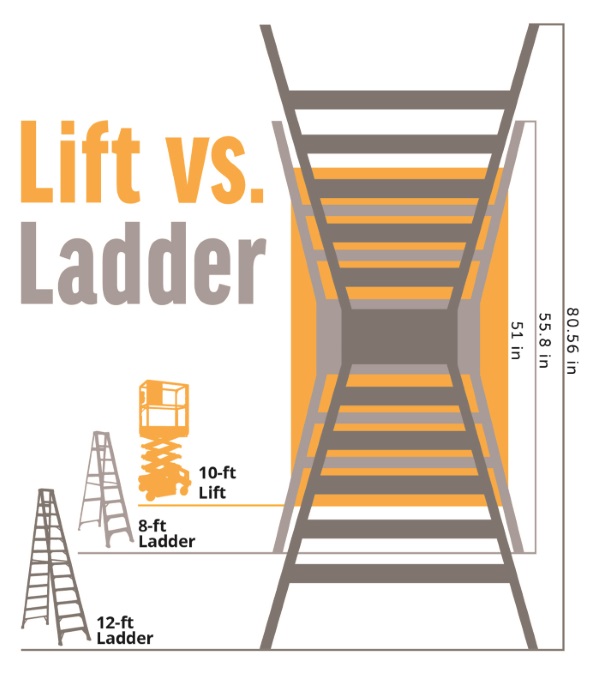
But what about when it comes to navigating through doorways, around tight corners or throughout confined areas? A ladder may be fairly simple to move by collapsing it or folding it up, but the taller it gets, the more cumbersome moving it becomes. Not only do ladders get heavier as they get taller, but those taller heights also make it challenging to get around corners and into tight spaces. Low-level lifts, on the other hand, take lifting and awkward maneuvering out of the equation. Operators can simply lower the units down to an overall height as low as 63.6 inches, and if it’s a self-propelled lift, use the controls on the platform to navigate to the next area. In addition, a zero-turn radius feature on some lifts, coupled with widths as narrow as 30 inches, means maneuvering around 32-inch doorways and down hallways is hassle-free. A lift also eliminates the risk of a strain associated with lugging around a heavy ladder.
Low-level scissor lifts can never compete with ladders’ light weight, but some of the lightest scissor lift models can be used on tile, laminate and raised floors without the risk of damage. Some push-around units weigh just 575 pounds and have wheel loads as low as 115 psi. Some self-propelled units are more impressive yet, with dual front wheels that enable them to achieve wheel loads as light as 75.8 psi.
We’ve proven low-level scissor lifts can get into nearly all the same areas as ladders. But the impact these small machines can have on worker safety are much larger than their small stature.
Rise Above the Risk
High-reach work comes with challenges, and when using a ladder to perform that work, those challenges become compounded and can test the human body. For example, HVAC and plumbing technicians installing pipes and ductwork overhead need ample materials and tools as the job progresses. When they’ve completed one section, they must step down, move the ladder, grab more materials and climb back up. This is not only inefficient, but the repetitive climbing can cause injuries to knees and hips, and standing on the rungs for long periods can lead to painful plantar fasciitis. This scenario also sets the installer up for a fall. In fact, ladder users should never carry heavy objects or tools up the ladder.
In addition, once workers are on the ladder their lateral reach is limited, restricting how much work they can accomplish in one spot. As a result, many are tempted to — and often do — overreach and risk the ladder toppling over. These reasons are why improper ladder usage continues to make OSHA’s Top 10 most cited violations, year after year. In fact, according to the last study provided by the Center for Disease control, 81% of all fall injuries among construction workers in 2011 involved a ladder. All of those injuries likely could have been prevented with a low-level lift.
Some self-propelled low-level scissor lifts can hold as much as 750 pounds and offer as much as 15 square feet of platform space, including their extensions. That’s plenty of capacity for ample materials and supplies. Also, loading the lift with those supplies is substantially easier and less taxing on the body due to lower platform heights. Operators simply load the lift, step up the 20 or so inches to get on the lift, then drive and elevate. And because workers can load the lift with more materials, they make fewer trips up and down, which enhances productivity. In addition, some units feature integrated pipe racks, which give installers a place to rest longer materials, while ensuring the lift stays balanced even with two people on the lift. These types of features help boost efficiency while maintaining safety.
Don’t Pay the Price
Most would agree a low-level lift is substantially safer and more efficient than a ladder, but there is still one problem — accessibility to a low-level scissor lift. If a lift isn’t available on the jobsite, an employee isn’t likely to ask for it and wait around for it to show up. They will instead move ahead with what they have, which is often a stepladder; and just like that the risk of injuries from a fall on the job skyrockets.
It’s not just injuries employers need to worry about, though. Those falls aren’t cheap. Just one worker’s compensation claim can cost tens of thousands of dollars, which is just a fraction of the U.S. Consumer Product Safety Commission’s estimated $24 billion in annual costs associated with ladder injuries.
Under the Occupational Safety and Health Act, employers are responsible for providing employees with a safe workplace. Making safer equipment, such as low-level scissor lifts, available to employees is just one part of the equation, however. Employers must also train employees on when and where to use that equipment, and to understand that ladders should always be considered last. If a scissor lift can get in the space, it should always be used in place of a ladder. In fact, some contractors who clearly understand the risks and associated expense of ladders simply do not allow them on the jobsite unless absolutely necessary and with specific protocols enforced.
Aside from minimizing injuries and worker’s compensation costs, there is one more benefit to offering low-level lifts not many talk about: employee retention. The workforce is a different landscape than it was 30 years ago and keeping employees is harder than ever. The younger workforce simply doesn’t want to put their bodies through the day-to-day physical demands of construction work, and those who have been in the industry for years take a bit longer to recover from those tasks.
Providing all employees, whether 25 or 55, with equipment that allows them to do their jobs safely and efficiently not only minimizes their risk of injuries, but also demonstrates that employers value their workers and the time they dedicate to their businesses. The benefits of that are twofold — employees get a safe worksite and are generally happier while employers get more productive employees.
Putting Ladders in Their Place
Just like a runner wouldn’t expect to win a race injury-free wearing sandals, a contractor shouldn’t expect optimal safety when using a ladder. Safety isn’t a race, but if it were, ladders wouldn’t stand a chance against low-level scissor lifts’ safe and spacious platforms, easy maneuverability or ergonomics. Ladders will likely always be an option when it comes to work-at-height jobs, but there is a time and place for them, and typically it’s last.
Looking for a reprint of this article?
From high-res PDFs to custom plaques, order your copy today!