Thermal Short Circuits
A CONVERSATION REGARDING COMPROMISED FIREPROOFING DURING AN INHERENT STAGE OF APPLICATION.

The unique condition that allows heat to bypass its protective thermal barrier is defined as, and should be considered to be, a thermal short circuit. Within the context of spray fireproofing a thermal short circuit provides an avenue through which the high heat, presumably from a fire, can transfer from the source to the structural steel effectively short circuiting the monolithic barrier of fire-resistant materials.
Thermal short circuits within the fireproofing industry generally take one of two forms. One, those thermal short circuits that are inherent to the means and methods of the design or construction process; hangers or stiffeners would be examples. And two, those that are the result of physical damage; damaged fireproofing, that I assume everyone knows must be repaired. Our conversation today will focus on compromised fireproofing by some penetrating attachment that is inherent to the means and method of the design and the construction process. These penetrations, for discussion purposes, can be subdivided into three general attachment categories: small-scale, thin gauge and structural penetrations.
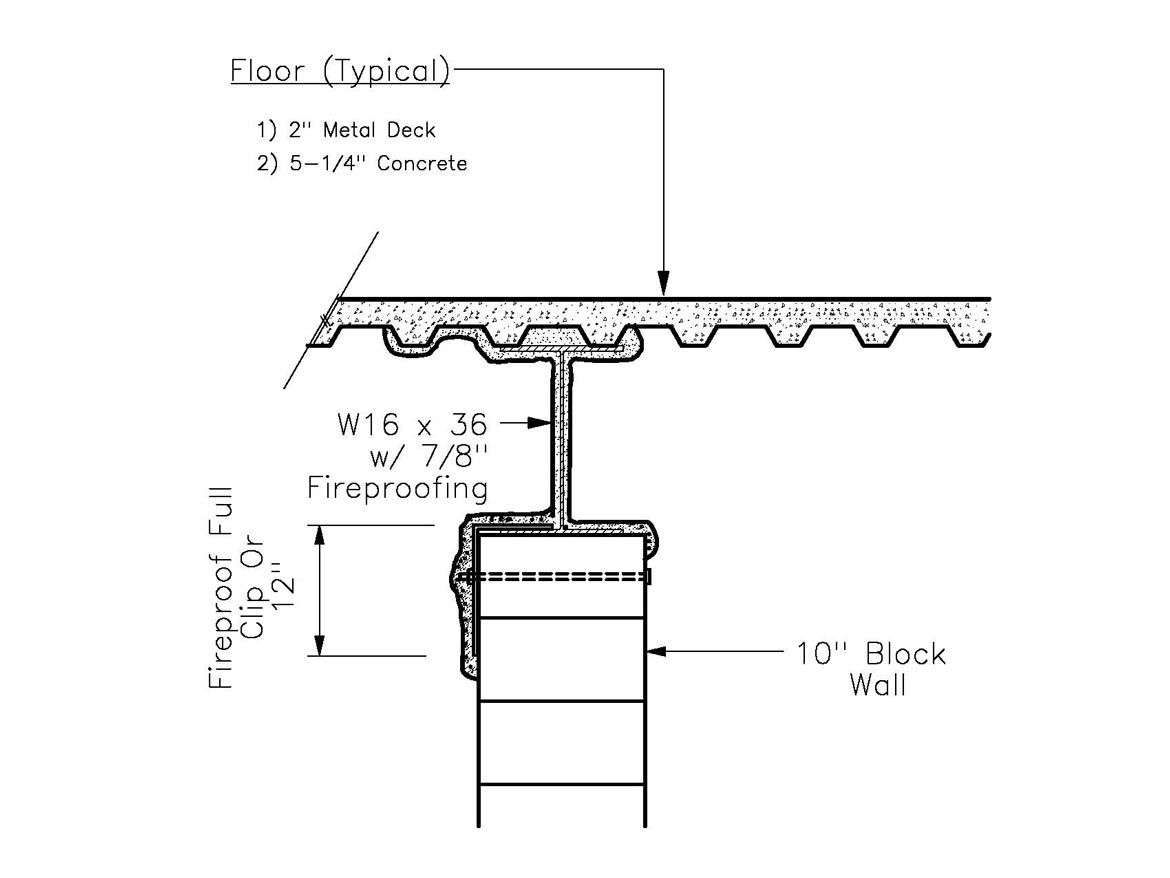 Photo Credit: TEK Design
 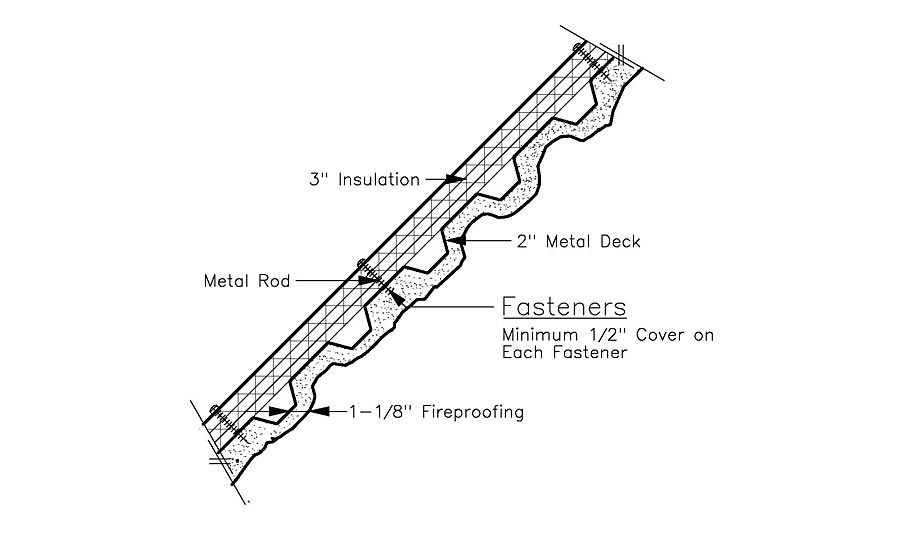 Photo Credit: TEK Design
 Small-Scale Penetrations
Small-scale penetrations, such as that of a screw fastener or equally small penetration, can have devastating consequences. The field situation that initiated our research was a sloped roof over a collegiate library. Apparently, there was a problem with the roof. Rightly or wrongly, the blame was placed on the roofer for not using screws that were long enough to include his roofing, insulation, one or two layers of gypsum board, and on through the metal decking.
Forced to refasten the entire roof, he responded by getting the longest screw possible. They were screwed and drilled through everything, the entire roof assembly, through the fireproofing and the underside of the deck. These screws penetrated the fireproofing into the interior of the attic/mechanical area by 1/2 inch to maybe 1 inch.
The protocol covering this situation comes from the Underwriters Laboratories Fire Resistance Directory which requires that each fastener penetration must be protected by a minimum of 1/2 inch of fire-resistant material. The logic behind this was to combat what could happen if the fasteners were not properly protected, and these were not. It is conceivable that a relatively small fire on the inside could transfer heat through the fastener and ignite the extremely flammable polyurethane insulation on the roof. The urethane insulation once lit, could spread quickly throughout the roof and the rest of the building. It is this low combustion point that initiates the 1/2-inch tip coverage.
Thin Gauge Penetrations
It has been my experience as a fireproofer that drywallers love to fasten their partition bracing to the steel frame however it tickles their fancy. Or at least to the fireproofer it seems that way. Inevitably this means scraping off the fireproofing, and brings us to the second of three categories; the thin gauge penetration. The issue here is how far down the thin gauge brace does the fireproofing have to go? Do we have to patch to the thickness of the original application, or do we have to extend the patch 12 inches down the length of the piece, as if it were a wrought iron angle?
After discussing the problem with several engineers and building officials, it was determined that nothing was to be gained by spraying any distance along the thin gauge brace. The logic is based on the minimum W/D ratio of .38 could not be achieved via thin gauge steel framing. Even the heaviest of the gauged material doesn’t come close to meeting that requirement, therefore cannot be a compliant application, no matter what we do.
If we traveled down the plane of a thin gauge brace, by any length (it could be 12 feet or even 4 inches), we are not gaining any unique UL approval nor are we increasing compliancy at any level. With no perceptible engineered benefit, we are just spending time, money and materials. For these reasons it was determined that spraying or patching any thin-gauge penetrations other than to the depth required to provide the rating of the structural member, was unnecessary.
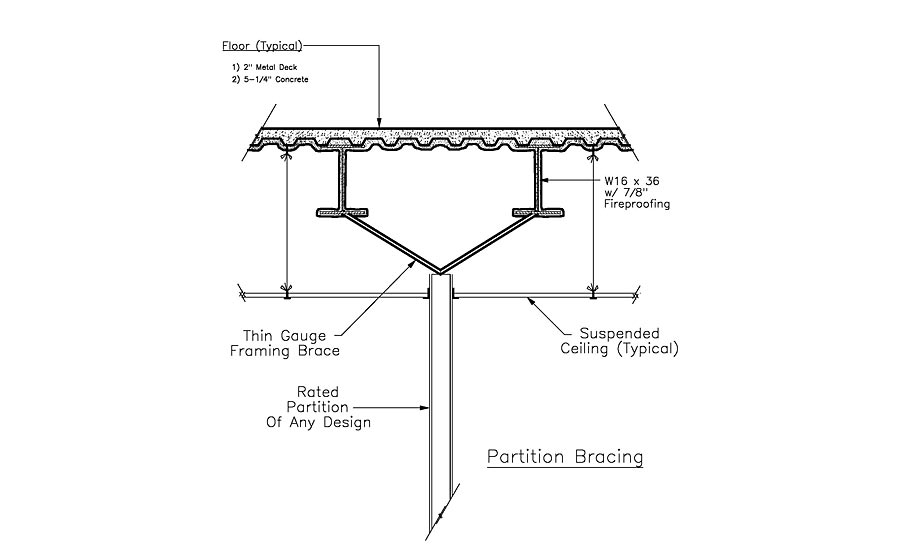 Photo Credit: TEK Design
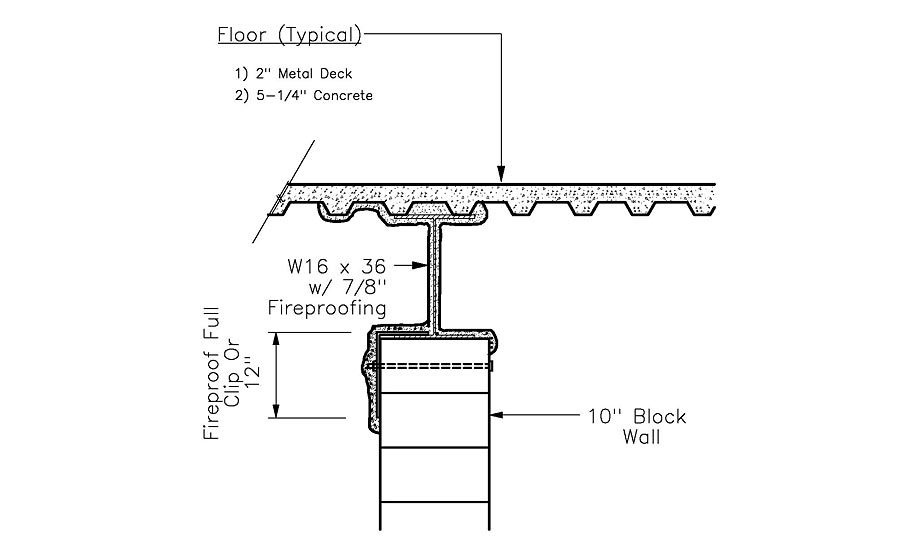 Photo Credit: TEK Design
Structural Penetrations
A structural penetration is that unique condition where the penetrating steel meets the minimum W/D ratio of .38. This typically could be an angle iron, tube steel, plates, or anything else that is heavy enough to meet the minimum W/D ratio.
In these “structural” situations, it was engineered among the building professionals and like-minded experts, that the spray must extend down the length of the brace a required minimum of 12 inches away from the monolithic layer and at the same depth as the structural member itself. This concept originates from UL required treatment for bridge and clip attachments.
The logic applied here was that the penetration member with the W/D was:
- Large enough to transfer significant heat;
- Of sufficient size to fall under the umbrella of the UL Fire Resistance Directory and;
- Was so similar to a masonry clip that it should in fact be handled like a masonry clip of which there is some guidance.
For the record, UL requires a masonry clip to be sprayed the complete width of the clip and the entire depth of the clip if less than 12 inches, and to a minimum of 12 inches if the clip is longer. The thickness shall be the same as the adjacent steel to which it is attached. Any cross bridging/bracing, with a W/D greater than .38, as may be required for stabilizing a series of bar joists, would also fall under this 12 inch rule. Verbiage contained within most UL tests itself support this 12 inch requirement.
Go Forth, Be Armed With Knowledge
I have described my thoughts, as an applicator, for four patch and repair conditions that are typically encountered in the field. The first and obvious condition is the physical damage to the monolithic layer of SFRM--which I hope everyone know must be repaired. The second is a small-scale penetration, a screw tip if you will. The third being a thin gauge penetrate. And lastly, the fourth, a structural penetration. Each is to be handled in its own way. It is my hope that an eventual reader will be able to better recognize each condition and arm themselves with knowledge therefore putting themselves in a better position for its resolution.
Looking for a reprint of this article?
From high-res PDFs to custom plaques, order your copy today!




.webp?height=200&t=1647266946&width=200 "WC0322-FEAT-Fireproofing-p1FT-poorly-installed-electric-cable-damaging-the-fireproofing.IMG_20150415_104940481-(1).jpg")

