Rethinking Acoustics
The distinction between “noise” and “sound” is expansive and the implications are significant in terms of subjective and objective attributes of the built environment.

Background sound is an intrinsic part of our daily experiences, yet its fundamental role within the built environment is often overlooked.
This omission is most apparent in noise mitigation projects where building professionals exclusively rely on absorptive materials and partition assemblies and, hence, performance indicators such as the noise reduction coefficient, sound transmission class and noise isolation class—a singular focus that fails to consider that occupants can perceive a space with a higher controlled level and spectrum of background sound as “quiet.”
Revisiting our acoustical lexicon and refining our use of terms such as “noise,” “sound,” “silence” and “quiet” allows for a more nuanced discussion of occupants” needs and expectations, and fosters opportunities to significantly improve acoustical privacy and satisfaction while realizing the cost and material savings engendered by a more holistic approach to design.

An individual's assessment of sound depends on a variety of factors, such as their expectations for the environment, the task in which they are engaged, the sound's level and frequency content, as well as the level and spectral distribution of background sound present within the space.
Credit: iStockPhoto/Emir Memedovski
The Human Factor
What turns a “sound” into a “noise” (i.e. unwanted sound) in the common vernacular?
Context
A person’s assessment of sound generally depends on personal preferences and expectations for the occupied environment, as well as the activity in which they are engaged. For instance, consider a conversation at “normal level” in two environments: a library and a busy restaurant. In the former, nearby occupants engrossed in a task requiring concentration are likely to find the conversation too loud, annoying, and disruptive. In the latter, the level of conversation may not be sufficiently loud to allow for clear communication. Expectations are based on an understanding of the purpose of the space and the task at hand.
Content
One’s description of sound tends to focus on two main properties: its level (often referred to as volume) and its spectral distribution. A “hissy” or “screechy” sound is one that has a lot of high frequency information (e.g. a young child screaming). A “bassy” or “rumbly” sound is one with a lot of low-frequency information (e.g. a lion roaring). A space without a balanced sound spectrum can sound worse than one with a higher sound level but with a balanced spectrum
Cover
The human experience is also determined by the space’s background sound level, which is considered to be the collection of all (ambient) sounds within it. Often, a room is too “silent” (i.e. its ambient level is too low) and a source of sound becomes uncomfortable (e.g. a clock ticking, cars driving by, people talking, lights humming) because its level is higher than the background sound. The disruptive impact of these annoying noises can be lessened by raising the background sound level, which either completely covers them up or reduces the amount of change occupants perceive within their acoustical environment.
The Need for Control
Given both the scientific and human factors, one can readily see there are advantages to controlling background sound, rather than accepting large variations in its level and spectra. The consequence of neglecting this principal parameter of architectural acoustical design is an environment that is perceived to be “noisy,” as presented in Figure 1. The alternative—to add sound to reduce the perception of a noisy environment—might seem counter-intuitive but consider Figure 2. By precisely controlling the spectrum and level of sound (in this case, to a target overall sound pressure level of 47 dBA), one can make the space sound more comfortable.
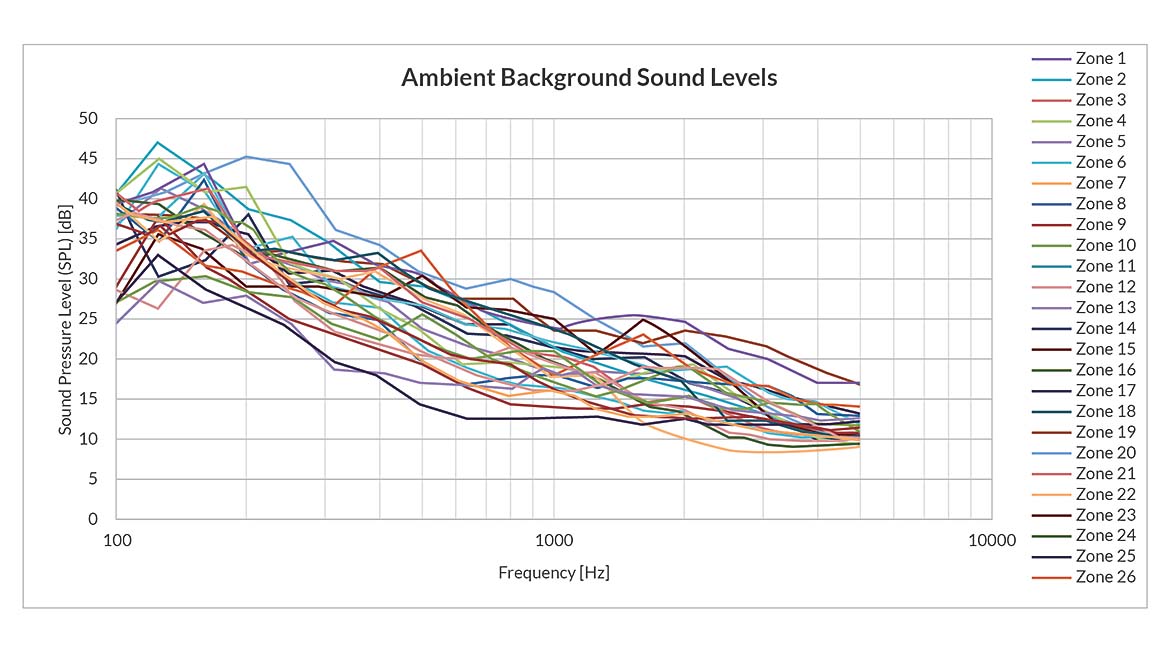
Figure 1. Many people assume that the acoustic conditions are uniform throughout a facility, but without the use of a properly designed and commissioned sound-masking system, it is never the case. In this example of an unmasked space—one floor, primarily consisting of open plan—the “natural” background levels of the unoccupied space vary considerably between the 26 zones in which ambient measurements were taken.
Credit: KR Moeller Associates Ltd.
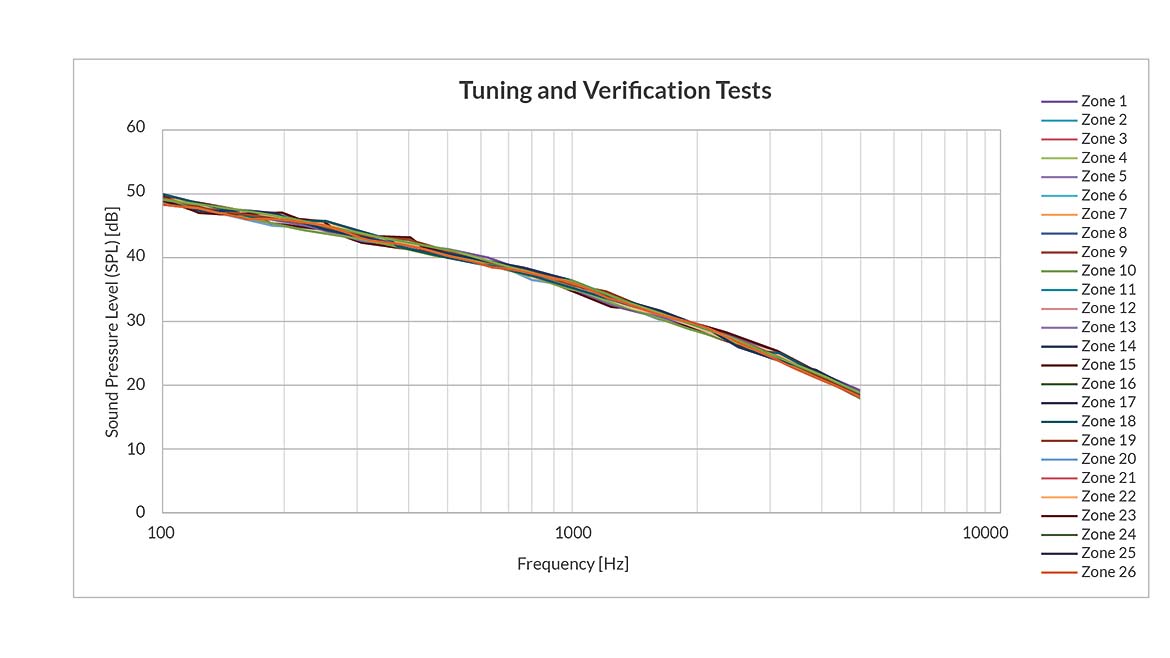
Figure 2. These inconsistencies can be addressed using a sound-masking system—the only acoustical treatment that can accurately control the background sound level within a facility. Here, you can see the difference when masking sound is applied and tuned so that it consistently meets the NRC curve within each zone to ensure uniformity of acoustic conditions throughout the space. The acoustically consistent environment is more comfortable—or “quiet”—for occupants.
Credit: KR Moeller Associates Ltd.
The difference between one’s experience in a space with a very low ambient level and one with a higher ambient level suggests just as there is a need to differentiate between “sound” and “noise,” there is value in distinguishing between a “silent” space and a “quiet” one. Whereas “silent” infers the absence of sound, a “quiet” space can be characterized by a constant ambient sound that is comfortable and not readily noticeable by its occupants. Spaces such as these are perceived to be less “noisy” and more comfortable—or “quiet.”
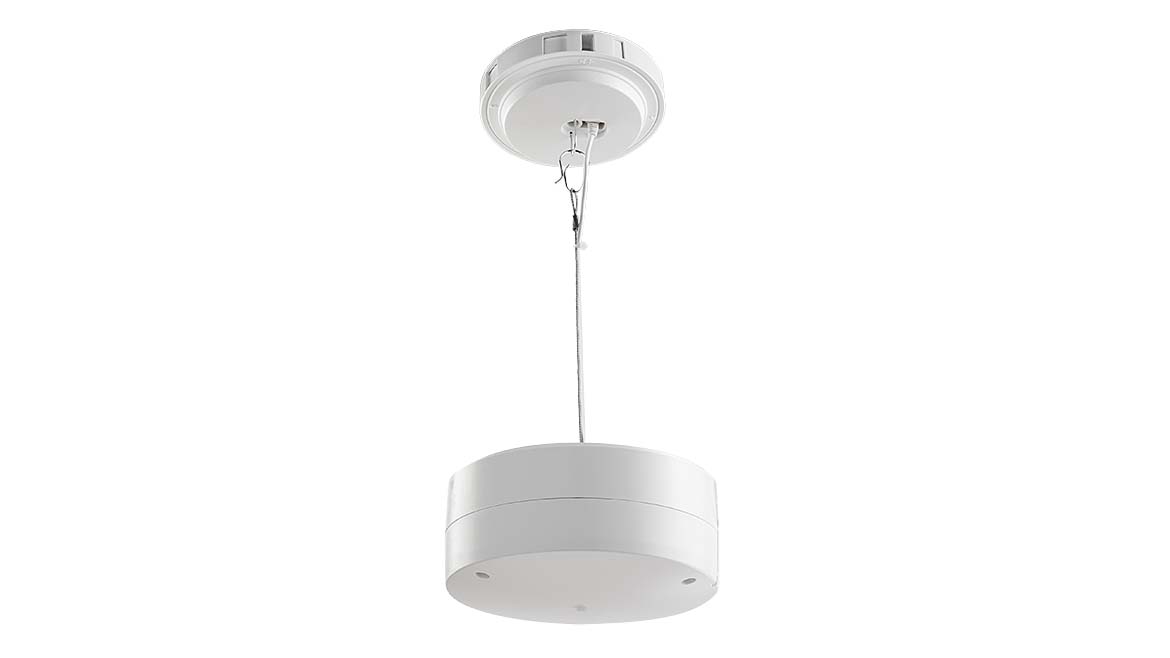
A sound-masking system uses a series of loudspeakers installed in a grid-like pattern in an open ceiling or above the ceiling treatment in order to control the level and properties of background sound within commercial spaces.
Credit: Jon Evans Photography
Evolution of Sound Masking
Advanced technologies—called sound masking systems—have been developed to control the level and properties of background sound within commercial spaces. The first instances of their installation followed publication of renowned acoustician William Cavanaugh’s influential Speech Privacy in Buildings (1962), which outlined the ABCs (i.e. absorb, block and cover) of architectural acoustics. However, at the time, there were several obstacles to their adoption, including use of white noise—a sound more appropriate for conducting laboratory tests than achieving acoustical privacy and comfort in commercial office settings.
Based on tests measuring both comfort and effectiveness, the National Research Council eventually refined the masking spectrum, resulting in the cost-effective open-plan environment masking spectrum shown in Figure 3. In the last decade or so, great advancements have also been made with regards to the ability to tune the generated sound delivered to the space—which is influenced by the environment’s layout, furnishings and finishings—to consistently achieve the desired results throughout all treated areas. When designed with small zones no larger than 21 to 63 m2 (225 to 625 sf) offering fine volume (i.e. 0.5 dBA) and frequency (i.e. 1/3 octave) control, a software-tuned masking system can provide consistency in overall volume not exceeding ±0.5 dBA, as well as a highly consistent spectrum.

Figure 3. The National Research Council (NRC) Cost-Effective Open-Plan Environment (COPE) masking spectrum. The slope is approximated by 4.90 dB/oct. between 125 and 5,000 hertz (Hz). While the low frequencies do not contribute as greatly to speech privacy as the frequencies in the middle to high range, they are necessary for comfort. Without those, occupants would perceive the sound as “hissy.”
Credit: KR Moeller Associates Ltd.
Ensuring Minimum Background Sound Level
While the importance of managing background sound levels using a sound masking system is now recognized in standards, guidelines, and building codes worldwide, many have yet to capitalize on the ways in which the technology can now be used as a tool in architectural design.
To promote a more well-rounded approach, AS/NZS 2107:2016, Acoustics, recommended design sound levels and reverberation times for building interiors, specifies criteria acknowledging several benefits of minimum background sound levels, including the “insurance policy” it provides against loss of acoustic isolation and speech privacy. However, an even more beneficial approach was proposed by Cavanaugh when he said, “an increase in the background sound level has the same effect on intelligibility as an increase in the transmission loss.” It is on this basis that Sound & Vibration 2.0: Design Guidelines for Health Care Facilities allows for a point-for-point exchange in kind between the measure of isolation—STC—and the background level (dBA).
Consider the following simplified scenario, which is intended to quickly illustrate the approach:
An enclosed room conforming to a field-tested STC-45 rating requires a 30 dBA background sound level for speech privacy; or
-
Alternatively, if the background sound level is raised to a constant level of 40 dBA, the composite performance of the construction of the environment (walls, ceiling, floor) can be reduced to STC-35 rating. Providing the background sound is precisely generated and consistently delivered by the masking system, this enhanced design process affords the opportunity to explore new options, including:
greater selection of materials (performance, cost);
cost of labor associated with installation (difficulty, time required);
building to the ceiling instead of to the deck, with appropriate selection of acoustical tile with isolation properties (ceiling attenuation class [CAC] criteria);
reduction in quantity of materials and labor (installation time, difficulty, and complexity);
ease of reconfiguration of a space due to demising walls;
layout consideration and post-building adjustments (facility flexibility);
the cost of continuing the partition above the ceiling to the deck is more significant and the difficulty in installation (height of plenum, penetrations, interferences); and
reduction in material waste and environmental repercussions.
As mentioned earlier, using masking to control background sound levels also acts as an “insurance policy.” Should the space underperform—which can occur for any number of reasons—there remains the opportunity to raise the background sound level upward to 45 dBA for enclosed spaces and 48 dBA for open areas to improve the psychoacoustical measures of the space.
Conclusion
Although sound is ubiquitous—a constant and inescapable experience—its positive role within the built environment is not commonly appreciated, leading to ongoing debate about the control (or lack thereof) of background sound levels within various types of facilities. The distinction between “noise” and “sound” is expansive and the implications are significant in terms of subjective and objective attributes of the built environment. It is by refining the definitions of those terms, as well as that of “silence” and “quiet,” that appreciable opportunities can be fostered to improve the design of the built environment and promote occupant well-being.
Looking for a reprint of this article?
From high-res PDFs to custom plaques, order your copy today!