Walls & Ceilings logo
search
cart
facebook twitter linkedin youtube youtube Spotify Podcasts Apple Podcasts Spotify Podcasts Apple Podcasts
  • Sign In
  • Create Account
  • Sign Out
  • My Account
Walls & Ceilings logo
  • NEWS
  • TOPICS
    • Drywall
    • Stucco/EIFS
    • Ceilings
    • Steel Framing
    • Fireproofing
    • Interior Plaster
    • Building Envelope
    • Insulation
    • Technology
    • Interior
    • Exterior
    • Women In Construction
  • COLUMNS
    • Up Front
    • All Things Gypsum
    • Art & Craft of Plastering
    • Stucco Stop
    • Steel Deal
    • Industry Voices
  • PRODUCTS
    • Buzz Guide
  • EVENTS
    • Industry Events
    • Webinars
    • BUILD Expo
  • MEDIA
    • Videos
    • Podcasts
    • Photo Galleries
    • BUILD26 Videos
    • Take our Quiz!
    • Infographics
  • EXCLUSIVE
    • Newsletters
    • Top 50 Contractors
    • Contractor of the Year
    • State of the Industry
    • W&C Store
    • Market Research
    • CEUs
    • Sponsor Insights
    • Custom Content & Marketing Services
  • DIRECTORY
  • EMAGAZINE
    • eMagazine
    • Advertise
    • Archive Issues
  • SIGN UP!
Building EnvelopeExteriorStucco/EIFS

Stucco Cladding: A Modern Approach With Stone Wool

Explore the fire safety, durability and moisture management advantages integrating stone wool continuous insulation in stucco systems.

By Mark Fowler
Stucco Cladding: A Modern Approach With Stone Wool
September 10, 2024

Stucco has a long-standing history as a preferred cladding material due to its aesthetic appeal, codified fire ratings, and durability. Today, various types of stucco cladding options are available in the market. With the increasing adoption of energy codes requiring continuous insulation—insulation that is continuous across all structural members without thermal bridges other than fasteners and service openings—insulated stucco assemblies are now widely utilized. According to a 2019 market study by the Stucco Manufacturers Association, it is projected that over the next decade, two-thirds of stucco used in the U.S. will be an insulated system.

Emerging from the energy crisis of the 1970s, proprietary stucco, often referred to as one-coat stucco, began incorporating foam plastic insulation for enhanced energy efficiency along with a fiber-reinforced cementitious outer coating. Modern proprietary stucco systems can mitigate many of the complexities and risks associated with traditional stucco, offering high-quality results in less time and at a lower cost through a specified system approach. These systems have gained significant acceptance in the United States, particularly in the Southwest and South-Central regions.

Stucco Cladding using Stone Wool

Mineral Wool for CI

While rigid foam plastic insulation is commonly used for exterior-insulated stucco assemblies, rigid mineral wool is a viable alternative as an insulation substrate for cement stucco claddings. Stone wool products for stucco applications are noncombustible, and therefore do not trigger NFPA 285, Standard Test Method for Evaluation of Fire Propagation Characteristics of Exterior Wall Assemblies Containing Combustibles. Additionally, noncombustible mineral wool may eliminate the need to encapsulate the board with lath and stucco at openings, potentially reducing labor and installation time at fenestrations.

Stone wool provides a high-density, rigid substrate for the keying of plaster and is vapor permeable (>30 perm when tested in accordance with ASTM E96), which increases the drying potential of the assembly. Widely used in Europe with cement plaster, stone wool has proven effective as a continuous insulated cladding with noncombustible benefits. Similar to cement in its noncombustible and dimensionally stable properties, stone wool is recognized by several proprietary stucco manufacturers in North America for use within their systems.

The SMA has reviewed third-party test reports of cement plaster over mineral wool panels and recognizes this as a viable practice that specifiers and applicators can confidently adopt. It is important to adhere to specific manufacturer report holder’s details when working with proprietary one-coat stucco.

Design & Installation Considerations

Fire Resistance

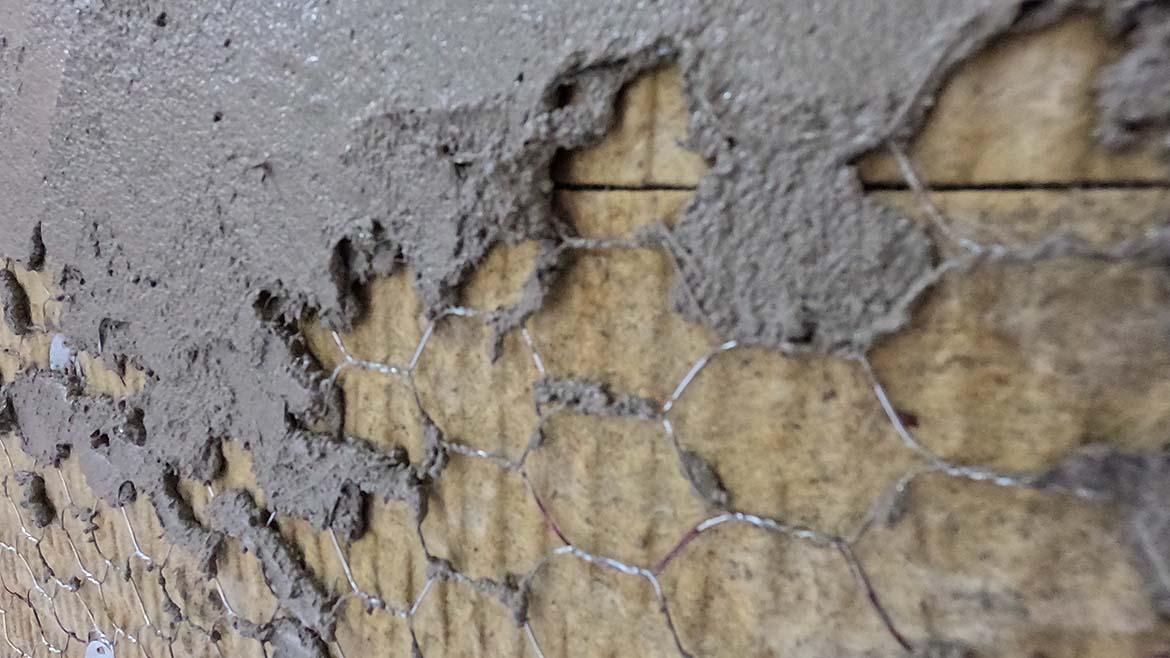
Noncombustible stone wool insulation boards used in stucco systems do not produce toxic smoke or promote flame spread. They can be part of proprietary one-coat stucco cladding assemblies tested in accordance with ASTM E119, Standard Test Methods for Fire Tests of Building Construction and Materials. This includes the industry's first 100% load-bearing (unrestricted) 1-hour fire-rated continuous insulated assembly over a minimum 3/8-inch basecoat and a minimum 1/8-inch finish coat thickness per ASTM C926, and a minimum 20-ga. self-furring lath secured to wood framing per ASTM C1063, Standard Specification for Installation of Lathing and Furring to Receive Interior and Exterior Portland Cement-Based Plaster.

The International Wildland-Urban Interface Code and California Chapter 7A cover materials used in new buildings within WUI areas, as defined in Section 702A of the California Building Code. Stone wool under cement stucco is likely to be a preferred cladding for noncombustible and CI energy requirements, particularly in growing WUI zones. Predictions from the University of Nevada, Las Vegas and FEMA indicate that up to 35 percent of all residential housing in the U.S. will be in WUI zones, making fire-resistant cladding a major consideration in the design and construction process.

Moisture Management

Independent third-party testing has verified that 1” rigid mineral wool over a water-resistive barrier meeting or exceeding Grade D 60-minute building paper provides compliance with the >90 percent drainage efficiency requirements from Annex A2 of ASTM E2925. This means that cement plaster over rigid mineral wool complies with all Climate Zones outlined in the 2021 International Building Code Section 2510.6 and the International Residential Code Section R703.7.3 without needing a separate drainage mat.

Durability

  • UV Exposure: Testing shows no significant change in compressive strength, water absorption, or thermal resistance of stone wool insulation.
  • Impact Resistance: Evaluated per ASTM E695, stone wool substrate demonstrates resilience to impacts with an ability to rebound.
  • Termite Resistance: Testing according to ASTM D3345-74 and American Wood Protection Association E1-09 shows that stone wool meets or exceeds the performance of standard preservative-treated wood.
  • Coefficient of Expansion: Stone wool’s expansion coefficient closely matches that of steel and concrete, providing a stable substrate. 

(Image based on study “Dimensional Stability of Rigid Board Insulation Products” conducted by RDH Building Science.)

Cement plaster should be mixed and applied per SMA or proprietary one-coat stucco manufacturers' recommendations. For any concerns regarding the use of cement plaster over mineral wool panels, contact the SMA for guidance.

Mineral Wool

Quick Facts about Rigid Mineral Wool for Stucco Cladding

  • R-value: 4.0 to 4.2 per inch
  • Moisture: Passed Annex A2 of ASTM E2925 for 90 percent drainage efficiency
  • Impact resistance: Tested in accordance with ASTM E695, Standard Test Method of Measuring Relative Resistance of Wall, Floor, and Roof Construction to Impact Loading.
  • Fire Resistance: Noncombustible, with assemblies that are NFPA 285 compliant, passed ASTM C411, Standard Test Method for Hot-Surface Performance of High-Temperature Thermal Insulation. This includes the industry’s first 100 percent load bearing (unrestricted), 1 hour fire-rated assembly with sheathing and a separate 1 hour fire-rated assembly over open framing. One mineral wool manufacturer has secured approval within the California State Fire Marshal’s Building Materials Listing Program.

*Contact manufacturer’s for specific testing information

KEYWORDS: acoustics CI (continuous insulation) fire resistance mineral fiber moisture stucco WUI (Wildland-Urban Interface)

Share This Story

Looking for a reprint of this article?
From high-res PDFs to custom plaques, order your copy today!

Headshots fowler

Mark Fowler joined Walls & Ceilings as editorial director in 2006. Fowler grew up in the construction business and has held a number of positions in different companies and associations. He spent 11 years with the Northwest Wall and Ceiling Bureau before moving to his position with Soltner Group Architects in Seattle. Fowler is currently the executive director of the Stucco Manufacturers Association. He can be reached at Mark@markfowler.org.


Recommended Content

JOIN TODAY
To unlock your recommendations.

Already have an account? Sign In

  • Abercrombie & Fitch

    EIFS in 2026: How Specialty Finishes Are Redefining Exterior Wall Systems

    As building codes, owner expectations, and design demands...
    Stucco/EIFS
    By: Regi Mendoza
  • proper air and vapor control

    From Energy Efficiency to Moisture Management: Why Air and Vapor Control Matter

    How proper air and vapor control within building...
    Building Envelope
    By: Benjamin Meyer AIA, LEED AP
  • Linear Metal Ceiling Beam Baffles

    Top 25 Ceiling Contractors of 2026

    Suspended ceilings demand precision, code compliance and...
    Ceilings
    By: John Wyatt and Tanja Kern
You must login or register in order to post a comment.

Report Abusive Comment

Manage My Account
  • eMagazine Subscription
  • Newsletters
  • Online Registration
  • Manage My Preferences
  • Subscription Customer Service

More Videos

Sponsored Content

Sponsored Content is a special paid section where industry companies provide high quality, objective, non-commercial content around topics of interest to the Walls & Ceilings audience. All Sponsored Content is supplied by the advertising company and any opinions expressed in this article are those of the author and not necessarily reflect the views of Walls & Ceilings or its parent company, BNP Media. Interested in participating in our Sponsored Content section? Contact your local rep!

close
  • medical professionals moving a patient on a stretcher through the halls of a medical building
    Sponsored byNational Gypsum Company

    What Does High Performance Mean When It Comes To Gypsum Boards?

Popular Stories

Linear Metal Ceiling Beam Baffles

Top 25 Ceiling Contractors of 2026

Wichita Biomedical Campus

Wichita Drywall Worker Dies After Scaffolding Fall

QXO Just Changed the Game-Here's What Contractors Are Asking

QXO Just Changed the Game-Here's What Contractors Are Asking

An interior drywalling work in progress

Boost Profits with AI Scheduling

Events

June 24, 2026

The Bright Side & Benefits of Designing with Integrated Lighting

Credits 1 AIA LU/HSW; 0.1 ICC CEU

This course will explore the pivotal role architects and lighting design play in creating safer, more sustainable spaces. Learn how to avoid common lighting mistakes and make informed decisions that create the best visual environment for occupants. 

January 1, 2030

Webinar Sponsorship Information

For webinar sponsorship information, visit www.bnpevents.com/webinars or email webinars@bnpmedia.com.

See our full library of webinars

View All Submit An Event

Products

2026 National Painting Cost Estimator

2026 National Painting Cost Estimator

See More Products

Related Articles

  • Up Front: A Walls & Ceilings Editorial Column by Mark Fowler

    Have We Missed the Mark?

    See More
  • Stucco Getty Images

    Being a Stucco Surgeon: One Company’s Success

    See More
  • The staff and family behind Phampena Inc in Auburn, Washington.

    All in the Pham

    See More

Related Products

See More Products
  • bim 3e.jpg

    BIM Handbook: A Guide to Building Information Modeling for Owners, Designers, Engineers, Contractors, and Facility Managers, 3rd Edition

  • building codes illustated.jpg

    Building Codes Illustrated: A Guide to Understanding the 2021 International Building Code, 7th Edition

  • Builder's Guide to Stucco, Lath & Plaster

See More Products

Related Directories

  • Rockfon

    Rockfon North America provides a complete ceiling system offering, combining stone wool and specialty metal ceiling panels with metal suspension systems. Easy to install and durable, Rockfon’s stone wool material and product range helps protect people from noise and the spread of fire, while contributing toward a sustainable future.
  • PAC-CLAD | Petersen

×

Connect with the industry’s leading resource for unparalleled insights and education.

Join thousands of industry professionals today. Shouldn’t you know what they know?

JOIN NOW
  • RESOURCES
    • Advertise
    • Contact Us
    • Directories
    • Store
    • Want More
  • SIGN UP TODAY
    • Create Account
    • eMagazine
    • Newsletters
    • Customer Service
    • Manage Preferences
  • SERVICES
    • Marketing Services
    • Reprints
    • Market Research
    • List Rental
    • Survey/Respondent Access
  • STAY CONNECTED
    • LinkedIn
    • Facebook
    • Instagram
    • YouTube
    • X
  • PRIVACY
    • PRIVACY POLICY
    • TERMS & CONDITIONS
    • DO NOT SELL MY PERSONAL INFORMATION
    • PRIVACY REQUEST
    • ACCESSIBILITY

Copyright ©2026. All Rights Reserved BNP Media, Inc. and BNP Media II, LLC.

Design, CMS, Hosting & Web Development :: ePublishing