Walls & Ceilings logo
search
cart
facebook twitter linkedin youtube youtube Spotify Podcasts Apple Podcasts Spotify Podcasts Apple Podcasts
  • Sign In
  • Create Account
  • Sign Out
  • My Account
Walls & Ceilings logo
  • NEWS
  • TOPICS
    • Drywall
    • Stucco/EIFS
    • Ceilings
    • Steel Framing
    • Fireproofing
    • Interior Plaster
    • Building Envelope
    • Insulation
    • Technology
    • Interior
    • Exterior
    • Women In Construction
  • COLUMNS
    • Up Front
    • All Things Gypsum
    • Art & Craft of Plastering
    • Stucco Stop
    • Steel Deal
    • Industry Voices
  • PRODUCTS
    • Buzz Guide
  • EVENTS
    • Industry Events
    • Webinars
    • BUILD Expo
  • MEDIA
    • Videos
    • Podcasts
    • Photo Galleries
    • BUILD26 Videos
    • Take our Quiz!
    • Infographics
  • EXCLUSIVE
    • Newsletters
    • Top 50 Contractors
    • Contractor of the Year
    • State of the Industry
    • W&C Store
    • Market Research
    • CEUs
    • Sponsor Insights
    • Custom Content & Marketing Services
  • DIRECTORY
  • EMAGAZINE
    • eMagazine
    • Advertise
    • Archive Issues
  • SIGN UP!
Building EnvelopeExteriorInsulation

Meeting IECC Thermal Requirements

Continuous insulation can meet the standards and help you reach tax incentives

By Brian McKay
A man on a ladder installing continuous insulation
Images courtesy of Weatherization Partners Ltd.
January 9, 2025

As the industry evolves, staying ahead of energy standards presents challenges for builders, but it can also be a benchmark for quality and innovation. The introduction of the 2021 International Energy Conservation Code underscores the key role continuous insulation can play in new homebuilding projects.

What are the 2021 IECC Thermal Requirements?

Newer energy codes encourage the use of CI as an option to meet prescriptive (wall) thermal requirements, as well as options for building thicker walls with greater cavity insulation levels. An advantage of exterior CI is that it can allow builders to continue using 2x4 construction instead of moving to 2x6 construction and the various design changes, costs and potential loss of square footage associated with that change. Whether building with 2x4 or 2x6 wall construction, exterior CI can also allow builders to use standard batt insulation and avoid using more expensive insulation types in the wall cavity.

It is estimated that adopting the 2021 IECC will deliver energy savings of at least 10 percent, or 20 percent or more in states where older codes are in place.

2021 IECC Prescriptive R-Value Requirements - Wood-Framed Wall

Here are four benefits to using CI to meet the new IECC thermal standards, taking advantage of available tax incentives.

1. ENERGY STAR and Eligibility for 45L Tax Credits

All new dwellings acquired on or after Jan. 1, 2025, seeking ENERGY STAR certification and the 45L tax credit eligibility will need to adhere to ENERGY STAR v3.2, which calls for 2021 IECC thermal requirements. These include heightened insulation requirements that are more difficult to meet without using continuous insulation in most climate zones.

2. Continuous Insulation Provides a Simple and Effective Path for Thermal Compliance

Using exterior CI in any of the climate zones can help simplify the thermal compliance process for many, providing a compliance path while optimizing performance. As a material that is continuous across all structural members and installed over framing, CI can boost the thermal performance of the building envelope and potentially reduce homeowner costs associated with heating and cooling.

For example, adding one inch of product, like DuPont Styrofoam Brand XPS Insulation, to a 2x4 wall with R-13 batt gives you a 50 percent higher effective R-value when compared to a 2x4 with only batt.1
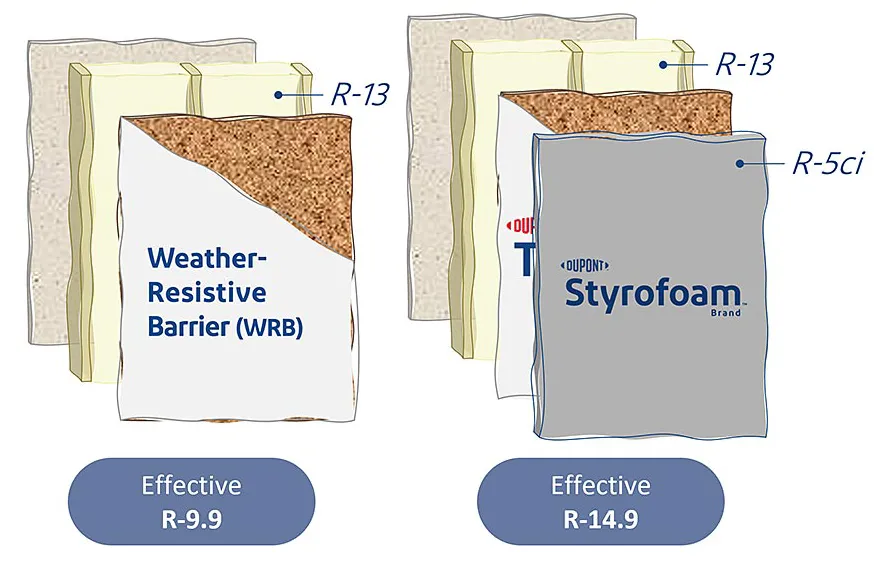
R Values with an WRB and DuPont Styrofoam

The U-Factor Area alternative method can also allow builders to meet code compliance through trade-offs between R-values in the roof, wall, window and foundation, rather than the prescriptive method. Using exterior CI can help achieve high UA values when compared to adding more insulation since the effective R-value of the high surface area directly affects UA.

3. Leverage Tax Incentives to Help Offset Costs

Financial incentives available through the Inflation Reduction Act of 2022 can help offset the costs of implementing CI. Builders can take advantage of these benefits through Dec. 31, 2032, when choosing to implement upgrades in energy efficiency.

The most significant incentive is the Energy-Efficient Home Credit (Section 45L), which allows builders to claim a federal tax credit of up to $5,000 per home. It’s available for homes that are certified to meet ENERGY STAR or Zero-Energy-Ready Home standards.

Here are some specific things that homebuilders can do to make their homes more energy-efficient and qualify for the 45L credit:

  • Insulate the home properly;
  • Install energy-efficient windows and doors;
  • Seal air leaks around the home;
  • Install energy-efficient appliances and HVAC systems, and;
  • Use renewable energy sources, such as solar panels or geothermal heating and cooling.

If you’re not sure whether your homes meet the requirements, you can contact a certified energy rater for help. Also, talk to a manufacturer’s rep to learn if their company has a certificate that the builder can use to provide to the IRS for the tax credit. In addition, energy raters can inspect your homes and provide you with a certificate of compliance if they meet the standards.

Once your homes are certified, you can file for the tax credit using IRS Form 8908.

4. Continuous Insulation Enhances Building Performance and Homeowner Value

The use of CI in new homebuilding offers additional benefits beyond compliance. Its application can mitigate condensation potential, thus reducing the likelihood of callbacks related to moisture management. The optimized thermal envelope and higher effective R-value can also mean reduced HVAC equipment, less energy usage and, thus, lower energy bills for the homeowner, leading to significant long-term savings.

Regardless of how you reach the new building codes, it’s best to work with manufacturers that provide in-field support for their products; someone a builder can talk to and discuss installation training and any design-related challenges.

Calculations assume 16-inch o.c. framing and the following material R-values:
• Interior air film – an R-value of 0.68
• Half-inch gypsum – an R-value of 0.45• Two-by-four – an R-value of 3.71
• Two-by-six – an R-value of 5.83
• Half-inch OSB – an R-value of 0.62
• One-inch Styrofoam XPS – an R-value of 5
• Exterior air film – an R-value of 0.17

KEYWORDS: building codes CI (continuous insulation) DuPont energy codes EnergyStar flashing housewraps R-value taxes WRB (weather resistant barrier)

Share This Story

Looking for a reprint of this article?
From high-res PDFs to custom plaques, order your copy today!

Wc0118 ft2 houston p5 author mckay
Brian McKay has been involved in the commercial and residential building industry since 2006. He is Director of Marketing and Communications for Weatherization Partners Ltd. (which recently celebrated a milestone of reaching a billion in sales with DuPont Tyvek), and a current board member of the Building Enclosure Council of Dallas.

Recommended Content

JOIN TODAY
To unlock your recommendations.

Already have an account? Sign In

  • Abercrombie & Fitch

    EIFS in 2026: How Specialty Finishes Are Redefining Exterior Wall Systems

    As building codes, owner expectations, and design demands...
    Stucco/EIFS
    By: Regi Mendoza
  • proper air and vapor control

    From Energy Efficiency to Moisture Management: Why Air and Vapor Control Matter

    How proper air and vapor control within building...
    Building Envelope
    By: Benjamin Meyer AIA, LEED AP
  • Linear Metal Ceiling Beam Baffles

    Top 25 Ceiling Contractors of 2026

    Suspended ceilings demand precision, code compliance and...
    Ceilings
    By: John Wyatt and Tanja Kern
You must login or register in order to post a comment.

Report Abusive Comment

Manage My Account
  • eMagazine Subscription
  • Newsletters
  • Online Registration
  • Manage My Preferences
  • Subscription Customer Service

More Videos

Sponsored Content

Sponsored Content is a special paid section where industry companies provide high quality, objective, non-commercial content around topics of interest to the Walls & Ceilings audience. All Sponsored Content is supplied by the advertising company and any opinions expressed in this article are those of the author and not necessarily reflect the views of Walls & Ceilings or its parent company, BNP Media. Interested in participating in our Sponsored Content section? Contact your local rep!

close
  • medical professionals moving a patient on a stretcher through the halls of a medical building
    Sponsored byNational Gypsum Company

    What Does High Performance Mean When It Comes To Gypsum Boards?

Popular Stories

Linear Metal Ceiling Beam Baffles

Top 25 Ceiling Contractors of 2026

Wichita Biomedical Campus

Wichita Drywall Worker Dies After Scaffolding Fall

QXO Just Changed the Game-Here's What Contractors Are Asking

QXO Just Changed the Game-Here's What Contractors Are Asking

An interior drywalling work in progress

Boost Profits with AI Scheduling

Events

June 24, 2026

The Bright Side & Benefits of Designing with Integrated Lighting

Credits 1 AIA LU/HSW; 0.1 ICC CEU

This course will explore the pivotal role architects and lighting design play in creating safer, more sustainable spaces. Learn how to avoid common lighting mistakes and make informed decisions that create the best visual environment for occupants. 

January 1, 2030

Webinar Sponsorship Information

For webinar sponsorship information, visit www.bnpevents.com/webinars or email webinars@bnpmedia.com.

See our full library of webinars

View All Submit An Event

Products

2026 National Painting Cost Estimator

2026 National Painting Cost Estimator

See More Products

Related Articles

  • Panel Thermal Efficiency Meets Requirements of the Future

    See More
  • Layers of exterior cladding

    What to Consider When Selecting a Rainscreen

    See More
  • Meeting Energy Code Requirements with Continuous Insulation

    See More

Related Products

See More Products
  • barrys.jpg

    Barry's Advanced Construction of Buildings, 4th Edition

See More Products

Related Directories

  • ATLAS Roof & Wall Insulation

    With decades of proven performance, Atlas EnergyShield continuous wall insulation provides an uninterrupted thermal barrier over an entire wall, not just in wall cavities between studs. Atlas polyiso creates a versatile, effective barrier for thermal, air, moisture, and vapor control. Whether building a single family home or a high-rise, Atlas EnergyShield wall insulation will meet energy codes and ensure the best building performance.
×

Connect with the industry’s leading resource for unparalleled insights and education.

Join thousands of industry professionals today. Shouldn’t you know what they know?

JOIN NOW
  • RESOURCES
    • Advertise
    • Contact Us
    • Directories
    • Store
    • Want More
  • SIGN UP TODAY
    • Create Account
    • eMagazine
    • Newsletters
    • Customer Service
    • Manage Preferences
  • SERVICES
    • Marketing Services
    • Reprints
    • Market Research
    • List Rental
    • Survey/Respondent Access
  • STAY CONNECTED
    • LinkedIn
    • Facebook
    • Instagram
    • YouTube
    • X
  • PRIVACY
    • PRIVACY POLICY
    • TERMS & CONDITIONS
    • DO NOT SELL MY PERSONAL INFORMATION
    • PRIVACY REQUEST
    • ACCESSIBILITY

Copyright ©2026. All Rights Reserved BNP Media, Inc. and BNP Media II, LLC.

Design, CMS, Hosting & Web Development :: ePublishing