Walls & Ceilings logo
search
cart
facebook twitter linkedin youtube youtube Spotify Podcasts Apple Podcasts Spotify Podcasts Apple Podcasts
  • Sign In
  • Create Account
  • Sign Out
  • My Account
Walls & Ceilings logo
  • NEWS
  • TOPICS
    • Drywall
    • Stucco/EIFS
    • Ceilings
    • Steel Framing
    • Fireproofing
    • Interior Plaster
    • Building Envelope
    • Insulation
    • Technology
    • Interior
    • Exterior
    • Women In Construction
  • COLUMNS
    • Up Front
    • All Things Gypsum
    • Art & Craft of Plastering
    • Stucco Stop
    • Steel Deal
    • Industry Voices
  • PRODUCTS
    • Buzz Guide
  • EVENTS
    • Industry Events
    • Webinars
    • BUILD Expo
  • MEDIA
    • Videos
    • Podcasts
    • Photo Galleries
    • BUILD26 Videos
    • Take our Quiz!
    • Infographics
  • EXCLUSIVE
    • Newsletters
    • Top 50 Contractors
    • Contractor of the Year
    • State of the Industry
    • W&C Store
    • Market Research
    • CEUs
    • Sponsor Insights
    • Custom Content & Marketing Services
  • DIRECTORY
  • EMAGAZINE
    • eMagazine
    • Advertise
    • Archive Issues
  • SIGN UP!
ExteriorInterior

What is Decarbonization & What do Bio-based Materials Have to do With it?

The path to decarbonization in the built environment is challenging, but the growing use of bio-based materials like hemp offers a promising solution.
By Mattie Mead
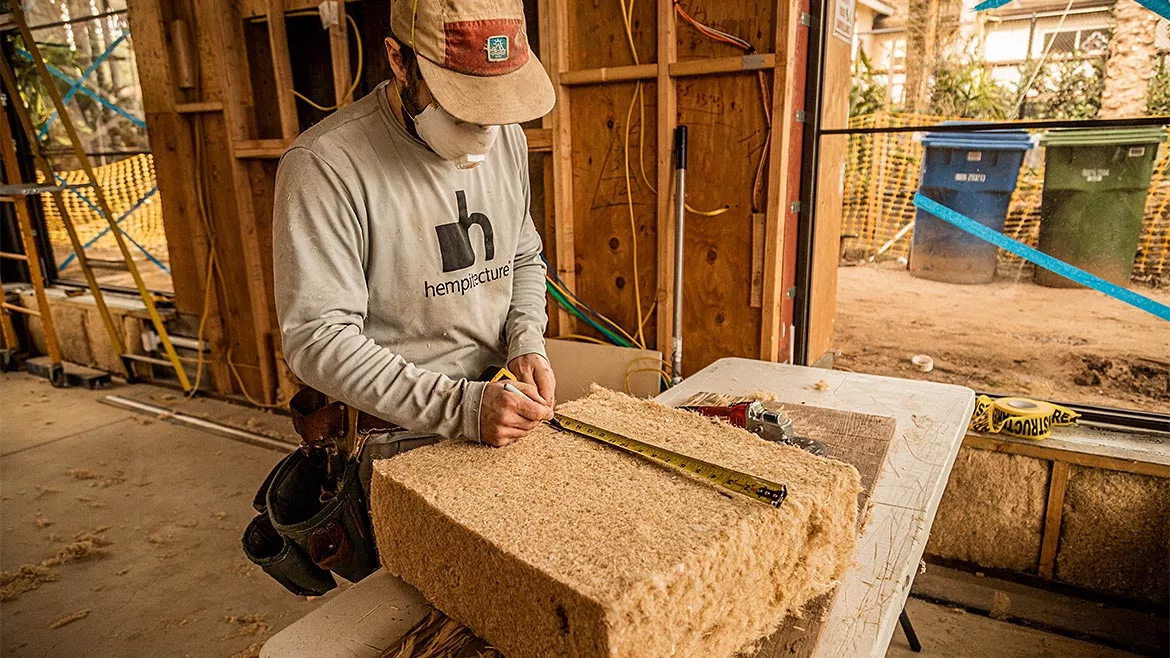
Hempitecture - HempWool-is-easy-and-safe-to-work-with
Images credit: Steven Busby | Hempitecture
June 2, 2025

Decarbonization has become more widely discussed and increasingly top-of-mind for the architecture, design, and construction industries as these players contend with their role in harming or helping the planet. As we’ve seen from growing interest in movements such as the AIA 2030 Commitment, a set of goals to reach net zero in the built environment, there is a call to action for more active strategies to address the materials and processes used in developing the built environment in the years to come. As the construction industry continues to be accountable for nearly 40 percent of global carbon emissions, we must identify how to modify or fully replace traditional construction approaches to reverse these effects and help build a healthier future so that the built and natural environments can live in harmony long term.

Working with bio-based materials from the very beginning of the project process is one way contractors and developers can transition from harmful options such as concrete and steel, which not only require excessive energy to manufacture but offer no long-term benefits to the structures and communities in which they are used. Hemp can be sustainably sourced and has carbon sequestering abilities that enhance the building’s positive impact on the environment. By prioritizing decarbonization and opting to work with these materials when possible, building owners, developers, and architects and designers are authentically contributing toward a safer and healthier planet. Not just talking the talk, but actively doing something about it.

Hempitecture Factory
HempWool-insulation-being-cut
HempWool-installed-in-the-ceiling-of-a-home-in-Venice-CA
empWool-insulation-in-a-beautiful-home-in-Venice-CA

Understanding Decarbonization 

Decarbonization is the reduction or elimination of carbon dioxide emissions from any process like manufacturing or the production of energy. From an organizational standpoint, decarbonization refers to a company or product’s dedication to reducing the greenhouse gas emissions produced by the combustion of fossil fuels caused by their business operations. This can be reflected in their processes, the materials they work with, and the overall carbon footprint of the company. While many companies claim to prioritize minimizing their carbon footprint and working toward decarbonization, many of the building products that are commonly used throughout the industry significantly harm the environment.  

Traditional building materials, such as steel and concrete, although reliable and durable, have a high carbon footprint. Concrete is particularly detrimental to the environment due to the amount of carbon dioxide released during its creation. The machinery required to power steel manufacturing plants also causes significant negative outcomes, emitting tons of carbon dioxide per day from one of the largest manufacturing industries in the world. Additionally, traditional insulation products, such as fiberglass and spray foam, release harmful volatile organic compounds and contribute to greenhouse gas emissions. 

Net zero is a commonly used term in corporate social responsibility plans that refers to the balance between the amount of greenhouse gas emitted and the amount removed from the atmosphere. In the context of the built environment, this means designing, constructing, and operating buildings that contribute minimal carbon emissions throughout their lifecycle. Implementing net-zero products, which can absorb more CO2 than they emit overall, architects and builders are advancing decarbonization efforts more so than if they worked with carbon-neutral materials or harmful solutions. By prioritizing decarbonization, the industry is paving the way for a healthier and safer future for generations to come. 

When looking to specify materials that will advance a project’s decarbonization goals, project stakeholders need to take into consideration the embodied carbon of the structure, which refers to the greenhouse gas emissions associated with the manufacturing, transportation, installation, maintenance, and disposal of building materials. Unlike operational carbon, which results from energy consumption during a building’s use, embodied carbon is locked into the materials and processes before the building becomes operational.  

Embodied carbon emissions occur upfront, meaning that if it can be limited, the overall carbon footprint of the building can be minimized before residents begin to utilize it. This ensures that regardless of how the property is used, the integrity of the structure will continue to positively impact the environment. Measuring embodied carbon is also how buildings achieve LEED certifications, a label that building owners are increasingly seeking as a way to meet local regulations and attract sustainably-minded businesses and residents.  

The Rising Role of Bio-Based Materials 

Hemp and other organic materials are increasingly being researched and specified for their sustainable properties. Opportunities to source and create building materials during a process that yields less CO2 result in structures that continue to positively impact the environment long after they are built. Mass timber has also entered the conversation as a viable and accessible option due to the sustainable practices used to harvest wood and the carbon sequestering capabilities of mass timber buildings.  

Industrial hemp is an accessible choice for sustainable insulation due to its eco-friendly characteristics and high-performing insulation properties. Hemp is also a renewable resource that grows quickly, requires minimal water, and doesn’t need any pesticides or fertilizer. This makes the product highly accessible and prevents further damage to the environment––unlike other materials that require pesticides and fertilizer, causing long-term damage and risk to the surrounding land and water sources. Hemp also captures more CO2 than it emits during its lifecycle, lending to healthier living spaces by avoiding the use of toxic chemicals found in traditional insulation materials. Further, hemp prevents the build-up of moisture and mold, which can contribute to poor indoor air quality.  

There are also emerging and established alternatives to traditional concrete that can be applied to the walls, flooring, and roofing in both residential and commercial insulation. This hemp lime formulation has even been tested by ASTM E84 standards, meaning it is 100 percent fire resistant and one of the safest solutions for any homeowners or building owners looking to increase building safety.  

The path to decarbonization in the built environment is challenging, but the growing use of bio-based materials like hemp offers a promising solution. Hemp represents a significant step forward in sustainable construction, and by embracing this eco-friendly alternative, architecture and construction professionals will play a pivotal role in reducing carbon emissions and creating healthier, more resilient spaces. The adoption of hemp and other bio-based materials is more than just a trend—it’s a necessary shift toward a future where buildings not only minimize harm to the planet but actively contribute to its restoration.

KEYWORDS: carbon reduction decarbonization design-build environmental impacts material costs net zero project management sustainable design

Share This Story

Looking for a reprint of this article?
From high-res PDFs to custom plaques, order your copy today!

Matthew mead
Matthew (Mattie) Mead is the founder and CEO of Hempitecture, a building materials manufacturer that uses biobased, carbon-capturing inputs to create healthier, high-performing products for a more sustainable planet. An Idaho-based, adventure-seeking entrepreneur, Mattie has a passion for re-envisioning the materials traditionally used in construction and beyond. On a mission to discover tangible solutions to the climate crisis, Mattie founded the Hempitecture concept in 2012 during his studies of architecture, environmental sciences, and entrepreneurship at Hobart College in Geneva, New York.

Recommended Content

JOIN TODAY
To unlock your recommendations.

Already have an account? Sign In

  • Abercrombie & Fitch

    EIFS in 2026: How Specialty Finishes Are Redefining Exterior Wall Systems

    As building codes, owner expectations, and design demands...
    Stucco/EIFS
    By: Regi Mendoza
  • proper air and vapor control

    From Energy Efficiency to Moisture Management: Why Air and Vapor Control Matter

    How proper air and vapor control within building...
    Building Envelope
    By: Benjamin Meyer AIA, LEED AP
  • Linear Metal Ceiling Beam Baffles

    Top 25 Ceiling Contractors of 2026

    Suspended ceilings demand precision, code compliance and...
    Ceilings
    By: John Wyatt and Tanja Kern
You must login or register in order to post a comment.

Report Abusive Comment

Manage My Account
  • eMagazine Subscription
  • Newsletters
  • Online Registration
  • Manage My Preferences
  • Subscription Customer Service

More Videos

Sponsored Content

Sponsored Content is a special paid section where industry companies provide high quality, objective, non-commercial content around topics of interest to the Walls & Ceilings audience. All Sponsored Content is supplied by the advertising company and any opinions expressed in this article are those of the author and not necessarily reflect the views of Walls & Ceilings or its parent company, BNP Media. Interested in participating in our Sponsored Content section? Contact your local rep!

close
  • medical professionals moving a patient on a stretcher through the halls of a medical building
    Sponsored byNational Gypsum Company

    What Does High Performance Mean When It Comes To Gypsum Boards?

Popular Stories

Linear Metal Ceiling Beam Baffles

Top 25 Ceiling Contractors of 2026

Wichita Biomedical Campus

Wichita Drywall Worker Dies After Scaffolding Fall

QXO Just Changed the Game-Here's What Contractors Are Asking

QXO Just Changed the Game-Here's What Contractors Are Asking

An interior drywalling work in progress

Boost Profits with AI Scheduling

Events

June 24, 2026

The Bright Side & Benefits of Designing with Integrated Lighting

Credits 1 AIA LU/HSW; 0.1 ICC CEU

This course will explore the pivotal role architects and lighting design play in creating safer, more sustainable spaces. Learn how to avoid common lighting mistakes and make informed decisions that create the best visual environment for occupants. 

January 1, 2030

Webinar Sponsorship Information

For webinar sponsorship information, visit www.bnpevents.com/webinars or email webinars@bnpmedia.com.

See our full library of webinars

View All Submit An Event

Products

2026 National Painting Cost Estimator

2026 National Painting Cost Estimator

See More Products

Related Articles

  • Finish Line: What Not to do With EIFS

    See More
  • Vertical Section Through Rounded Foam Shape

    The Finish Line: Things Not To Do With EIFS

    See More
  • Contractor Scam

    What to Do to Avoid Fake Contractor Scams

    See More

Related Products

See More Products
  • business.png

    How to Succeed With Your Own Construction Business

  • Accidents Waiting to Happen: Best Practices in Workers' Comp Administration and Protecting Corporate Profitability

See More Products

Related Directories

  • Acoustic Ceiling & Partition Co.

    At ACP, we build more than just buildings. We build brighter futures for our customers, our community, our employees, and the next generation. As we strive to maintain our status as a premier interior finish contractor, our primary focus continues to be professional integrity and exceptional workmanship. Our do-what’s-right attitude and our commitment to never settle for the status quo set us apart and position us for continued success. Above all, we put people first and value building relationships with our customers and the communities we serve.
  • DAP Products

    Founded in 1865, DAP is a leading manufacturer and supplier of caulks, sealants, foam, adhesives, and patch and repair products with a history of first-to-market innovations. For 165 years, DAP has provided professional contractors, remodelers and do-it-yourselfers with trusted, quality, reliable, and long-lasting products. For more information about DAP products and applications, visit our website at www.dap.com.
×

Connect with the industry’s leading resource for unparalleled insights and education.

Join thousands of industry professionals today. Shouldn’t you know what they know?

JOIN NOW
  • RESOURCES
    • Advertise
    • Contact Us
    • Directories
    • Store
    • Want More
  • SIGN UP TODAY
    • Create Account
    • eMagazine
    • Newsletters
    • Customer Service
    • Manage Preferences
  • SERVICES
    • Marketing Services
    • Reprints
    • Market Research
    • List Rental
    • Survey/Respondent Access
  • STAY CONNECTED
    • LinkedIn
    • Facebook
    • Instagram
    • YouTube
    • X
  • PRIVACY
    • PRIVACY POLICY
    • TERMS & CONDITIONS
    • DO NOT SELL MY PERSONAL INFORMATION
    • PRIVACY REQUEST
    • ACCESSIBILITY

Copyright ©2026. All Rights Reserved BNP Media, Inc. and BNP Media II, LLC.

Design, CMS, Hosting & Web Development :: ePublishing