Draft Your Acoustic Team
How picking the right players keeps your walls winning.
Double dribble: Sealing the wall construction gap at the floor is potentially one of the highest acoustical scoring plays in wall construction. Achieving a pressure tight seal here can mean a gain of 20 points in the wall's sound isolation. Thinking that no one will know (since it will later be covered by the wall base) coaches tend to send in their least experienced player to execute this task. To the contrary, bad construction gap seals are easily discovered, showing up as noise "hot spots" in acoustic camera scans conducted during punch list investigations, and result in one of the most common call-back, tear-out and rework issues.
Images courtesy of Acoustics by JW Mooney LLC.
Achieving top-notch acoustical performance is about assembling the right team. Each trade must bring their best "game" to ensure acoustical excellence from tip-off to final buzzer.
Just as NBA teams carefully choose players at the upcoming 2025 NBA Draft, construction teams must carefully draft, coach, and coordinate every trade to maintain acoustical excellence. Your project's soundproofing reputation depends on assembling the right team—trades that work together seamlessly, communicate effectively, and commit to flawless execution.
During job site observations I get the chance to talk with highly skilled contractors who invest the expert craftsmanship and precision work needed to create acoustically rated wall and ceiling assemblies. They take obvious pride in their work as we discuss how they successfully maneuvered around the latest obstacles to score a great performance. Maintaining the acoustical integrity of each build involves every trade on the job site, requiring teamwork and clear communication between all trades. Great walls and ceilings reflect the professionalism and attention to detail of every contractor involved—not just the ones initially installing them.
Common “Violations and Fouls” and How to Avoid Them

Out of Bounds: Executing the construction of sound-rated walls and ceilings is tough enough when they are designed and planned correctly. But not relaying those plans to everyone on the construction team can lead to out-of-bounds violations, which quickly bring play to a halt.
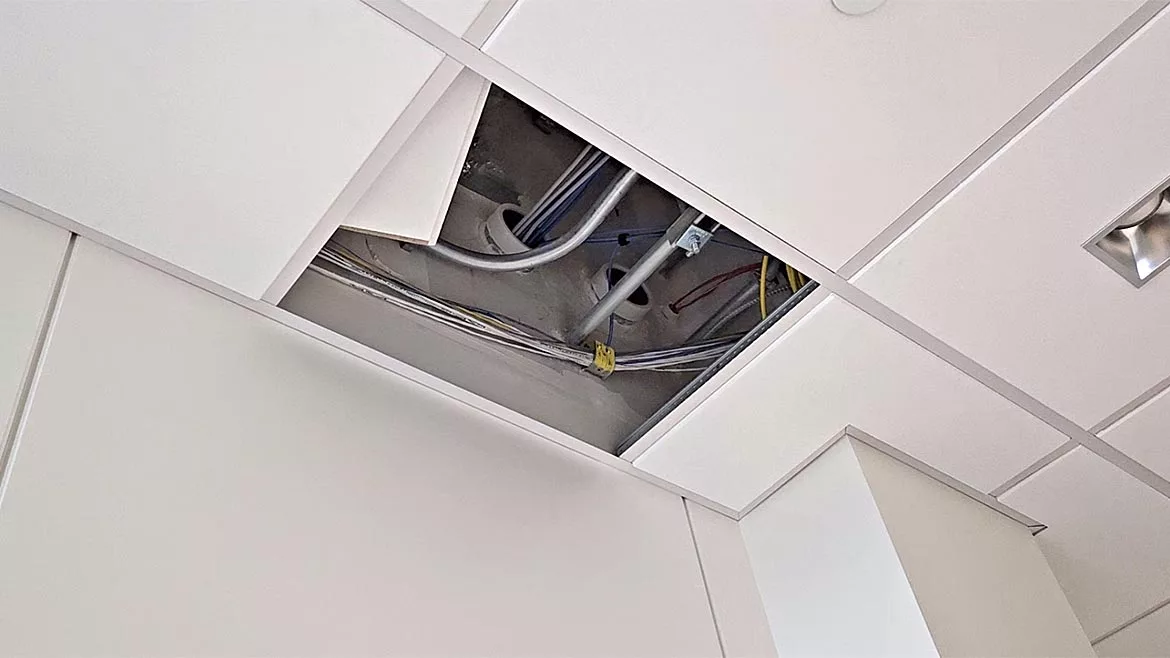
As an example, a large penetration in a structural beam was engineered to accommodate a large diameter HVAC duct. Unfortunately, this wasn’t relayed to the plumbing and electrical contractors who were scheduled on the job site before the mechanical contractor. Not knowing the intended future purpose of the penetration, those early contractors filled the opening with their pipe and conduit runs. Once on the job site, with the opening unavailable, the mechanical contractor hung the 2 foot diameter duct below the structural beam. Next on the job site were the wall and ceiling framers who saw they could not continue their work since the duct was now at mid-ceiling height. The penalty for this out-of-bound involved tear-out and rework for the whole construction team.
The best coordination plays don't run smoothly unless they are communicated to everyone on the team, each team member recognizes what is out of bounds, and someone makes the call.

Double dribble: Sealing the wall construction gap at the floor is potentially one of the highest acoustical scoring plays in wall construction. Achieving a pressure tight seal here can mean a gain of 20 points in the wall's sound isolation. Thinking that no one will know (since it will later be covered by the wall base) coaches tend to send in their least experienced player to execute this task. To the contrary, bad construction gap seals are easily discovered, showing up as noise "hot spots" in acoustic camera scans conducted during punch list investigations, and result in one of the most common call-back, tear-out and rework issues.
Construction gap sealing details are typically included on the wall-type construction drawings and these should be followed. Most details require the construction gap to be straight, no wider than 3/8 inch, and with no damaged edges allowed. Once the gap is straight and even, the surfaces to be sealed need to be cleaned. Failure to clean drywall dust from the floor is a common cause for acoustic seals that later open up after a day or two.
The gap can then be sealed tight using backer rod and flexible acoustical sealant. More exotic details may require setting the top gypsum layer into the sealant before fastening it to the wall. Successfully following details like these requires knowledge, patience, experience and talent; not someone new to the game.
While plumbing penetrations are easily taken care of with acoustical sealant and duct penetrations can be solved with the use of duct silencers, technical wiring penetrations tend to be the most difficult due to the difficulty of getting a good seal around multiple wire bundles. Proper technical penetrations through sound-rated walls are sealed on both ends. This can be accomplished using wiring compatible putty or by specifying smoke barrier-rated wiring penetrations.

Back Court Violation: One type of sound wall violation that is regularly missed are the large wall penetrations required to accommodate items such as fire extinguisher cabinets, and bathroom towel & trash units. These instances can easily rob 30 points from a wall's sound rating by removing the gypsum mass, reducing the wall cavity insulation, and through sound leakage around the cutout.
Violations of this type require a time-out to determine the best plan forward. If the cabinet has a sound rating equal to or greater than that of the wall that it is being installed in, the solution may simply be to seal around the cabinet. If the cabinet has no sound rating, the solution may require custom framing and gyp work to create a custom, built-in wall niche, sized for the cabinet.
STC Playbook: Plays, Squads, and Pro Tips for Soundproofing Success
Every winning team has a playbook with practiced plays. Each play requires the backing of all players and the practiced coordination of a small squad. Here are a few plays which should be in every team's playbook.
Play #1: “Seal the Perimeter”
(Closing gaps and penetrations around wall edges and ceiling connections.)
Squad:
- Drywall Finishers
- Plumbing Contractors
- Electricians
- HVAC Contractors
- General Contractors (Supervisors)
Pro Tips:
- Drywall Finishers: Prepare, clean and the seal all drywall seams and perimeter edges with acoustical sealant—don’t leave unsealed gaps at floor, wall, or ceiling joints. Follow construction drawing details.
- Plumbing Contractors: Precisely cut ceiling and wall penetrations; ensure proper sealing of all pipe penetrations with flexible acoustical sealant or approved sleeves.
- Electricians: Install putty pads on electrical boxes embedded in rated walls, and ensure airtight sealing at conduit penetrations.
- HVAC Contractors: Apply acoustic caulking or gaskets at duct penetrations; avoid oversized cut-outs that allow air (and sound) leaks.
- Supervisors: Inspect perimeter sealing carefully prior to final finishes; insist on immediate correction of unsealed or inadequately sealed gaps.
Play #2: “Mass Defense”
(Maintaining adequate mass and continuity to block sound.)
Squad:
- Wall Framing Contractors
- Drywall Installers
- General Contractors (Supervisors)
Pro Tips:
- Wall Framers: Ensure studs are sized and spaced according to specified acoustical details; no shortcuts or substitutions that compromise mass or spacing.
- Drywall Installers: Verify proper layering, thickness, and fastening per the acoustic specifications—no substitutions without acoustic approval.
- Supervisors: Inspect materials regularly to confirm compliance with the specified acoustical design; address deviations promptly.
Play #3: “Isolation Defense”
(Preventing structure-borne sound transmission.)
Squad:
- Framing Contractors
- Plumbing Contractors
- General Contractors (Supervisors)
Pro Tips:
- Framers: Confirm that resilient channels or isolation clips are correctly installed—never fasten them rigidly or bridge across layers.
- Plumbing Contractors: Isolate plumbing fixtures, pipes, and drains from structural elements using resilient hangers and sleeves.
- Supervisors: Conduct regular checks for rigid connections between isolated components and structural framing; correct any issues immediately.
Play #4: “Control the Pace”
(Managing timing and coordination to maintain acoustical quality.)
Squad:
- General Contractors (Supervisors)
- All Trades
Pro Tips:
- Supervisors: Plan clear staging of trades to ensure sealing and acoustic measures remain uncompromised as new work proceeds. Hold quick “huddles” to reinforce acoustical priorities at critical phases of construction.
- All Trades: Communicate proactively about upcoming tasks; coordinate penetrations beforehand to minimize acoustic compromises.
Play #5: “Block the Penetration”
(Effectively sealing all openings introduced by later trades.)
Squad:
- General Contractors (Supervisors)
- Electricians
- Plumbing Contractors
- Low-Voltage/Data Contractors
Pro Tips:
- Supervisors: Map out all STC-rated walls for the later trades and review the rules for maintaining those ratings. Consider using colors or warning signs as reminders.
- Electricians: After running wires and conduit, always fill penetrations completely with acoustical sealant or putty pads.
- Plumbers: Seal plumbing penetrations thoroughly with acoustical caulk or acoustic-rated pipe sleeves—don’t leave gaps unsealed.
- Low-Voltage Contractors: Route wiring neatly through acoustically sealed sleeves, ensuring no air gaps remain.
Play #6: “Final Buzzer Inspection”
(Performing final quality assurance.)
Squad:
- General Contractors (Supervisors)
- Acoustic Consultant
- Building Inspectors
Pro Tips:
- Supervisors: Conduct detailed walk-throughs, inspecting specifically for unsealed penetrations. Note which players used hammers and which ones used properly sized hole saws on those expensive sound walls.
- Acoustic Consultant: Verify that walls and ceilings meet acoustic design criteria through visual and acoustic inspections as needed.
- Inspectors: Confirm compliance with code and acoustical specifications, paying close attention to common oversights like perimeter sealing and penetrations.
Like any good basketball team, soundproofing effectiveness comes from clear communication, executing each play correctly, and all trades working as one cohesive unit. By collaborating, each trade supports the quality, reputation, and success of the entire construction team.
Looking for a reprint of this article?
From high-res PDFs to custom plaques, order your copy today!





