Making Complex Framing Simple
From Complex Curves to Clean Installs: Inside the Seaport’s 10 World Trade Project
Century Drywall and Radius Track teamed up early to transform curved ceilings and canopies from complex design challenges into clean, efficient installations.

In Boston’s Seaport District, the 10 World Trade tower is quickly becoming a landmark for its sweeping curves and bold design. For those building it, the real achievement isn't just the architecture on display, but how a collaborative construction team has delivered complex framing that aligns with tight tolerances, accelerates the schedule, and minimizes risk in the field.
At the podium level, where curved walls, domed ceilings, and wood-finish canopies define the experience, the installer Century Drywall and Radius Track worked together to transform complex design challenges into straightforward field installation. Their partnership, supported by Suffolk Construction (general contractor) and Sasaki (architect), is a case study in how installers and fabricators can collaborate early to achieve constructability without compromise.
Establishing Clip Hangers to Avoid Conflicts
One of the biggest risks on a project with dense MEP systems, fire protection, and heavy structure is where and when to hang ceilings. Waiting until the space is congested almost guarantees clashes, costly change orders, and delays.
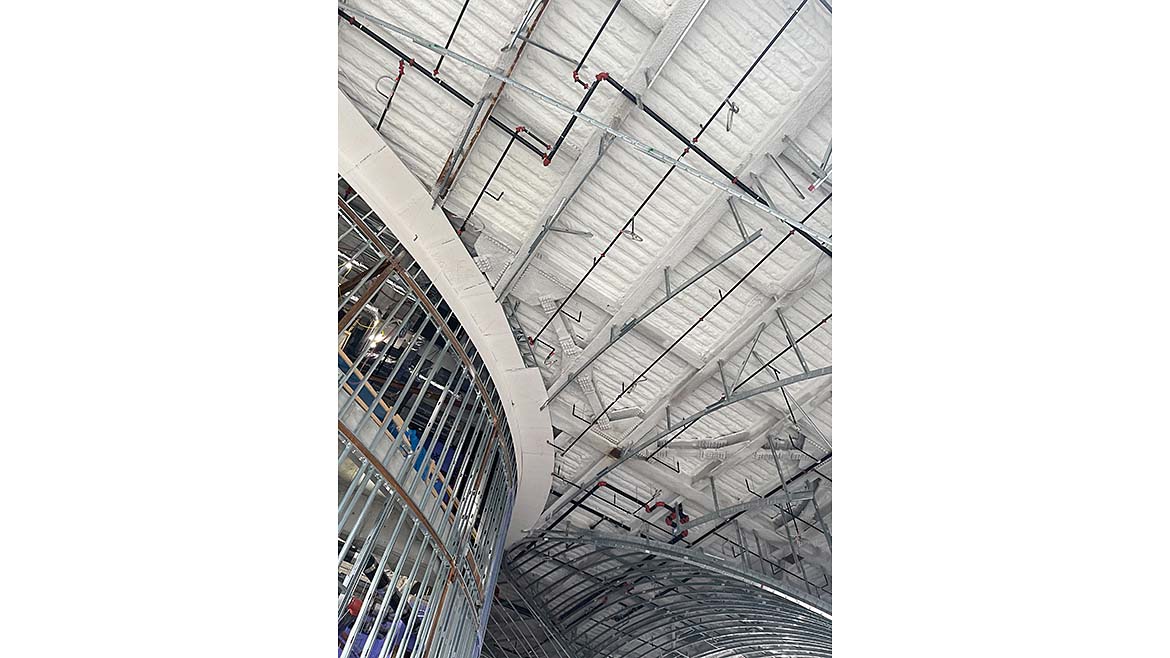
At 10 World Trade, Century Drywall and the fabricator took a different approach. By leveraging a coordinated 3-D model, the team identified structural hanging points months before material shipments. This model was shared with the GC, design team, and other trades, giving everyone an opportunity to validate the approach and avoid conflicts virtually rather than in the field.
Armed with precise layout data, Century Drywall’s crews were able to set hangers nearly two months before material arrived, while the work area and ceiling cavities were still open and before spray fireproofing was applied. This early installation ensured hangers were accurately located, free of conflicts with future sprinklers, ductwork, and piping, and required no touch-up of the fireproofing. The result was a clean, conflict-free ceiling zone that kept crews moving efficiently.
Jeff Montague, vice president of sales and marketing at Radius Track, recalled a conversation with one of Century Drywall’s project managers: “If you try to set clips before fireproofing, you’re basically working blind; it’s like, ‘This better work.’ The issue with the layout at 10 World Trade was that the survey points were close together and in odd orientations, making it hard to see the apparent logic in the layout. We had to depend on the process because, at this point, you're committed. During these early stages, everyone feels uneasy, but when the drops aligned perfectly with the studs, that's when the trust in the process really paid off.”
Photos: Radius Track
Turning Design into a Clear Install Plan
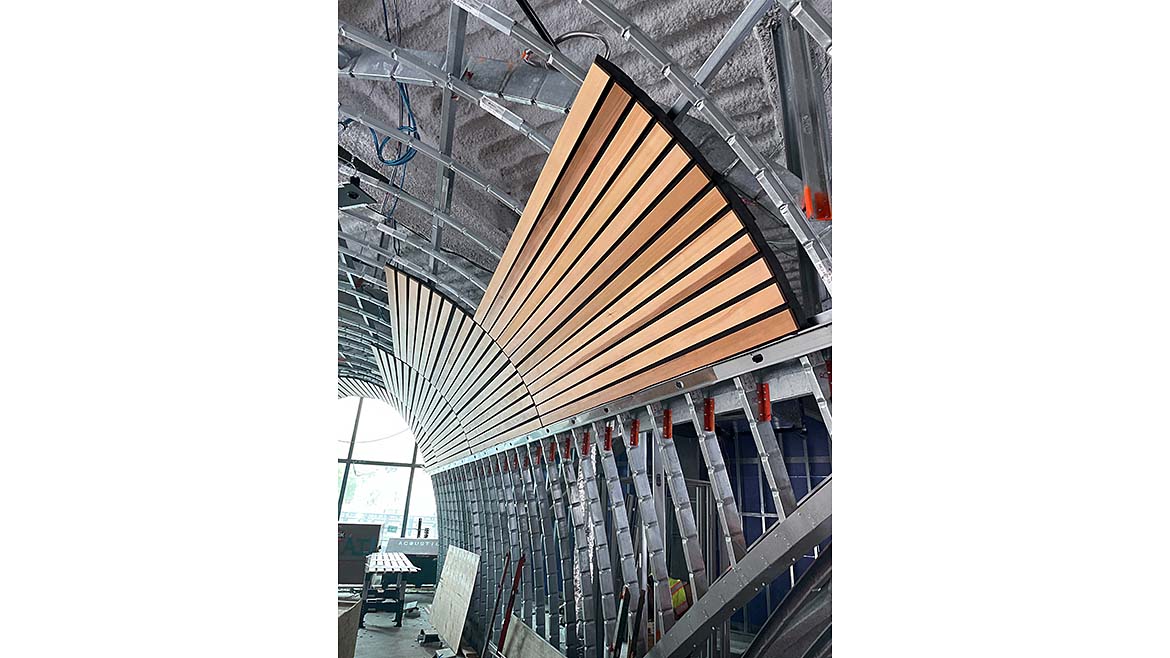
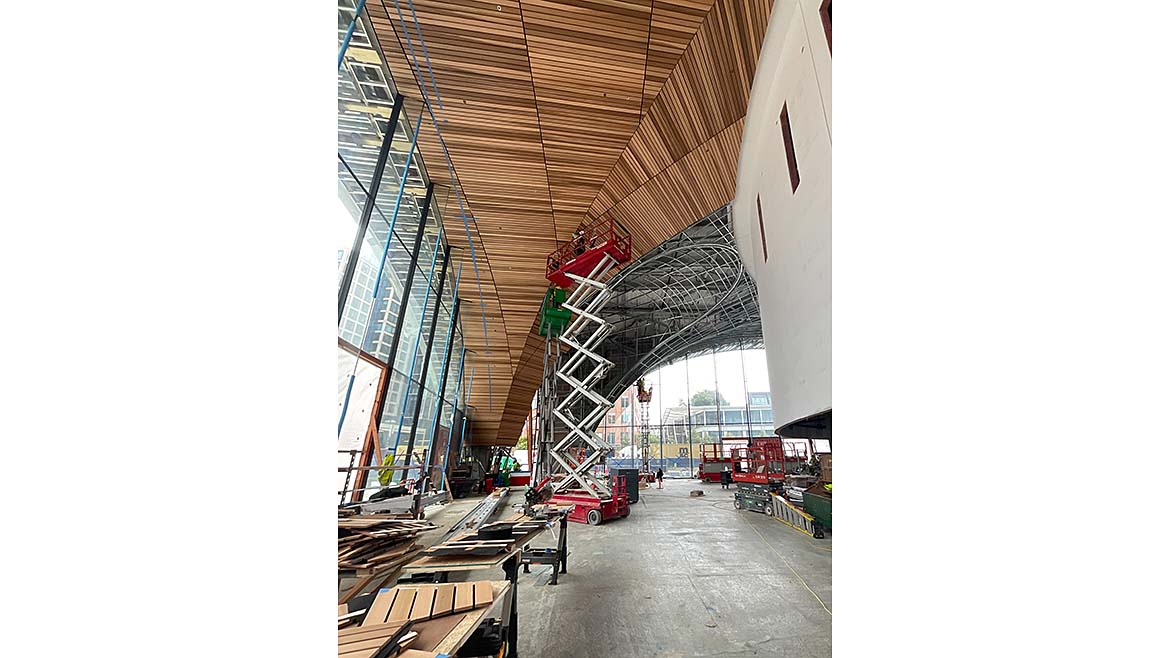
The project’s signature interior feature—a dome ceiling clad in complex wood panels—brought another layer of challenge. The Armstrong wood panel worked entirely in 2-D, while the project design existed in 3-D. This gap could easily have created misalignment between the architect’s vision and what was buildable in the field.
The fabricator’s designers “unrolled” the dome’s curved surfaces into 2-D geometry so the panel fabricator could confidently set out joint lines and backer strips. Once the panel drawings were complete, the fabricator remapped that geometry back into 3-D and translated it into layout points. Those points gave Century Drywall exact hat channel and stud locations for clip installation long before the wood arrived on site.
Because this coordination happened upfront, the wood panels were installed cleanly on the first try. The rhythm of the joint lines (central to the architectural effect) was preserved, and no significant RFIs or change orders were needed.
Khanh Nguyen, a lead designer with the fabricator, explains: “Our role was to act as a bridge between the architect’s 3-D design intent and the panel manufacturer’s 2-D workflow. By reconciling those two worlds and giving Century precise clip locations, we eliminated guesswork in the field. The dome ceiling took shape exactly as Sasaki envisioned—and it went up without costly delays.”
Photos: Radius Track
Exterior Canopies: Faster, Simpler, and More Predictable
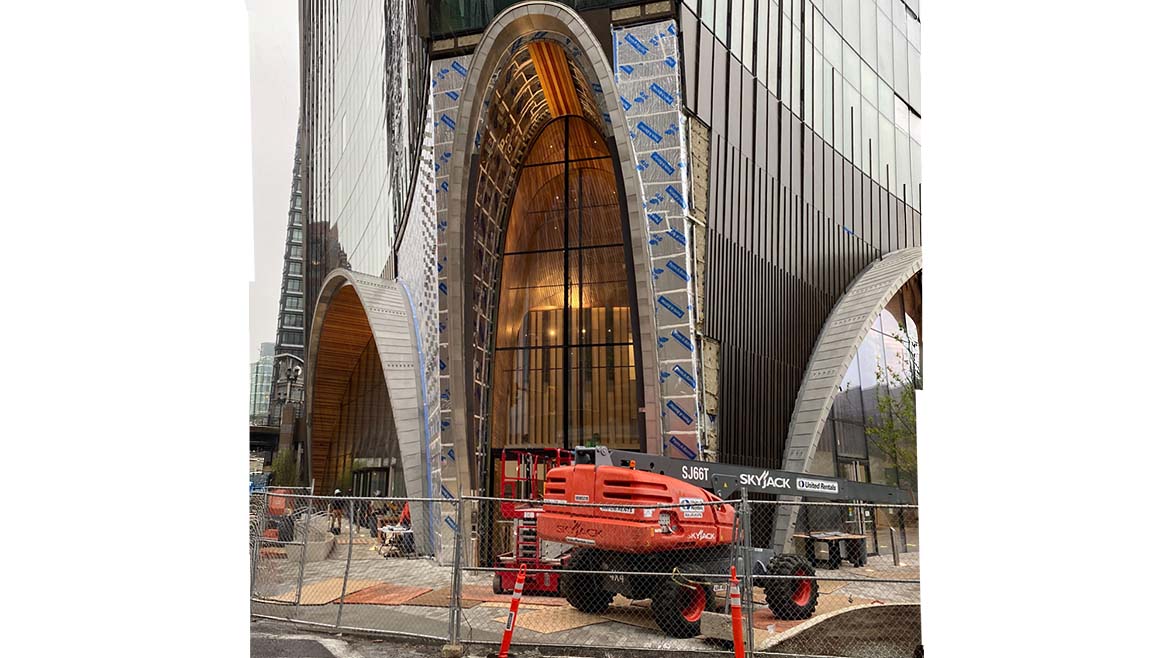
The exterior canopies, finished in wood-look metal panels, tested the team’s ability to simplify.
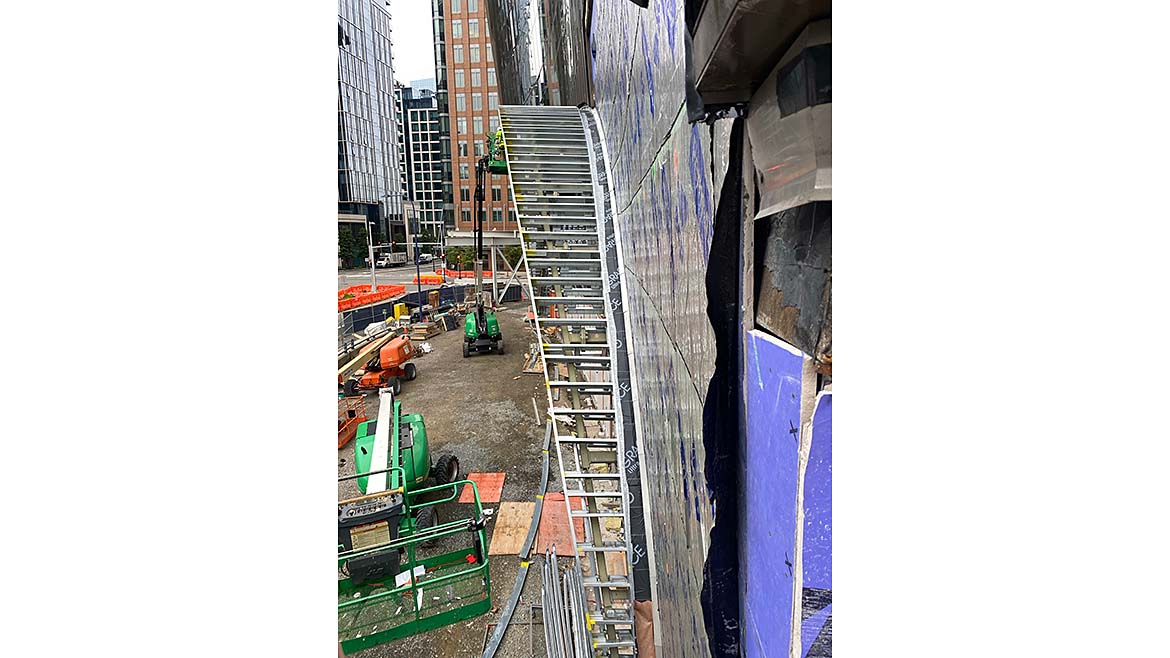
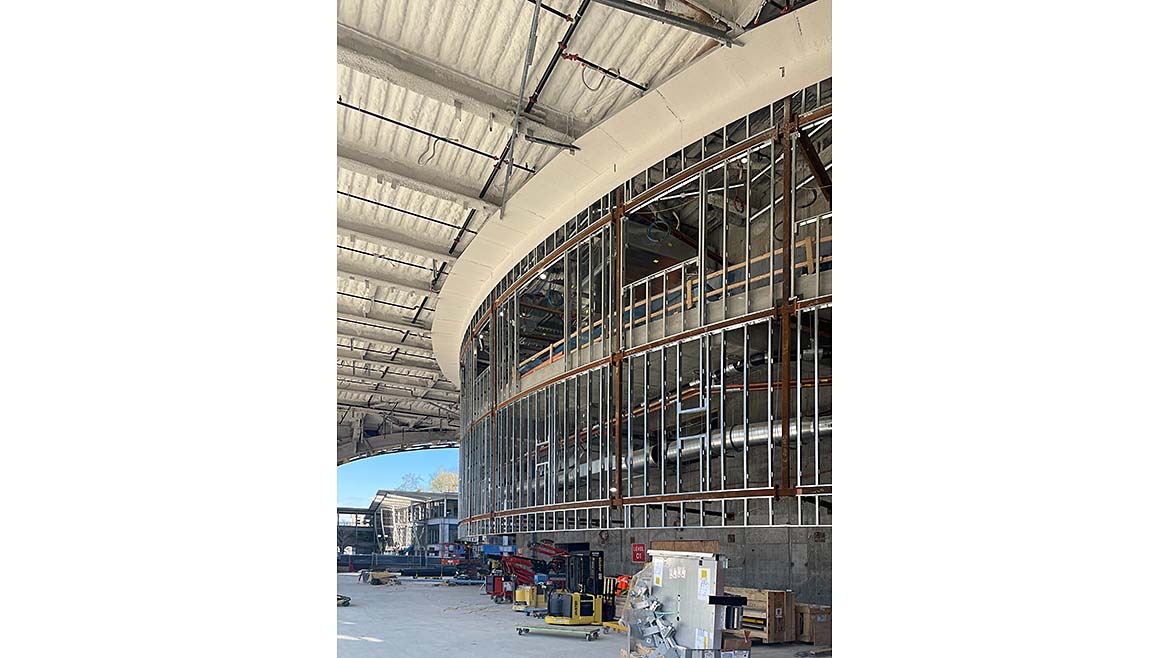
The original canopy design called for a network of custom laser-cut connection plates to attach panels to trusses. This would have been expensive, time-consuming and prone to coordination issues. Instead, the fabricator and Century Drywall developed an approach using prebuilt light-gauge trusses and gutter panel sections fabricated in 10 to 12-foot lengths.
This approach reduced field connections, cut down installation steps, and clarified the gutter design for the architect early in the build process. For Century Drywall, the benefit was clear: predictable assemblies arriving on site, with fewer variables to manage during installation.
“On the façade, by coordinating the specific location of each stud, we were able to eliminate an entire layer of the cladding system,” says Ross Phelan, senior design technologist with the fabricator. “The clips are mounted directly to the studs without a rail. That same coordination was applied successfully on the underside of all of the canopies.”
Photos: Radius Track
A Proven Partnership
For Suffolk Construction, the value of having an aligned installer and fabricator was evident throughout the project. Century Drywall's crews, backed by the pre-engineered systems, executed scopes that might otherwise have slowed progress. Instead of presenting problems, the team consistently arrived with solutions.
The formula for success was straightforward:
- Early collaboration: Engaging the fabricator in advance allowed Century Drywall to lock in hanger points and avoid clashes.
- Precise digital-to-field translation: Unrolled geometry and survey-ready points ensured the wood dome ceiling installed without rework.
- Simplified assemblies. Prefabricated trusses and panels streamlined canopy construction and reduced field labor.
- Trusted partnership. Century Drywall’s field expertise and the fabricator’s modeling precision worked hand-in-hand to deliver results.
Though the project as a whole continues to move toward completion, the podium level already stands as a showcase of what's possible when installers and fabricators collaborate from the start. For Century Drywall, it was another opportunity to deliver a high-profile project in Boston. For the fabricator, it demonstrated the value of supporting the installer with constructible solutions. And for Suffolk and Sasaki, it meant architectural intent was realized without compromise.
Looking for a reprint of this article?
From high-res PDFs to custom plaques, order your copy today!