GA Corner
Adapting GA-600 Wall Systems for Larger Stud Sizes
The GA-600-2024 manual confirms that substituting larger studs—such as 2x6 in place of 2x4—does not affect a wall system’s fire rating, provided all other system details remain consistent, though designers should review potential acoustic impacts.
Q: I found a wall system in GA-600 that meets my requirements. However, it was tested with 2x4 studs, and I need to use 2x6 studs. Can I substitute 2x6 studs in this GA-600 wall system?
A: When designing or specifying fire-rated wall assemblies, the GA-600-2024 Fire Resistance and Sound Control Design Manual is among the most frequently cited references in the construction industry. Each system included in the manual represents a tested and proven combination of materials and configurations that achieve specific fire-resistance and sound-control ratings. However, project conditions often differ from laboratory testing, which raises a common question among designers, in so far as the above:“If a GA-600 wall system calls for 2x4 studs, can I use 2x6 studs instead without affecting the fire rating?”
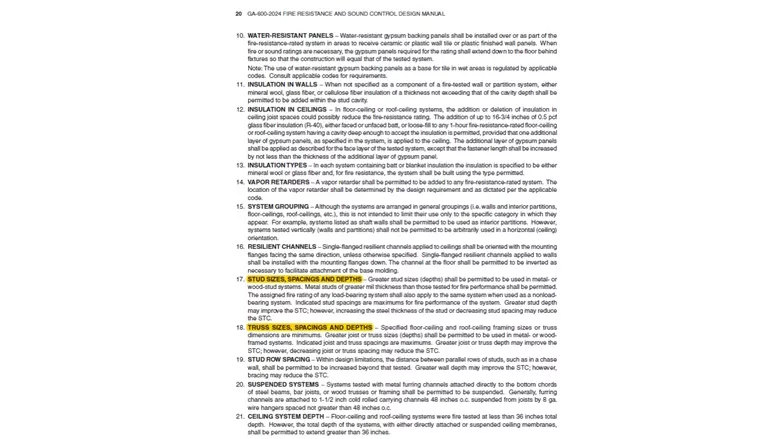
According to Explanatory Note #17 in GA-600-2024, the answer is yes. The manual explicitly permits the use of greater stud sizes, stating:“Greater stud sizes (depths) shall be permitted to be used in metal- or wood-stud systems. Metal studs of greater mil thickness than those tested for fire performance shall be permitted.”
This guidance is important because it clarifies that increasing stud depth, such as substituting 2x6 framing for 2x4, does not invalidate the listed fire rating of the system. The reason is that the fundamental fire-resistive performance is based primarily on the number and type of gypsum panel layers, attachment methods, and fastener spacing, not on the specific stud depth. In fact, larger studs often provide additional air space, which can improve thermal and acoustic performance.
The note also provides important nuance regarding acoustics. While deeper studs may increase the Sound Transmission Class (STC) rating by providing greater separation between wall faces, other changes, such as thicker metal studs or reduced spacing, may have the opposite effect and decrease the STC. Therefore, any modifications should be reviewed comprehensively to ensure both structural integrity and acoustic performance are maintained.
Furthermore, GA-600 notes that the stud spacings listed in each system represent maximums required to maintain the tested fire performance. Designers can always choose closer spacings for structural reasons, but exceeding the listed spacing would take the assembly outside the scope of the tested configuration.
The same flexibility applies to joists and trusses, as outlined in Explanatory Note #18, which allows the use of greater joist or truss depths in place of the tested minimums. As with wall systems, these modifications do not compromise the fire rating, provided that spacing remains within tested limits.
Ultimately, the GA-600-2024 provides designers the latitude to adjust framing depth for constructability or structural needs while maintaining fire-resistive compliance. When substituting 2x6 studs for 2x4s, the wall assembly retains its assigned fire rating, as long as the system’s other details match the tested design.
For more specific requirements, referencing GA-600-2024 Fire Resistance and Sound Control Design Manual directly is best practice.
Looking for a reprint of this article?
From high-res PDFs to custom plaques, order your copy today!