Construction Job Openings Rise by 25,000 in April
ABC reports construction job openings climbed 25,000 in April amid labor shortages.
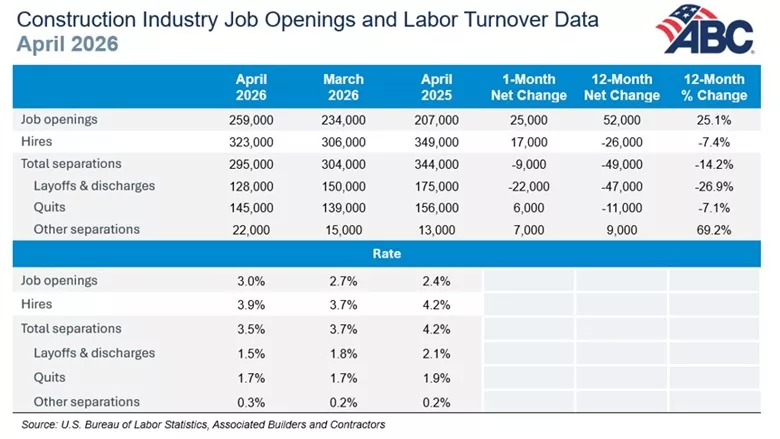
The construction industry recorded 259,000 job openings at the end of April, according to an analysis by Associated Builders and Contractors of data from the U.S. Bureau of Labor Statistics’ Job Openings and Labor Turnover Survey. The survey defines a job opening as an unfilled position for which an employer is actively recruiting.
Construction job openings rose by 25,000 from March and were up 52,000 compared with April 2025, reflecting continued demand for workers across the industry.
“This release of April data suggests that contractors are increasingly struggling to fill open positions,” said ABC Chief Economist Anirban Basu.
According to ABC, layoffs remained exceptionally low in April, reaching their lowest level since the first half of 2022. At the same time, industry job openings have increased by more than 25% over the past year, signaling persistent hiring challenges despite openings remaining below historic highs.
ABC attributes the labor shortage to several factors, including immigration policy changes, a declining number of undocumented workers and ongoing shortages in specialized trades. Demand for skilled workers involved in data center construction has been particularly strong.
While contractors continue to express confidence in expanding their workforce over the next six months, as measured by ABC’s Construction Confidence Index, labor availability is expected to remain constrained in the near term.
A Breakdown by States
Construction employment rose in 32 states and the District of Columbia from April 2025 to April 2026, while 32 states added jobs between March and April, according to an analysis of new federal data released today by the Associated General Contractors of America. Association officials said the employment gains were a good sign but cautioned that future construction employment could be impacted if Congress fails to pass a new highway and transit bill before the current legislation expires at the end of September.
“It’s encouraging to see construction employment increasing in many parts of the country,” said Ken Simonson, the association’s chief economist. “But many states will struggle to maintain current employment levels later this year if Congress fails to renew federal legislation to fund highway and transit construction after the current law expires on September 30.”
Between April 2025 and April 2026, 32 states and D.C. added construction jobs, 15 states shed jobs, and employment held steady in New Hampshire, North Dakota and Rhode Island.
Texas added the most construction jobs (18,700 jobs or 2.1 percent), followed by North Carolina (13,600 jobs, 4.9 percent), Ohio (13,500 jobs, 4.5 percent), Louisiana (8,000 jobs, 5.8 percent), Illinois (7,300 jobs, 3.0 percent) and Missouri (7,300 jobs, 4.9 percent). Louisiana had the largest percentage gain over 12 months, followed by West Virginia (5.7 percent, 2,000 jobs) and 4.9 percent increases in North Carolina, Missouri and Nebraska (3,100 jobs).
California lost the most construction jobs from April 2025 to April 2026 (-14,500 jobs, -1.6 percent), followed by New Jersey (-4,900 jobs, -3.0 percent), Washington (-3,500 jobs, -1.6 percent), Arizona (-3,200 jobs, -1.4 percent), Georgia (-2,300 jobs, -1.0 percent) and Mississippi (-1,800 jobs, -3.3 percent). The largest percentage loss was in Alaska (-5.6 percent, -1,100 jobs), followed by Mississippi, New Jersey and Arkansas (-1.7 percent, -1,100 jobs).
For the month, industry employment increased in 32 states, declined in 15 states, and was unchanged in New Hampshire, Oklahoma, South Dakota and D.C. Florida added the most construction jobs (6,000 jobs or 0.9 percent), followed by Texas (3,500 jobs, 0.4 percent), Massachusetts (3,100 jobs, 1.8 percent), North Carolina (2,700 jobs, 0.9 percent) and New Mexico (2,600 jobs, 4.9 percent). The largest percentage gain occurred in New Mexico, followed by Kansas (2.2 percent, 1,600 jobs), Massachusetts and Montana (1.8 percent, 700 jobs).
New Jersey lost the most construction jobs from March to April (-1,500 jobs, -0.9 percent), followed by Washington (-1,400 jobs, -0.6 percent), Georgia (-1,100 jobs, -0.5 percent), Pennsylvania (-1,100 jobs, -0.4 percent) and Arkansas (-900 jobs, -1.4 percent). The largest percentage loss was in Maine (-1.9 percent, -700 jobs), followed by Vermont (-1.2 percent, -200 jobs), New Jersey and Rhode Island (-0.9 percent, -200 jobs).
Association officials noted that the federal surface transportation bill provides the bulk of the funding state and local officials need to improve roads, bridges and transit systems. They added that those investments benefit many transportation builders while stimulating broader economic activity that helps all construction employers. But they warned that any delay in passing a new bill will make it hard for officials to plan new transportation upgrades.
“Improving our transportation system is the best way to boost economic activity and sustain these recent job gains,” said Jeffrey D. Shoaf, the association’s chief executive officer.
What It Means for Wall and Ceiling Contractors
The rise in construction job openings signals continued labor challenges for wall and ceiling contractors, particularly those specializing in drywall, framing, acoustical ceilings and interior finishing work. These trades are heavily dependent on skilled craft labor, and increased competition for workers across the broader construction industry could make recruiting and retention more difficult in the months ahead.
South: Wall and ceiling contractors in the South are likely to face the most intense labor competition. Rapid population growth, ongoing commercial development and a surge in data center, manufacturing and distribution projects continue to drive demand for interior trades. Contractors may encounter wage pressure as workers are drawn to large industrial and infrastructure projects that often offer premium pay.
West: In the West, labor availability remains a challenge despite some slowing in multifamily construction. Demand for skilled wall and ceiling workers is being supported by data center construction, healthcare projects and public-sector investments. Contractors in states such as Arizona, Nevada and Texas may face particularly strong competition for drywall finishers, framers and acoustical ceiling installers.
Midwest: Midwestern wall and ceiling contractors are benefiting from manufacturing-related construction, including semiconductor, electric vehicle and battery facilities. While project pipelines remain healthy, specialized construction work often requires experienced crews, creating recruiting challenges for contractors already facing an aging workforce. Labor shortages could contribute to scheduling delays and increased labor costs.
Northeast: The Northeast continues to see steady demand from institutional, healthcare and renovation projects. While the region generally benefits from a more established union workforce, contractors may still struggle to find qualified workers for specialized interior systems. Labor constraints could become more pronounced as major public and private projects move into interior build-out phases.
Across all regions, the increase in job openings highlights the importance of workforce development, apprenticeship programs and employee retention strategies. Wall and ceiling contractors that invest in training and productivity-enhancing technologies may be better positioned to navigate ongoing labor shortages while maintaining project schedules and profitability.
Looking for a reprint of this article?
From high-res PDFs to custom plaques, order your copy today!