How Air Barriers Support Healthier Indoor Air
The First Line of Defense
.webp?t=1782487541)
When indoor air quality comes up in building design discussions, the focus tends to move quickly to HVAC equipment, filtration ratings, and mechanical ventilation. Of course, those things matter, but the conversation is incomplete if it overlooks the building envelope. The wall itself, and specifically whether air moves through it in a controlled or uncontrolled way, determines what the people inside it are actually breathing.
Air barriers are increasingly recognized as a foundational element of residential building performance. They reduce uncontrolled air leakage, and in doing so, they change (for the better) the conditions under which every other system in the home operates. HVAC equipment works more predictably, humidity is easier to manage, outdoor pollutants have fewer routes in, and the mechanical ventilation system can do its job as designed.
The case for air barriers in healthy building design rests on thinking about the envelope as a system rather than a collection of individual layers.
Air Control and Heat Control Are Not the Same Thing
One of the more persistent misconceptions in residential construction is the idea that insulation and air barriers do the same job. However, insulation controls heat flow and air barriers control airflow. Both are essential, but they address different physical mechanisms, and conflating them tends to produce buildings where one or both functions are underspecified.
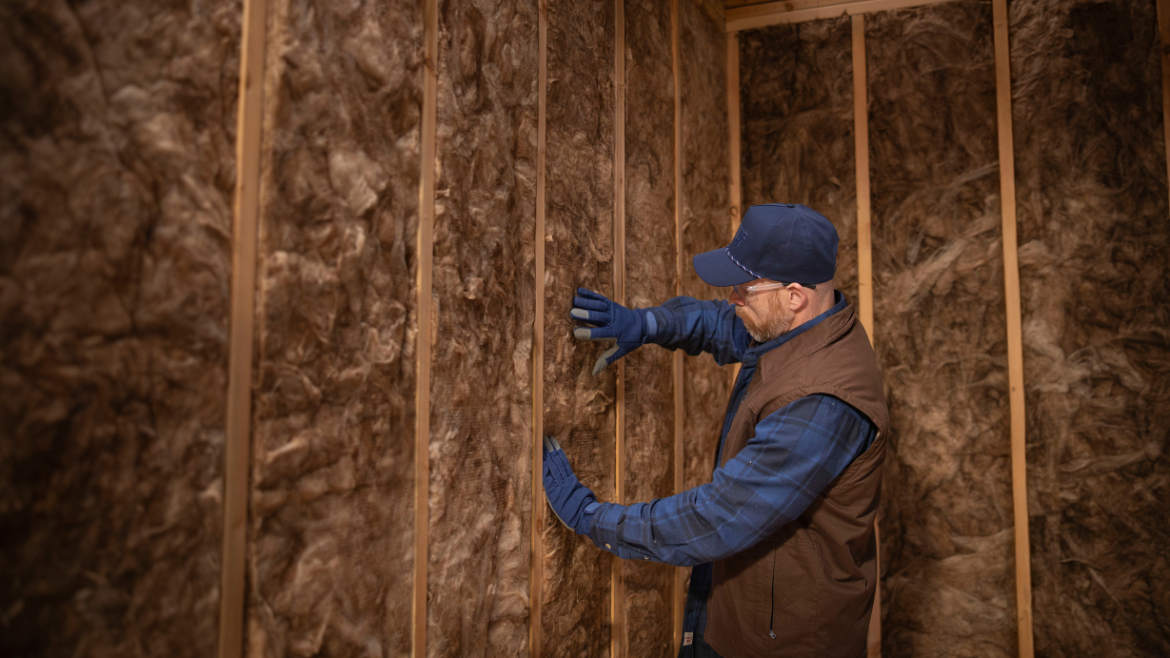
Fiberglass insulation, for example, resists thermal transfer across the wall cavity. It keeps interior temperatures more stable and contributes to the kind of consistent thermal environment that makes a home comfortable across seasonal extremes. What it does not do, on its own at least, is prevent air from moving through gaps and penetrations in the envelope.
That distinction matters for indoor air quality because both functions are necessary for a high-performing building envelope. Uncontrolled air leakage creates a pathway. Warm, humid outdoor air moving into wall cavities during summer creates conditions that can support mold growth. Seasonal pollen, dust, and other airborne particulates enter through the same unintended gaps. The building envelope, when it leaks, introduces a steady and largely unfiltered stream of outdoor contaminants into spaces that occupants expect to be clean.
The solution, then, is not to choose between air control and insulation. The best indoor environmental outcomes come when those layers are designed together, as parts of a single strategy rather than separate line items.
As Clint Shireman, Manager of Training and Certifications for Building Envelope at Knauf Insulation North America, puts it:
“Air barriers and insulation are often discussed as though they do the same job. Both are essential, but they serve different functions. Air barriers control airflow, while insulation controls heat flow. The best indoor air quality and moisture-management outcomes come when those layers are viewed not as isolated products, but as parts of a single building science strategy.”
Humidity, Moisture, and What Gets In Through the Wall
Moisture management is one of the more direct connections between air barrier performance and indoor air quality. During summer months in particular, vapor-laden outdoor air is under pressure to move into cooler, conditioned spaces. When the envelope provides clear, unintended pathways, that moisture enters the wall cavity and, depending on assembly design, may have nowhere to go.
As a result, indoor humidity becomes harder to control, and conditions within the cavity may become more favourable for microbial growth over time. In more humid climates, a home built without effective air control at the envelope level is asking its mechanical systems to compensate for a problem that originates in the wall.
A well-designed air barrier helps limit that unintended airflow. When paired with properly installed insulation, the wall assembly maintains thermal performance across its full thickness, reduces condensation risk at critical surfaces, and gives the HVAC system a more predictable latent load to work with. This allows the building to maintain indoor humidity levels more consistently while reducing runtime and wear on equipment.
Sean Goddard, Product Manager of Coils and Indoor Air Quality at Trane, explains the mechanical side of this relationship:
“Air barriers significantly reduce the infiltration of hot, humid outdoor air, which directly lowers the latent load on HVAC equipment and helps prevent excess indoor moisture that can lead to comfort issues or microbial growth. By stabilizing the building envelope, HVAC systems can maintain intended indoor humidity setpoints more consistently, improving comfort while also reducing runtime and energy consumption across varying seasonal conditions.”
Outdoor Pollutants and the Limits of Filtration Alone
Pollen and dust do not enter homes only through open windows and doors. They infiltrate through cracks in the envelope, around window frames, and along any pathway where there is a pressure difference between indoors and outdoors.
According to AAFA's 2025 Allergy Capitals report, pollen seasons are starting earlier and lasting longer than they did just 30 years ago, with some parts of the United States now experiencing pollen all year round. During peak allergy seasons, or periods of elevated outdoor pollution, infiltration routes can increase occupants' exposure to airborne allergens, even in homes that appear tightly built.
An effective air barrier reduces those unintended pathways. It does not stop outdoor air from entering the home altogether, but it prevents that air from moving uncontrolled through the fabric of the building. Fresh air is then brought in deliberately, through the mechanical ventilation system, as a separate and intentional strategy. That distinction is really significant. Air entering through a designed ventilation path passes through filtration. Air entering through gaps in the wall does not.
This also has a practical effect on HVAC performance. This also eases the load on the filtration system itself, as Goddard notes:
“This decreases the burden on HVAC filtration systems, allowing them to operate more effectively and extend their service life by handling lower particulate loads.”
An independently certified high-efficiency filter performs significantly better in an envelope that is not continuously admitting unfiltered outdoor air.
Product selection plays a role here as well. Insulation, HVAC filters, and other building materials that have been independently certified against defined indoor air quality standards help specifiers and builders make more informed choices, rather than relying on self-declared claims or marketing terms. Certification based on published standards provides clarity and trust that marketing language alone cannot.
Examples of this approach can be seen across both the building envelope and mechanical systems. Knauf's Performance+® fiberglass insulation portfolio has earned Asthma & Allergy Friendly® Certification across its full residential and commercial range, having been independently tested for airborne dust and fiber release, VOC emissions, and resistance to fungal growth. On the HVAC side, the Trane CleanEffects® Whole Home Air Cleaner was the first whole-home air cleaning system to earn the Asthma & Allergy Friendly® Certification Mark, having met the program's requirements for allergen reduction, ozone levels within federal guidelines, and restored performance efficiency following the manufacturer's recommended cleaning procedure.
Ventilation Works Better When Airflow Is Predictable
There is an important distinction between a tight home and a stuffy home. Our aim is to control where fresh air comes from and to ensure it arrives at the right rate, not to eliminate it. As homes become tighter, natural infiltration decreases, which makes mechanical ventilation much more important, not less.
Without a properly specified ventilation strategy, a well-sealed home can accumulate VOCs, CO2, and moisture from everyday activities. Cooking, cleaning, off-gassing from finishes and furnishings, and, of course, breathing all contribute to indoor pollution. In a leaky home, those pollutants disperse through uncontrolled air exchange. In a well-sealed one, however, they stay unless ventilation removes them intentionally.
Balanced ventilation systems, including energy recovery ventilators (ERVs), bring fresh outdoor air into the home while helping retain some of the heat and moisture that would otherwise be lost. In warmer, more humid regions such as Florida and Texas, this can make a noticeable difference. The goal is straightforward: provide adequate fresh air without placing unnecessary demands on the heating and cooling system. Standards such as ASHRAE 62.2 help designers determine the amount of ventilation needed to support healthy indoor environments while maintaining energy performance.
These systems function as designed only when air leakage through the envelope is predictable and controlled.
That shift is what makes mechanical ventilation work.
“Air barriers transform buildings from relying on uncontrolled air leakage to having predictable, managed airflow pathways, enabling HVAC systems and ventilation equipment to operate as designed,” says Goddard. “This controlled environment supports the integration of balanced ventilation strategies, such as ERVs, which bring in fresh air while minimizing energy loss, recovering heat and moisture, and maintaining indoor comfort.”
The Whole-System Approach
Indoor air quality is not the product of any single component. It emerges from the interaction of the envelope, the mechanical systems, the occupants, and the materials inside the building. Integrating air sealing, mechanical ventilation, humidity control, and high-efficiency filtration into a coordinated strategy delivers better outcomes than any of those elements in isolation.
Air barriers contribute by changing the conditions under which every other system operates. When infiltration is reduced, HVAC equipment runs as intended. Temperature uniformity improves. Hot and cold spots, pressure imbalances, and short cycling, which can be common complaints in less controlled buildings, become less frequent.
Insulation reinforces that stability. By reducing heat transfer through the wall, it helps the HVAC system use less energy and supports more even temperatures across the cavity. Yes, these are efficiency outcomes, but they are also health outcomes, because occupants in better-maintained buildings are less likely to be exposed to poor quality indoor air.
 Knauf Insulation
Addressing Common Misconceptions
Two misconceptions come up repeatedly in discussions about air barriers and indoor air quality. The first is that insulation is primarily about energy savings. As Shireman points out, energy performance is a major benefit, but it is not the only one:
“Insulation also supports comfort, helps the building envelope perform more consistently and contributes to the overall resilience of the wall assembly. Those factors all matter when designing homes that are not only efficient, but also healthier and more durable over time.”
The second misconception is that tight buildings are problematic for indoor air quality. This conflates airtightness with insufficient ventilation, which is a design failure rather than an inherent property of well-sealed buildings. A home built to a tight envelope standard, with a properly sized and commissioned ventilation system, provides better indoor air quality than a drafty one, not worse. The fresh air is still there. The difference is that it arrives through a controlled pathway, so it can be filtered, conditioned, and delivered at a rate that supports occupant health.
Closing Thought
In practice, the homes that perform best are rarely those with the highest-rated individual products. They are the homes where insulation, air sealing, ventilation and filtration were designed to work together from the outset.
Air barriers are the first line of defense, but they work best as part of a system: airtightness supported by insulation, ventilation sized for the sealed envelope, filtration matched to real conditions, and humidity managed at the envelope rather than compensated for by mechanical equipment.
When those elements are considered together from the design stage, the result is a building that performs more reliably and more comfortably for the people who live in it.
The author acknowledges the technical input provided by Sean Goddard, Product Manager of Coils and Indoor Air Quality at Trane, and Clint Shireman, Manager of Training and Certifications for Building Envelope at Knauf Insulation North America, whose expertise in HVAC performance, wall systems, insulation, moisture management, and residential building science informed the discussion presented in this article.
Looking for a reprint of this article?
From high-res PDFs to custom plaques, order your copy today!



.webp?height=200&t=1739822501&width=200 "Eco-Batt Insulation")


